Showing posts with label 1700s. Show all posts

Feb 22, 2009

Tales of Banks Peninsula


Canterbury Heritage is pleased to announce the Internet publication of a new edition of Tales of Banks Peninsula.

Compiled by 1883 and published the following year by Howard Charles Jacobson (1841-1910), the Editor and owner of the Akaroa Mail and Banks Peninsula Advertiser, the book is a compilation from various sources about old identities and early historic events, and also small pieces written by Jacobson for his newspaper.

Written by the Maori historian the Reverend James West Stack (1835 -1919), the first part covers the legends and folklore of the Maori, from the warfare between the Ngati Mamoe, Ngai Tahu, Ngatiawa and Ngapuhi tribes until the advent of European settlement in the mid 1830s. Stack's contribution is followed by the anecdotal reminisces of many of the earliest European pioneers in the district.

The book's historical significance may be appreciated by the knowledge that it was republished in 1894, 1917, 1976 and continues to be cited in the adjudications of the Waitangi Tribunal.

Where the subject matter deviates, the chapters have been re-paragraphed for this edition. In the interests of historians and genealogical researchers, etc., the proper nouns or names have been amended to their current usage. Punctuation, abbreviations and Dickensian-era grammar have also been slightly amended in accordance with current conventions, but beyond that, this revised edition remains faithful to the original text.


The links to the parts of the book (in blue) open in new tabs or windows.


TALES OF BANKS PENINSULA
Frontis and prefaces to the earlier editions.
FOLKLORE OF THE MAORI
Pa of Nga-Toko-Ono (The Pah of the Six)
Parakakariki
Tu Te Kawa
Waikakahi (Wascoe's)
Ngai Tahu Taking Possession
Te Mai Hara Nui
Kai Huanga (Eat Relation)
Raid on Panau (Long Look-Out)
Capture of Te Mai Hara Nui
Onawe
Maoris Reorganising
Death of Tu Te Hou Nuku
Conclusion
PART 1
European Account of the Massacre in Akaroa Harbour
George Hempleman and his Purchase of Akaroa
George Hempleman's Diary
"Headed Up" (The imprisonment of Puaka at Peraki)
The French Settlement of Akaroa
Early Days
Arrival of the First English Ship
Reminiscences of the First Five Years
A Lady Colonist's Experiences
Billy Simpson
Jimmy Robinson
Jimmy Walker
"Chips" (Adolph Friedrich Henrici)
Thomas Richard Moore, M.D
French Farm and the Survey
John Henry Caton
The Chief Paora Taki's Story
Story of a Snake Hunt in Akaroa Harbour by Mrs. Tikao
The Mysterious Disappearance of Mr. Dicken
Harry Head
The Loss of the Crest
PART 2
LeBon's Bay
Okain's Bay
Little Akaloa
German Bay
Robinson's Bay
Duvauchelle'a Bay South
Pigeon Bay
Head of the Bay
Island Bay
Little River
Charteris Bay
Gough's Bay
Peraki
MORE STORIES OF OLD SETTLERS
Mr. Philip Ryan
Mr. Thomas White
Mr. William Isaac Haberfield
PENINSULA STORIES IN VERSE
Akaroa
Our Jubilee
The Legend of Onawe
The Legend of Gough's Bay


Image credit: Akaroa, April 1840 (an engraving entitled Baie d'Akaroa, from Voyage au Pôle Sud et dans l'Océanie sur les corvettes l’Astrolabe et la Zélée, 1837-1840, by J. Dumont d'Urville.)

Feb 16, 2009

The Day That Canterbury History Began


The history of Canterbury began exactly 239 years ago with the first of a number of significant errors (among the more recent being that Polynesian folklore constitutes history).

On the 16th of February 1770, the crew of His Majesty's Barque Endeavour sighted what Lieutenant James Cook concluded to be an island, which was duly named after Joseph Banks, the expedition's wealthy Botanist.


Cook's mistake was realised in October 1809 when Captain Samuel Chase, of the sealing ship Pegasus out of Sydney, tried to sail between the alleged island and the mainland. To the far south, Stewart Island was named after the captured former Spanish brigantine's first officer William Stewart, who surveyed that island's principal harbour.

Solomon Levey (1794-1833), a discharged convict of Sydney, and his business partner Daniel Cooper (1785-1853) were regularly sending ships to Banks Peninsula by the mid 1820s. Their crews traded with the Maori at Puari in the bay that still bears the misspelled name of Port Levy. In 1829 Cooper and Levey established a trading post at Puari for purchasing sealskins, pork and flax and there were soon a dozen Europeans living among the more than three hundred Maori at the settlement.

Prior to the 1850 inauguration of the Canterbury Association's settlement there were more than a thousand Europeans living in the vicinity of Banks Peninsula. Among their descendants can be counted Solomon Levey's kin unto the ninth generation.

Comment

Jayne said...

That was a very beginner's sort of mistake Cook made, considering how accurate his maps were (and continue to be).

My theory is that he was having too many late nights, too many games of "I Spy" and was just as human as any one else - he was exhausted.


Canterbury Heritage said...

The fine wines and general standard of luxury enjoyed in Endeavour's wardroom as a consequence of Joseph Bank's wealth and generosity might have been contributory factors to the mistake. However, the opinion that it was an island would probably have come from a member of the crew in the crow's nest.

Bearing in mind that even at Cathedral Square the land is (currently) less than 7 metres above mean sea level, it's feasible that Endeavour passed Banks Peninsula on a low tide, without sailing far enough into Pegasus Bay to ascertain the lie of the land in the vicinity of New Brighton.


kuaka said...

From Cook's Journal:

"At 8 o’Clock we had run 11 Leagues since Noon, when the land extended from South-West by West to North by West, being distant from the nearest shore about 3 or 4 Leagues; in this situation had 50 fathoms, a fine sandy bottom. Soon after this it fell Calm, and continued so until 6 A.M., when a light breeze sprung up at North-West, which afterwards veer’d to North-East. At sun rise, being very Clear, we plainly discover’d that the last mentioned land was an Island by seeing part of the Land of Tovy-poenammu open to the Westward of it, extending as far as West by South.... This Island which I have named after Mr. Banks, lies about 5 Leagues from the Coast of Tovy poenammu..."

Captain Cook's Journal during his first voyage round the world made in H.M. Bark “Endeavour” 1768-71 (Link opens in a new window).


Canterbury Heritage said...

Cook's estimate would have placed Bank's 'island' 24 kilometres off the coast.


Image credits: detail from James Cook's map of the South Island (
nzhistory.net), Endeavour replica off the Lyttelton Heads on the 16th of February 1996.

Jun 30, 2008

Podcast: Captain Cook and Georg Forster in the Antarctic

A 55 minute audio documentary from the Australian Broadcasting Corporation.

It´s not well known that the first major scientific expedition to the Antarctic was led by James Cook during his 1773 voyage to New Zealand.

It´s even less well known that the voyage was recorded by a young German writer and natural historian who sailed with Cook.

Georg Forster´s A Voyage Round the World was one of the most famous and influential travel narratives of its time: a scientific adventure story which ranges from the terrors of the Antarctic ice to cannibalism amongst the Māori in New Zealand, which is graphically recounted in this documentary.

In this podcast hear readings from Forster´s book, Cook´s journals and The German Traitor, a novel based on Forster´s life.

Jun 28, 2008

Historical Revision

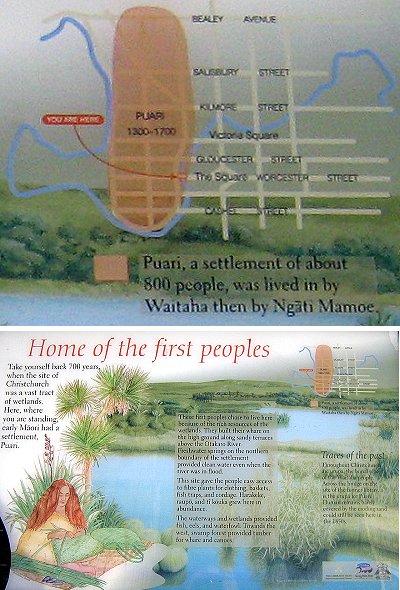
Hyped by the local TV station as the Southern Hemisphere's finest cultural precinct, this is an interpretive display sign at the centre of things.

Amongst the information that it conveys to the visitor is the revelation that Christchurch is in fact a 700 year old community originally known as Puari, with a population of about 800.*

There's no historical evidence for this assertion, which would appear to be an unfortunate instance of the facts not being allowed to get in the way of a good story.

The notion that a Māori version of prehistoric events should not be questioned conveys the idea that they have some privileged access to the truth. And when people sense that they are held to account by a different standard of evidence to everyone else, they understandably begin to reinterpret their past in line with current values and expectations rather than hard evidence.

* Puari was a large settlement at Port Levy on Banks Peninsula. Known to European whalers from the later 1820s, the population had declined by the mid 1840s, as a consequence of inter-tribal warfare and disease, to about 300 Māori and 12 Europeans.

May 29, 2008

Historical Revisionism


Photographed by a tourist from Prague is an interpretive display sign located on Oxford Terrace near Hereford Street.

An unfortunate example of the current fashion in historical revisionism, based on little more than popular folklore and mythology.

Apr 25, 2008

Podcast: Astronomy and Empire


From the BBC's In Our Time series Melvyn Bragg and three distinguished academics discuss the link between colonial expansion and scientific discovery.

The 18th century explorer and astronomer James Cook wrote: 'Ambition leads me not only farther than any other man has been before me, but as far as I think it possible for man to go'. Cook's ambition took him to the far reaches of the Pacific and led to astronomical observations which measured the distance of Venus to the Sun with unprecedented accuracy.

Cook's ambition was not just personal and astronomical. It represented the colonial ambition of the British Empire which was linked inextricably with science and trade. The Transit of Venus discoveries on Cook's voyage to Tahiti marked the beginning of a period of expansion by the British which relied on maritime navigation based on astronomical knowledge.

How had ancient trade routes set a precedent for colonial expansion? What was the link between astronomy and surveying? What tools did the 18th and 19th century astronomers have at their disposal? And how did the British justify their colonial ambition and scientific superiority?

Contributors
Simon Schaffer, Professor in History and Philosophy of Science at the University of Cambridge

Kristen Lippincott, former Director of the Royal Observatory, Greenwich

Allan Chapman, Historian of Science at the History Faculty at Oxford University