Showing posts with label ARCHAEOLOGY. Show all posts

Jul 2, 2009

Moa Rebuilt Using Ancient DNA

A Kiwi, an Ostrich and the giant Moa, each with its egg.
Little did Avonside, Christchurch resident Sir Johann Franz Julius von Haast (1822-1887) envisage that his pioneering archaeological endeavours in the 1860s would one day lead to scientists performing the first DNA-based reconstruction of the extinct Moa.
Researchers from the University of Adelaide and Landcare Research in New Zealand have identified four different Moa species after retrieving ancient DNA from Moa feathers believed to be at least 2,500 years old.
Image courtesy of Wikimedia Commons

Mar 27, 2009

Looters Ransack Historic Site


The Rising Sun hotel was built on what had been the garden of Dr. Augustus Florance in 1865 by Frank Innes, who had arrived at Lyttelton aboard the Sebastopol two years earlier. 

Situated in the Christchurch suburb of St Albans and more infamously known as the Rising Hell, the much altered and extended hotel became the Caledonian in 1878. As such it continued to enjoy something of a louche reputation until closing in late 2007.

The extensive site was undergoing evaluation by archaeologists from the University of Otago when the dig was raided during the night of the 26th of March, 2009. Artefacts and layers of information critical to archaeological analysis were destroyed as the looters picked over the site, upon which it's reported that sixty town-houses are to be built.
video 

Dec 31, 2008

Archaeology Podcasts


Feedback from our readers indicates a significant level of interest in Archaeology. Here then are our reccomendations for regular podcasts relating to recent develpments in this scientific field. Links open in new windows.


From Cambridge University via BBC radio comes the Naked Archaeology programme about recent international developments. Web site   RSS audio feed.


Employing more than 200 archaeologists, Wessex Archaeology produces Archaeocast, a weekly digest of European Archaeology. Web site  RSS news feed   RSS audio feed.


Each month more than 150,000 readers view the Stone Pages Web guide to European megaliths and other prehistoric sites. Web site   RSS news feed.   RSS audio feed.


Finally, should one be immune to an overdose of American hyper-vivacity, then the weekly Audio News Digest from Archaeologica might be considered worth a listen. Web site   RSS audio feed.


About Podcasting:

For those new to podcasting please read the Introduction to Podcasting article.


Aug 11, 2008

1870 Cantebury Masonic Lodge


Christchurch's The Press newspaper has recently published an article relating to the discovery of the hidden ground floor facade of the 1870 Masonic Lodge on the east side of Manchester Street, between Worcester and Hereford Streets.

Unfortunately the article contains some significant inaccuracies, which for the benefit of the historical record, we are pleased to correct:-
Named after the Patron Saint of the English city of Canterbury, the foundation stone of the second St Augustine Lodge No. 4 building was laid on the 9th of March, 1870 and the first meeting was held there on the 10th of August in the same year.

The Lodge was built to the west of the stables situated behind the home of Samuel Bealey (1821–1909), second Superintendent of Canterbury. A large hall was built onto the back of the Lodge in 1883.

The Freemasons moved to their third premises in Gloucester Street West in April, 1916. By 1920 two single-storey shops were built on the front of their 1870 Manchester Street Lodge, with a third shop occupying the former lane access to the Right hand side. The old building continues to appear in the photographic record until 1968, but had been demolished by 1972.


Proposed Redevelopment

Property developer Angus McFarlane will restore the 1870 facade, incorporating it into the foyer and Coffee shop, of the six level Manchester Business Centre. The proposed design of the new building, as depicted above, will be modified to enable the historic Palladian style facade to be visible from Manchester Street.

The original article: Hidden wall revealed, 09 August 2008.


Large image opens in a new window

Architectural drawing by Canterbury Heritage for the site developer. The outer thirds of the lower floor facade have survived.

Jun 28, 2008

Historical Revision

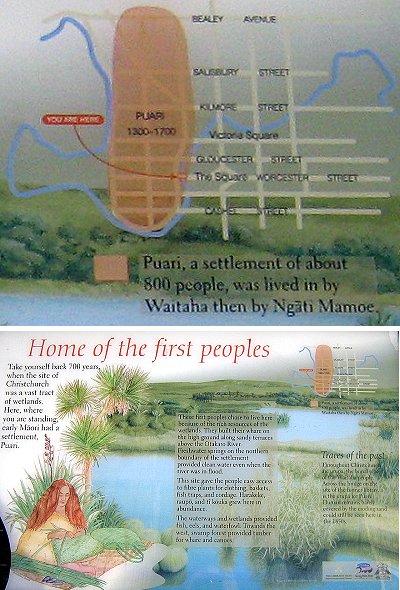
Hyped by the local TV station as the Southern Hemisphere's finest cultural precinct, this is an interpretive display sign at the centre of things.

Amongst the information that it conveys to the visitor is the revelation that Christchurch is in fact a 700 year old community originally known as Puari, with a population of about 800.*

There's no historical evidence for this assertion, which would appear to be an unfortunate instance of the facts not being allowed to get in the way of a good story.

The notion that a Māori version of prehistoric events should not be questioned conveys the idea that they have some privileged access to the truth. And when people sense that they are held to account by a different standard of evidence to everyone else, they understandably begin to reinterpret their past in line with current values and expectations rather than hard evidence.

* Puari was a large settlement at Port Levy on Banks Peninsula. Known to European whalers from the later 1820s, the population had declined by the mid 1840s, as a consequence of inter-tribal warfare and disease, to about 300 Māori and 12 Europeans.

May 29, 2008

Historical Revisionism


Photographed by a tourist from Prague is an interpretive display sign located on Oxford Terrace near Hereford Street.

An unfortunate example of the current fashion in historical revisionism, based on little more than popular folklore and mythology.

May 25, 2008

Archaeopedia: NZ & Pacific Archaeology

Archaeopedia is the online resource for Pacific Archaeologists.

The website is designed for those interested in New Zealand and Pacific archaeology.

The site uses Wikipedia software but it is independent of that site – having its own web address archaeopedia.com

Like Wikipedia the site invites contributions from users...

Feb 14, 2008

1874 Canterbury Club Renovations

The Canterbury Club was founded in 1872 as the merchants’ rival to the 1856 Christchurch Club, which was primarily identified with rural runholders. It still has a membership largely comprising lawyers, accountants and businessmen.

Completed in 1874, the Club building on Cambridge Terrace was situated next to the original home of the city's first Bishop. Built by the civil engineer Henry Cridland in 1851, it was the first dwelling West of the river.

An archaeologist was on hand yesterday to search for artifacts under the foundations of the Canterbury Club's caretaker's cottage on Worcester Boulevard. As part of the club's $5.5 million upgrade, the 19th century cottage is being relocated.

The Press, 14 February 2008

The 12 floor, 40 metre Club Tower, Canterbury House, Worcester Boulevard


Feb 13, 2008

Archaeological Evidence Reveals Lost Site of Early Christchurch Mansion

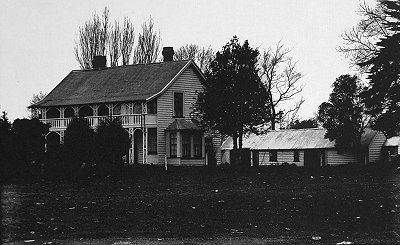
Occupying the 50 acre Rural Section 82 at Riversleigh (now part of Avonside), Wotton House overlooked the river, at the furthest reach of its quietest loop, from the early 1860s until about 1944.

Seated in front of his house, with his wife and two of his eleven children, is Fortunatus Evelyn Wright (1829-1912).

In a frontier town, where too many middle-class parvenus (with some of the veneer, but little of the substance) described themselves as "Gentleman," Forty Wright was the real McCoy. Descendant of French Dukes and the author John Evelyn (1620-1706), he was Canterbury's first Postmaster General.

Manager of the city's first Bank in 1856 and Consul for Sweden and Norway, Wright was also a director of the New Brighton Tramway Company and a Justice of the Peace.

Also among a litany of distinguished forebears was his namesake; the English privateer Fortunatus Wright (1712-1757). However, he should best be remembered for a paper that he read to the Philosophical Institute of Canterbury in 1873; On the desirability of dedicating to the people of New Zealand small areas of land assimilating in character to the village greens of England.

Newspapers took the matter up and the recreational reserves that abound within the garden city are his lasting legacy. But the recreational reserve that once formed part of the grounds of his home is named after a local politician...


Shown above in a circa 1875 photograph, the eighty year-old mansion was demolished to make way for a much smaller house in spacious grounds, where archaeological evidence of its predecessor continues to be revealed in an extensive organic garden.

Revised 5 October, 2008.

The previously unidentified lower photograph is in the collection of Christchurch's Canterbury Museum.

Feb 9, 2008

The Mystery of the Timaru Bottle Dump

The mystery of the bottle dump on the site of the original Timaru court building may have been solved, possibly proving it wasn't a case of court staff being fond of a drink or two.

Archaeologist Kiri Petersen has been checking out the Heaton Street site prior to work on a new courthouse beginning and located a pit containing hundreds of bottles dating back to the 1870s.

The site was probably that used by a bottling factory for five or six years in the 1870s-1880s, according to South Canterbury amateur historian Jeremy Sutherland who has researched the history of South Canterbury breweries and bottling companies.

He suspects Mrs Petersen had located an area where the bottling company dumped its broken or unusable bottles.

The Alton Brewery began production in 1873 on the site now occupied by the Countdown supermarket. It later became the New Zealand Breweries and operated through to the mid 1970s.

Mr Sutherland said it was possible the bottling company had bottled both beer from the neighbouring brewery as well as bottling aerated drinks.

He noted virtually all the torpedo shaped bottles recovered were damaged, which supported his view it was the dump of a commercial operation. The bottles could either have been broken by youngsters attempting to get the marble out, or the glass might have gone cloudy making it unsuitable to be reused.

Mr Sutherland said it was common for brewing and bottling companies to dump bottles on site. When the nearby brewery site was cleared 12 years ago, three old wells were located. Each had been filled in using bottles and other rubbish.

The Timaru Herald, Thursday, 07 February 2008