Showing posts with label precinct. Show all posts

Jun 20, 2009

The Second Theatre Royal


LARGE IMAGE OPENS IN A NEW TAB OR WINDOW

This is a previously unknown circa 1877 photograph of the second Theatre Royal on the southern side of Gloucester Street East, between Manchester and Colombo Streets. Immediately beyond it is Beatty's Palace Hotel of 1877. Designed by A. W. Simpson and built by John L. Hall of the Canterbury Opera Company, the theatre opened on the 4th of November 1876.

Built by Matthew Allen and Sons, the 1,100 seat theatre replaced an earlier building, which had begun life as the Canterbury Music Hall in 1861. To honour Alexandra, Princess of Denmark and Wales, in 1863 the music hall was renamed as the Princess Theatre, becoming the first Theatre Royal three years later.

The theatre closed in 1908, to be replaced by the extant third Theatre Royal opposite and by 1910 the Palace Hotel had been converted into a cinema and renamed as The King's Theatre. Both buildings were subsequently acquired by The Press, with the street frontages converted into shops and the upper levels renovated as the newspaper's Copy and News Rooms and production departments. Only the upper level facades and the theatre's original roof line survive.


Recently acquired by an Australian construction company as part of an eight building complex, the 1907 Press building in Cathedral Square will be renovated for use as an hotel or offices and a lane precinct created through the property to link Press Lane to the Cathedral Junction vintage tram terminus.

With work projected to commence in October 2009, the company is proposing to construct a new multi-storey building behind the facades of the Palace Hotel and the second Theatre Royal. The artist's rendition below indicates that the pediment's will be restored to their former glory and it is therefore hoped that Queen Victoria's Coat of Arms will once again grace Gloucester Street.


We're greatfully indebted to Steven McLachlan of the Shades Stamp Shop at 108 Hereford Street for the original photograph, which is dated to 1877 by the lack of the stables to the Palace Hotel's Left and there being no Playbills and Posters, which soon began to adorn the theatre's Press Lane side wall (Right).

Apr 28, 2009

History Happened Here

No other New Zealand city can claim to have surviving buildings within the central business district from the first decade of settlement, but then neither does Christchurch, which appears to have ignored this unique distinction.

From its beginnings in 1851, that section of Cashel Street, which now lies within the City Mall, was the nascent town's first commercial precinct and the first block to be fully occupied by buildings. Remarkably, two of these early structures, although both altered beyond recognition, survive into the twenty-first century. Facing each other across the mall are the 1856 Union Bank and an original cottage of what is probably an even earlier vintage (below).


The earliest history of 87 Cashel Street West is still shrouded in mystery, but it's probable that by 1858 it was leased by the Draper Louis Nathan, Canterbury's first Jewish settler. Subsequently the premises of a Saddler, by 1875 the Cashel Street building had become adjoined on both sides by substantial second generation brick buildings, both of which survive behind modernised facades.


In 1876 the building was purchased by Nelson King Cherrill, who substantially renovated the premises, creating an ornamental arched shop facade. At this time the roof line was altered to a Mansard design, with an extant large window from the upper floor level through to the roof line, thus providing an ideal photographic studio to a popular London design, with which Cherrill would have been familiar (below). One of the most respected names in Victorian photography, Cherrill (1845-1916) closed his studio and returned to England in 1881.

In February 1884 the building became the photographic studio of Theophilus Easter (1832-1913), formery of Easter & Wallis of Colombo Street, but his soujourn was not long, as from 1887 to 1891, Thomas Reginald Attwood (c1865-1926) is recorded as being a photographer at the address. By 1908 the building had been subdivided into two street level shops, with the premises of a Signwriter occupying the first floor studio.


Now with a couple of fashionable frock shops on the ground floor, the upper level is currently an apartment (below).


Footnote

The renowned collector of early New Zealand photographs Anthony Rackstraw writes;

"It's probably only a minor observation, but for me its interesting to note that all the Cherrill portrait photographs I have would indicate from the shadow on the subject's face that they all sat in front of the studio window against the east wall (closest to Colombo Street), in the area that has now been subdivided off to form the kitchen. The eleven Cherrill photographs in the Alexander Turnbull Library collection also indicate this; the shadow is always in the same side of the face, except one which strangely is the other way around."

Anthony's observations would tie in with the stairway being at the Oxford Terrace (western) end of the studio, with the small window lighting the stairwell.

Addendum

Canterbury Photography said...

The tea and coffee importing business of Browne and Heaton can be seen in one of these photographs. The following is from an article that appeared in The Press of 25 November 1995:

"Browne and Heaton, tea and coffee specialists formerly of Cashel Street, have become a Christchurch institution - a name synonymous with good taste, but oddly enough there never was a Mr Browne or a Mr Heaton. The business was started in 1908 by Mr Billingham, who had worked for a well-known Birmingham tea and coffee importers by the name Browne and Heaton. Believing the name of a respected English firm would help him establish a business in Christchurch, he took the name of his former employers.

Sadly, Mr Billingham died soon after Browne and Heaton's opened in Cashel Street but the business continued under his assistant, Mr Smith, and has now been in the Smith family for three generations. Trevor Smith has worked at Browne and Heaton's for 54 years - starting work for his father after college in 1945. Ironically, when Trevor travelled to Britain five years ago, he found that the original Browne and Heaton (Birmingham) had long ceased to exist - bombed out in the early years of World War 2.

A wide selection of society shopped at Browne and Heaton: housewives, doctors, lawyers, immigrant ... and once a week Lady Wigram's chauffeur would call to pick up a standing order for freshly ground coffee. Now wholesalers in Tuam Street, Browne and Heaton still serve regular customers of many years."


Further reading


An illustrated biography of Nelson Cherrill on the Early Canterbury Photographers web site.

An appraisal of Nelson Cherrill's career by Bill Jay, first Director of Photography at London's Institute of Contemporary Arts


Photo credits

Engraving of the interior of a Victorian photographic studio: photoLondon

Detail from an 1878 photograph; collection of the Christchurch Photographic Society, detail from a 1946 photograph; collection of the Canterbury Museum, circa 1860 and 2009 photographs; Canterbury Heritage Archive.

Apr 4, 2009

Christchurch's First Palace


Situated on the quarter acre Town Section 404, the first house on the western side of the Avon River was built in 1851 by Henry John Cridland (1821-1867), Superintendent of Public Works for the Canterbury Association from 1849. A New Zealand Company surveyor from 1843, Cridland was also an artist, architect, and like many of his lower middle class contemporaries, a political schemer and property speculator.


By 1856 a large extension had been added to the rear of the house. In December of that year the Cridland family moved to their farm at Hoon Hay and the house became the episcopal palace of Henry John Chitty Harper (1804-1893), first Bishop of Christchurch. Harper and his large family, who fetched water from the river, occupied the house until the completion in late 1858 of the much grander Bishopscourt on nearby Park Terrace.


Situated on Cambridge Terrace, equidistant between Worcester and Hereford Streets, the house was the only occupant of the block's river frontage until 1863 when the first Public Library building was completed at the Hereford Street corner and then the Canterbury Club to the Worcester Street corner 1874.


In later years the old house appears to have been occupied by staff of the Canterbury Club. Demolished between 1918 and 1920, the site became part of the Club's garden, which was replaced with a sealed car park by 1965. As such it remains.


Harper's residential predilection for the western side of the Avon River, rather than the extensive Anglican church lands in the vicinity of Cranmer Square, was probably instrumental in the development of the area as the salubrious suburb of West End, much favoured by the professional classes.

The subsequent development of the Canterbury University College on what had previously been a residential block attracted academics to the suburb from the mid 1870s. By the 1930s many of the grand homes had become private hotels and rooming houses for the College's students.

A thriving bohemian culture developed among the artists, writers, poets and musicians who occupied the quarter through the following decades. Toward the latter part of the twentieth century the bishops, accountants and lawyers moved on to suburban Cashmere, the University left the area and much of the built heritage was replaced high rise concrete.

The city's first suburb, which was subsequently associated with many of the most illustrious names in the New Zealand arts community of the twentieth century, lost its name, social cohesion and much of the former aesthetic.

Photo Credits: the Canterbury Museum, the Christchurch Public Library, the Christchurch Art Gallery and the Alexander Turnbull Library.

Mar 29, 2009

Christchurch Art Gallery


Christchurch's first suburb was originally known as West End. Long forgotten as such, in the 21st century its centre is now the city's cultural precinct. Dominating this locale is what has been charitably described as a warehouse in a tutu.  Little more than a museum of artistic relics from bygone eras, it is the official Christchurch Art Gallery, but it's not a place where art happens.


On the other hand, and opposite side of Hagley Park, is another Christchurch Art Gallery. Situated in the long derelict livestock saleyards at lower Riccarton, it's a location where art actually takes place. As such it might well deserve equal recognition as a cultural precinct.


A photographic essay by Brendon Keenan of the Canterbury Saleyards art collection, where cameras are allowed, opens in a new tab or window.

Jun 28, 2008

Historical Revision

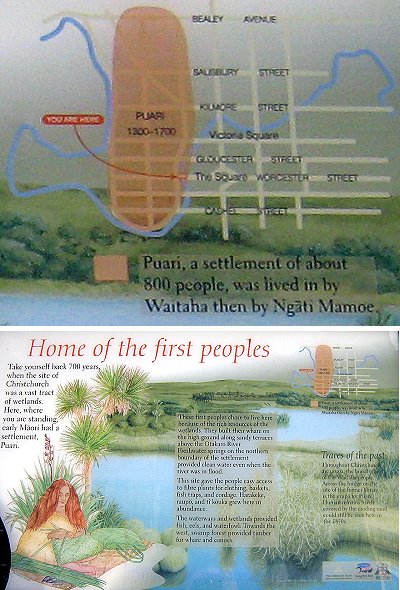
Hyped by the local TV station as the Southern Hemisphere's finest cultural precinct, this is an interpretive display sign at the centre of things.

Amongst the information that it conveys to the visitor is the revelation that Christchurch is in fact a 700 year old community originally known as Puari, with a population of about 800.*

There's no historical evidence for this assertion, which would appear to be an unfortunate instance of the facts not being allowed to get in the way of a good story.

The notion that a Māori version of prehistoric events should not be questioned conveys the idea that they have some privileged access to the truth. And when people sense that they are held to account by a different standard of evidence to everyone else, they understandably begin to reinterpret their past in line with current values and expectations rather than hard evidence.

* Puari was a large settlement at Port Levy on Banks Peninsula. Known to European whalers from the later 1820s, the population had declined by the mid 1840s, as a consequence of inter-tribal warfare and disease, to about 300 Māori and 12 Europeans.

May 6, 2008

Opposition to New Brighton Redevelopment


Brighton Beach 1927

From a city where the more salubrious suburbs are near the airport and sea frontage properties are the cheapest in the developed world comes further example of the cognitive inflexibility that's impeding regeneration of the once popular seaside suburb.

The New Zealand Historic Places Trust and the New Brighton Residents' Association (no web site or email contact) oppose plans for apartment buildings up to ten stories high along the sea front.

Opinions are polarised between those who believe the taller buildings will regenerate the declining suburb and allow sea views above the dunes and those who believe they will create a barrier between residents and the sea, destroying the suburb's increasingly bland character.

Tussle over taller buildings - The Press, 06 May 2008

Mar 6, 2008

Cultural Precinct

Worcester Street adjacent to Cathedral Square.

"The Southern Hemisphere's finest cultural precinct" Canterbury Television, February, 2008.

"It's hard for people who aren't familiar with our region to grasp just how much we have to offer ..." Christine Prince, chief executive, Christchurch & Canterbury Tourism , 25 February, 2008.

Photos by Kate Criner, a visitor from Philadelphia, USA