Showing posts with label emigrants. Show all posts

Jul 19, 2009

Spirit of Place: Christchurch 1862


1,792 x 768 PIXEL IMAGE OPENS IN A NEW TAB OR WINDOW

It is probable that this simple pencil sketch, the significance of which has long been forgotten, would have struck a deeply meaningful chord amongst our earliest pioneers. Indicating the extant of development a decade after those first settlers landed at this very place, it had been their first view of the swampy plain on which they would build a city.

This a restoration of a panoramic westerly view of the northern half of the city of Christchurch, in late 1861 or early 1862. The artist's vantage point is at the junction of Oxford Terrace and Kilmore Street, to the immediate west of the 1850 Bricks Wharf, which is just out of view to the Right. Here those pioneers arrived from Lyttelton, with their tents, heavy luggage and kitset houses and when the first land sales began on the 16th of April, 1851, this immediate vicinity was the most sought after.

Below top: The artist's position was near to the 1926 Bricks Wharf monument, seen in this 1935 photograph, with the Manchester Street Bridge in the distance. Below bottom: the site is approximately opposite where the Central Fire Station is now situated.

Attributed by us to the renowned architect Benjamin Mountfort (1825-1898), and probably intended as preparatory to a watercolur painting, the pencil sketch can be dated by, among other considerations, the absence of the first Oxford Hotel on the north-east corner of Chester Street East (now part of Oxford Terrace) and Colombo Street. Mountfort lived not far from this vantage point in Gloucester Street from 1860.

Above: to the near Left of the drawing, at what is now the south-west corner of Madras Street and Oxford Terrace is The Hollies, built in 1861 to Mountfort's Gothic design for the eccentric Christ's College Maths Master Christopher Calvert, it was the city's first stone house.

The central part of the panorama includes all of the buildings surrounding Market Place (now Victoria Square).

They are situated along Armagh, Colombo and Durham Streets (above), Chester Street, lower Whatley Road (now Victoria Street) and Cambridge Terrace, where the Town Hall is now sited (below). All of the accurately depicted buildings are identifiable from early photographs.

Below: to the far Right can be seen the 1860 Anglican Chapel of Ease of St Luke the Evangelist at the north-east corner of Kilmore and Manchester Streets. Another aisle was added in 1864, with a tower and spire built a decade later. Now known as St Luke's in the City, the slate roofed wooden church was rebuilt in stone in 1908.
By the time that this view was drawn the Utopian dream had succumbed to utilitarian pragmatism, the population was approaching 2,000, a telegraph line connected the city with its port, Kerosene lamps had been installed as street lighting and the old wharf was still in regular use by small steamers.

But six years later the Waimakariri River would reclaim its flood plain and the Avon rose to the limits of its upper banks as seen in the foregound of the drawing (below). Major civil engineering work ensued and in 1871 the original land contours in this vicinity disappeared beneath a gravelled Oxford Terrace.


The Alexander Turnbull Library reference:
Artist unknown :[Avon River, Provincial Court buildings and houses, Christchurch. 1870-1875?]
Reference number: C-081-006
1 drawing(s). Pencil drawing, 249 x 535 mm.. Horizontal image.
Part of Artist unknown :[Eight pencil sketches of Christchurch buildings and the Avon River. 1870-1875?] (C-081-003/009)
Drawings and Prints Collection.

Jun 10, 2009

Epitaph: John Grubb 1817-1898


As a member of the Canterbury Association's thirty-five strong initial work party, John Grubb, a thirty-two year old Scottish Carpenter arrived at Lyttelton on the 2nd of July, 1849.

His first responsibilty was the erection of the five prefabricated dwellings and Blacksmith's shop, carried from Wellington in the hold of the Fair Tasmanian. Three weeks later John commenced the construction of a 46 metre jetty, at which the first emigrants from the Association's chartered sailing ships would arrive 17 months later. Among those passengers were his wife Mary and their three daughters.


Early in the following year John Grubb built an extension across the front of what the historical record appears to indicate as being the 1849 prefabricated cottage of Joseph Thomas, the Principal Surveyor and Acting Agent of the Canterbury Association.

Initially granted a licence to occupy the site at the time when Captain Thomas relocateded to a more substantial dwelling, Grubb subsequently purchased the property for £23, when the set price for a bare section was £12.

By 1864 Mary and John's family included a further seven Lyttelton born children and an additional floor had been added to the 1851 extension.

Situated at 62 London Street, the house (below) remained in the Grubb family until 1961 and was purchased in 2006 by the Christchurch City Council for $260,000. We look forward to its restoration...


The mismanaged Canterbury Association collapsed in 1852 and John Grubb set himself up as a Shipwright on the foreshore (below foreground), in the vicinity of where the defunct second Railway Station now stands. A builder's model of John Grubb's Caledonia, the first vessel built of New Zealand timber and entirely by local industry, is in the collection of Canterbury Heritage.


Born on the 7th of November 1816, the former Mary Stott married John Grubb on the 26th of January 1842. She died at Lyttelton on the 18th of October 1886. Born on the 1st of May 1817 at Ferryport-on-Craig, Fifeshire, John survived his wife by a further twelve years. Lyttelton's oldest resident died in his 82nd year on Saturday, the 19th of February 1898.


The extensive and somewhat folkloric history of the Grubb family and their endeavours are well documented and thus the pioneering John Grubb can be considered as one of the seminal figures in the foundation of our community. That his final resting place in Lyttelton's Canterbury Street Cemetery lies ruined and forgotten might well seem to be a barometric indicator of our current cultural climate.

Jun 8, 2009

An Almost Forgotten Lyttelton Grave


Thomas Rousel Stevenson from Yorkshire had signed on at London in May 1901 as a Greaser aboard the Shaw, Savill & Albion Company's 14 year-old emigrant ship RMS Gothic.

The 7,750 ton steamer (above) had subsequently embarked passengers at Plymouth, before proceeding to Tenerife in the Canary Islands for coal. Well bunkered, the liner headed for Cape Town and then Hobart, before reaching Wellington. She sailed from the Capital on the 6th of June, arriving at Lyttleton on the following morning. Backing into the port's No.5 Wharf (below), she prepared to load chilled meat and butter over the next twelve days for her return to London via Cape Horn, Montevideo and Rio de Janeiro.


Granted shore leave, twenty six year-old Thomas was looking forward to visiting friends at Woolston that cold Winter's evening. Taking a train from Lyttelton, he fell from the carriage (in the vicinity below) fracturing his skull. Found later that night, he was taken back to the port, where an operation was performed at the hospital, but he died on the following morning.


In Lyttelton's Anglican cemetery, a Marble tombstone was erected at the expense of the Officers and crew of the Gothic. No longer marking the site of his grave, it's now set into the retaining wall of a path, which passes through the centre of the cemetery.

There is some confusion over Thomas's surname. Rousel, originally meaning a man with red hair, was an Anglo-Norman surname of great distinction and may have been considered somewhat pretentious for a humble engine room Greaser aboard a nondescript emigrant ship.

Lyttelton's Anglican cemetery on upper Canterbury Street was established in 1849, with the earliest burials predating the arrival of the first of the Canterbury Association's chartered emigrant ships.

May 9, 2009

Hack Circle or Pioneer Plaza?


LARGE IMAGE OPENS IN A NEW TAB OR WINDOW

Nicknamed the Hack Circle from the 1990s, the former site of the 1989 amphitheatre at the intersection of High and Cashel Streets is to be renamed as part of an upgrade that will include an extension to the vintage tram route. A Christchurch City Council spokesman is reported as saying that public submissions on a new name for the area could be the basis for a popular vote.

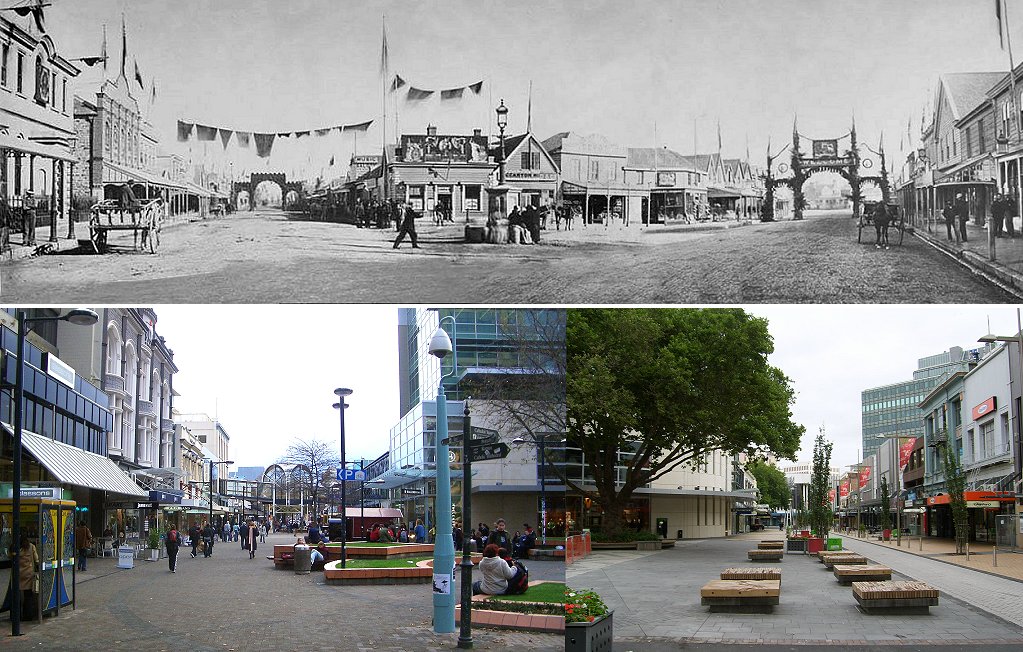
Accordingly we suggest the name Pioneer Plaza for what is undoubtedly one of the most significant historic locations in the city. Above is a panoramic view of the junction on the morning of Thursday, the 22nd of April 1869 and below is a similar aspect in 2008.


Known simply as "The Triangle" for a century, the triangular junction was matched to the south-east by the "Clocktower" junction at High and Manchester Streets and "The Bottleneck" junction at the intersection of High, Hereford and Colombo Streets to the northwest.

"The Triangle" intersection was the origin of the city's commercial precinct. Here was the 1851 passenger terminus for coaches to the ferry at Heathcote, first hotel (The White Hart), first Restaurant (Birdsey's), first Chemist shop (Wallace & Co), first fire station and the Customs House.


Above: Cobb & Company's circa 1854 booking office on the site now occupied by the Hallenstein's building. From here coaches departed for Papanui, Riccarton and the outlying settlements at Kaiapoi, Rangiora and Oxford. By the mid 1860s Cobb's coaches were carrying passengers from here to Timaru and the goldfields of the West Coast.


From here could be hired horse-drawn passenger cabs and Carrier's carts. Hansom cabs were a familiar sight on the rank until 1944 (above), which continued as a taxi rank into the 1960s.


Above: because of its historical significance as the place where they first arrived in Christchurch, the surviving pioneers from the first emigrant ships of 1850 gathered here to be photographed in 1900.


In 1910 the original gas lamp standard was replaced by a triangular flower bed, with a fountain at the centre. This feature survived until the early 1980s, but was removed for the 1983 first stage of the City Mall.

Accordingly, we consider that in naming the revamped intersection Pioneer Plaza, this generation will be honouring the memory of those pioneers who founded our city.


The 1989 Hack Circle amphitheatre

May 2, 2009

Podcast: Migrant Passenger Lists


With specific reference to New Zealand and the lack of lists of migrants arriving via Australia, this 53 minute talk from the UK's National Archives, will be of particular interest to family historians.

In Every journey has two ends: using passenger lists, Chris Watts reveals the benefits of using both arrival and departure records when searching for details of our migrant ancestors, as well as demonstrating how the shortcomings of content, indexing and accessibility can be minimised.

Photo: attended by the extant 1907 tug Lyttelton, RMS Rangitiki (1928-1962) docks at Lyttelton's Gladstone pier after a five week maiden voyage from London via Curacao and the Panama Canal.

Feb 22, 2009

Tales of Banks Peninsula


Canterbury Heritage is pleased to announce the Internet publication of a new edition of Tales of Banks Peninsula.

Compiled by 1883 and published the following year by Howard Charles Jacobson (1841-1910), the Editor and owner of the Akaroa Mail and Banks Peninsula Advertiser, the book is a compilation from various sources about old identities and early historic events, and also small pieces written by Jacobson for his newspaper.

Written by the Maori historian the Reverend James West Stack (1835 -1919), the first part covers the legends and folklore of the Maori, from the warfare between the Ngati Mamoe, Ngai Tahu, Ngatiawa and Ngapuhi tribes until the advent of European settlement in the mid 1830s. Stack's contribution is followed by the anecdotal reminisces of many of the earliest European pioneers in the district.

The book's historical significance may be appreciated by the knowledge that it was republished in 1894, 1917, 1976 and continues to be cited in the adjudications of the Waitangi Tribunal.

Where the subject matter deviates, the chapters have been re-paragraphed for this edition. In the interests of historians and genealogical researchers, etc., the proper nouns or names have been amended to their current usage. Punctuation, abbreviations and Dickensian-era grammar have also been slightly amended in accordance with current conventions, but beyond that, this revised edition remains faithful to the original text.


The links to the parts of the book (in blue) open in new tabs or windows.


TALES OF BANKS PENINSULA
Frontis and prefaces to the earlier editions.
FOLKLORE OF THE MAORI
Pa of Nga-Toko-Ono (The Pah of the Six)
Parakakariki
Tu Te Kawa
Waikakahi (Wascoe's)
Ngai Tahu Taking Possession
Te Mai Hara Nui
Kai Huanga (Eat Relation)
Raid on Panau (Long Look-Out)
Capture of Te Mai Hara Nui
Onawe
Maoris Reorganising
Death of Tu Te Hou Nuku
Conclusion
PART 1
European Account of the Massacre in Akaroa Harbour
George Hempleman and his Purchase of Akaroa
George Hempleman's Diary
"Headed Up" (The imprisonment of Puaka at Peraki)
The French Settlement of Akaroa
Early Days
Arrival of the First English Ship
Reminiscences of the First Five Years
A Lady Colonist's Experiences
Billy Simpson
Jimmy Robinson
Jimmy Walker
"Chips" (Adolph Friedrich Henrici)
Thomas Richard Moore, M.D
French Farm and the Survey
John Henry Caton
The Chief Paora Taki's Story
Story of a Snake Hunt in Akaroa Harbour by Mrs. Tikao
The Mysterious Disappearance of Mr. Dicken
Harry Head
The Loss of the Crest
PART 2
LeBon's Bay
Okain's Bay
Little Akaloa
German Bay
Robinson's Bay
Duvauchelle'a Bay South
Pigeon Bay
Head of the Bay
Island Bay
Little River
Charteris Bay
Gough's Bay
Peraki
MORE STORIES OF OLD SETTLERS
Mr. Philip Ryan
Mr. Thomas White
Mr. William Isaac Haberfield
PENINSULA STORIES IN VERSE
Akaroa
Our Jubilee
The Legend of Onawe
The Legend of Gough's Bay


Image credit: Akaroa, April 1840 (an engraving entitled Baie d'Akaroa, from Voyage au Pôle Sud et dans l'Océanie sur les corvettes l’Astrolabe et la Zélée, 1837-1840, by J. Dumont d'Urville.)

Feb 21, 2009

60th Anniversary: 21st of February, 1949


The Christchurch City Council informs its citizens that a grant of armorial bearings was made to the city by the Royal College of Heralds by letters patent on the 21st of February, 1949.

Being the sixtieth anniversary of that allegedly august event, we'd like to point out that Christchurch already had a coat of arms (below).


This prior armorial bearing included a depiction of the Lyttelton railway tunnel, which was replaced in the 1949 version by an abstract representation of the first four ships to bring emigrants from Gravesend to Lyttelton.

The first four ships mythological conceit emblazoned upon our more recent heraldic arms conveniently overlooks a number of awkward facts, not the least being that these newcomers were welcomed by the Canterbury Association's emigrants who had already arrived via Wellington.

Jan 23, 2009

Maori from Taiwan 5,200 years ago

New research into language evolution suggests that the Maori originated in Taiwan around 5,200 years ago. Scientists at The University of Auckland have used sophisticated computer analyses on vocabulary from 400 Austronesian languages to uncover how the Pacific was settled.

The results, published in the latest issue of the prestigious journal Science, show how the settlement of the Pacific proceeded in a series of expansion pulses and settlement pauses. The Austronesians arose in Taiwan around 5,200 years ago. Before entering the Philippines, they paused for around a thousand years, and then spread rapidly across the 7,000km from the Philippines to Polynesia in less than one thousand years. After settling Fiji, Samoa and Tonga, the Austronesians paused again for another thousand years, before finally spreading further into Polynesia eventually reaching as far as New Zealand, Hawaii and Easter Island.

Further reading: Science Daily


Nov 15, 2008

Our history may be somewhat closer than many of the more recent generations are aware...

As a child the Ngati Toa tribal chieftain Te Rauparaha (~1760-1849) remembered the visits of James Cook to New Zealand between 1769 and 1777. He also knew Edward Jollie (1825-1894), whose 1861 wedding was attended by this contributing Editor's Great Grandmother. Accordingly, there are no more than three degrees of separation between Captain Cook and living New Zealanders.

In the case of Canterbury there are still a few locals who knew the last survivor of the original settlers of 1850. Among them is 93 year-old Austen Deans, last surviving Great Grandson of John Deans who settled at Riccarton in 1843.


Richards Evans aged in 16 in 1864

Richard Evans (1848-1944) arrived aboard the Cressy as a two year old. The second to last survivor of the first four ships and a Patron of the Canterbury Pilgrims Association, he is remembered by Roger Ridley-Smith, who is thereby a remarkable link to the very beginnings of Christchurch.

The Reverend Frederick Brittan (1848-1945), last survivor of our first settlers, delivered a eulogy at Richard Evans' funeral.


Tea drinking 90 year-old Richards Evans seated beside a young Roger Ridley-Smith

Roger Ridley-Smith writes:
My father, E D R Smith, (1901-1975), a lawyer in Rangiora, knew Richard Evans. In 1938, the three of us went to the Bridle Track where there was a ceremony at the memorial there. It may have been the unveiling of it. Evans, who would have been aged ninety, sat in the back of my father's Chevrolet. and I recall him as a small man with a snow white beard. I was aged seven. Memory is fallible, but that is as I recall it.


Dilapidated and forgotten, this is the grave of Georgina Sophia and Richard Evans in St John's cemetery at Rangiora.


Canterbury Heritage is gratefully indebted to Sarndra Lees for the 1864 photograph of her Great Great Uncle and his grave. Also to Dr. Ridley-Smith for the 1938 photograph of his father's 90 year old friend.

We would also be very pleased to hear from anyone who can expand upon this interesting aspect of our history.

Sep 26, 2008

Podcast: Introduction To Family History

Need advice on how to begin tracing your family’s past?

Presented by Audrey Collins of the National Archives UK, this 58 minute talk is for anyone new to family history.

As well as advising on good research habits, the speaker provides an overview of the main resources available to family historians, such as birth and marriage certificates, online and offline resources, parish records, military records and newspapers.


Download mp3 audio file


Help with downloading files

To download this audio file, Right-click on the "Download..." MP3 link (or control-click on a Mac) and select "Save Target As..." (or "Download Linked File" on a Mac) to save the file to your hard drive.

Sep 13, 2008

John Robert Godley's London Home


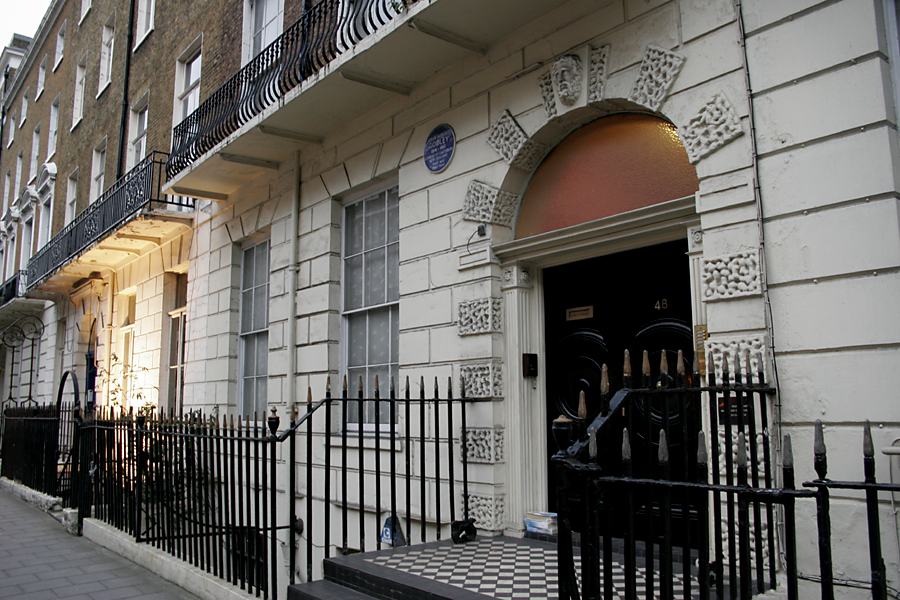
"Old Jack" Godley (1814-1861), a founder and second Lyttelton based Agent of the Canterbury Association, lived and died in this 1810 terraced house at 48 Gloucester Place, in London's Marylebone district (better known as Fitzrovia). Charlotte Godley survived her husband by 45 years and died in the Grade II listed townhouse on the 3rd of January 1907. Subsequently the home of the Rabbi Sir Philip Magnus, Baronet, it is now the St George Hotel.

Photographed by Ramanja

Aug 19, 2008

Edward Jollie Memoir


Edward Jollie was the Surveyor who laid out the township of Lyttelton and the city of Christchurch in 1849.

1 0. Preface

1.00Beginnings

2.00Wellington: 1842-1845

3.00Nelson: 1845-1846

4.00Otago: 1846-1847

5.00Nelson: 1848-1849

6.00Christchurch: 1849-1851

7.00North Canterbury: 1852-1860

8.00South Canterbury 1858-1859

9.00Auckland: 1860-1861

10.0Francis Jollie

11.0Christchurch 1861-1865

12.0Postscript

103 Acknowledgments & Bibliography

103 Appendices103 1

103 103Caroline Orsmond Jollie 1836 -1919

103
103Margaret Jollie 1862-1936

103 103Francis Jollie 1865~1921

103 103Elizabeth Jollie 1866~1928

103 103Mary Jollie 1868-

103 103Edward Jollie Jnr 1871-1925

103 103Jollie’s mother, Margaret 1795-1872

Jul 24, 2008

1865 Lyttelton Directory


Residential and Commercial Directory

of the

Township of Lyttelton, New Zealand

1865


Click on the above 1865 photographs to access the Directory, which is compiled from the Canterbury Heritage Biographical Index and includes
636 listings. The link opens in a new window.

Jul 17, 2008

1864 Canterbury Emigrant Ship


The world's oldest surviving clipper ship, The City of Adelaide, was built in 1864 to carry emigrants to Australia and New Zealand. As such she was a regular visitor to Lyttelton until 1887. The 860 ton vessel has been stored at the Scottish Maritime Museum in Irvine, Ayrshire since 1993.

Jul 15, 2008

Index: 1903 Canterbury Cyclopedia


Described as "that great repository of fiction," and published in six volumes between 1897 and 1908, the Cyclopedia of New Zealand was a vanity publication of biographical information and photographs of local identities, supplied by the individuals who cared to part with £5 in order to be included.

It is, however, an interesting social document, which reflects the values of the first and second generations who set the tone for our cultural development.

The 1903 Canterbury edition was published by the Cyclopedia Company at Horace Weeks's extant 1898 five story Printery on Manchester Street. Using the new half-tone process for the reproduction of photographic images, it captured the flavour of a Canterbury, which had recently survived yet another depression and was looking forward to the new century with optimism.

This 4,465 entry index of the 1,146 page volume has been extended from the 48,732 entry Canterbury Heritage Biographical Index of early settlers.


Available in library reference rooms, the Cyclopedia can also be purchased from second hand book shops or online via the TradeMe web site for about $150 to $350 per volume. They are also available on CD in PDF format for $25 each from Dunedin's Colonial Books.

Jul 11, 2008

Podcast: Solving Census Problems


David Annal takes a practical approach to overcoming the most common problems faced by family historians when using the 19th century census returns.

It may sometimes seem that your ancestors are missing from the returns - this talk aims to convince you that, if your ancestors were living in England or Wales at the time of the census, they were almost certainly recorded and you should be able to find them. The odds are firmly stacked in your favour.

Jul 6, 2008

New Zealand Cemeteries Online

Links to searchable databases open in new windows

Auckland
Waikato
Taupo
Hawkes Bay
Taranaki
  • New Plymouth District Te Henui, Awanui, Waitara, Inglewood, Oakura, Urenui, Purangi, Waireka, Tarata, Tataraimaka.
  • South Taranaki District Eltham, Hawera, Kaponga, Manaia, Okaiawa, Opunake, Otakeho, Patea, Ohawe, Waihi, Waverley, Manutahi, Pihama, Warea, Rahotu.
Manawatu
  • Palmerston North Kelvin Grove, Terrace End, Ashurst.
  • Horowhenua Fielding, Halcombe, Kimbolton, Pohangina, Rangiwahia, Rongotea, Sandon, Waituna West.
Wellington
Nelson
  • Tasman District Richmond, Lower Moutere, Motueka, Riwaka, Sandy Bay, Collingwood, Clifton, Takaka, Kotinga, Dovedale, Foxhil, Upper Moutere, Spring Grove, Brightwater, Ngatimoti, Tapawera, Murchison, Stanley Brook.
  • Nelson Marsden Valley, Stoke, Hira, Wakapuaka.
Canterbury
  • Hurunui District Balcairn, Culverden, Glenmark, Waipara, Hanmer Springs, Homeview, Cheviot, Horsley Down, Rotherham, Waiau, Waikari.
  • Christchurch Addington, Avonhead Park, Barbadoes Street, Belfast, Bromley, Linwood, Memorial Park, Ruru Lawn, Sydenham, Waimairi, Woolston, Yaldhurst.
  • Ashburton District Ashburton, Methven, Rakaia, Chertsey, Mt Somers, Ruapuna, Alford Forest, Winslow, Hinds, Waterton, Barrhill, Dorie, Windermere, Coldstream, Cracroft.
  • Timaru District Arundel, Geraldine, Pareora, Pleasant Point, Temuka, Timaru.
  • Waimate District (Download PDF 0.5 Mb) Hakataramea, Glenavy, Morven, Otaio, Waimate.
  • Mackenzie District Albury, Fairlie, Burkes Pass, Twizel.
West Coast
Otago

Jul 4, 2008

Pioneer Cemetery


A southerly view of Christchurch's first cemetery in Barbadoes Street at Cambridge Terrace. Here lie the pioneer settlers from the early 1840s. The chapel was demolished in 1955 and the old cemetery has become neglected and vandalised.

In the foreground is the grave of Johannes Georg Ruddenklau (1829-1891), City Councilor from 1866 and Mayor of Christchurch 1882-1891. A German Baker and Confectioner, Ruddenklau had a Pie shop at "The Triangle" (junction of High and Colombo Streets) by 1857, subsequently granted a Beer License, he built the City Hotel on the same site. The much photographed hotel was demolished in the early 1930s to make way for the current building.

Photographed by Andy Wragg, a recent Canterbury settler from the United Kingdom.

Jul 2, 2008

Where Canterbury Began


41 Charing Cross, subsequently known as 16 Whitehall, occupies part of the site of London's Whitehall Palace, which burnt down in 1698. Already a centre of London book publishing before it was built in 1765, the ground floor of the three-storey plastered brick building was a Coffee House by 1810.

The inaugural meeting of the Canterbury Association was held in the upper floor rooms on the 27th of March, 1848, where a resolution was passed: "that the name of the proposed settlement be "Canterbury" and the name of the chief town be "Christchurch."

Next door were the banking offices of Thomas Somers Cocks (1815-1899), an original member of the Canterbury Association. Cocks, Biddulph and Company became the Association's bankers. Thomas's cousin the Reverend Henry Bromley Cocks, (1832-1894), first Vicar of Sydenham, emigrated to Christchurch in 1861. Mount Somers in the foothills of mid-Canterbury is named after the banker to the Canterbury Association.

The 165 year-old building was demolished in 1930, to be replaced by the neo-Georgian offices of the Glyn Mills Bank. Known as Kirkland House, it now forms part of the British government's Cabinet Office. The commemorative plaque was unveiled on the 16th December 2003.

Jun 27, 2008

Podcast: Emigration Records

From the National Archives UK, this 42 minute talk explains the reasons behind the emigration of some 13 million people since the 17th century.

It discusses the most popular destinations for emigrants and sources such as outgoing passenger lists, passport records, and a host of emigration schemes supported and fostered by the government.

It also features the various child migration schemes that have been responsible in migrating some 150,000 children from the UK between 1618 and 1967.

Particular reference is made to the growing number of online sources relevant to this subject.