LARGE IMAGE OPENS IN A NEW TAB OR WINDOW
This is an 1880 photograph of the Canterbury Provincial Council buildings on the east side of Durham Street North. Built between 1857 and 1865, they are seen in this north-easterly view from Gloucester Street West, near to the junction with Cambridge Terrace.
The only purpose-built New Zealand provincial government buildings still in existence, with the 1876 abolition of the provincial governments, the buildings were in use as offices of central government departments by the time that this photograph was taken.
A regular subject for photographers, this is not a particulary important historical photo, but for one significant exception. With its central tower rising above the roof line, to the extreme Left can be seen the Great Hall of the Supreme Court (below). The Court building is partially obscured by the workshops of the Christchurch City Council at the corner of Armagh Street, which were replaced in 1890 by the extant Canterbury Society of Arts gallery.

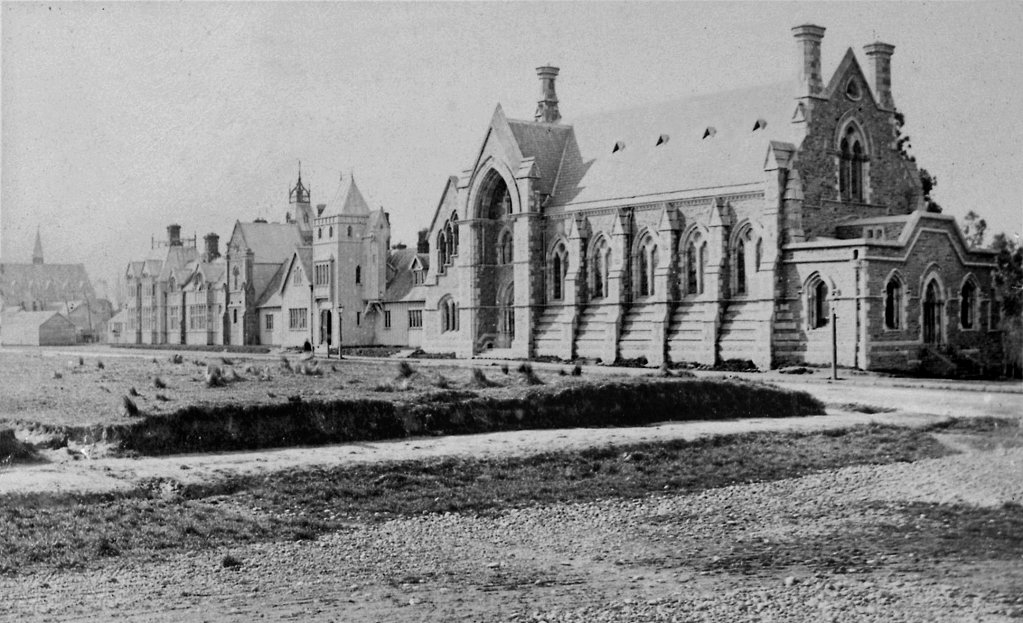
Built in 1869 to the design of Alexander Lean (1824-1893), the stone Supreme Court building complimented the Canterbury Provincial Council Chamber, which is widely considered to be the finest example of the medieval Gothic style in the Southern Hemisphere. Similar to the Provincial Council Chamber, a public gallery at the eastern end seated 200 juridicial spectators.

In the early 1880s the 12.3 by 15.35 metre hall acquired substantial extensions along two sides, as seen above in this circa 1885 photograph, taken from across the Avon River at Victoria Square.
The Supreme Court extensions were progressively demolished from 1974 to make way for the current Law Courts building (below), with the 115 year-old Great Hall succumbing in 1984 to what must be one of the city's worst acts of cultural vandalism.

An aside: in 1849 the Surveyor Edward Jollie laid out a rectangular Common bounded by Colombo, Armagh, Durham and Kilmore Streets. Advised by its Solicitor, Henry Sewell (later Prime Minister of New Zealand), that it was unlawful to do so, the Canterbury Provincial Council subverted parts of the public reserve for the construction of buildings. Thus it is that the property titles now occupied by the Law Courts, along with the Salvation Army, the Town Hall and the Crowne Plaza Hotel, might still be deemed unlawful.
We're greatfully indebted to Steven McLachlan of the Shades Stamp Shop at 108 Hereford Street, Christchurch for the top photograph, which precipitated this article.
The only purpose-built New Zealand provincial government buildings still in existence, with the 1876 abolition of the provincial governments, the buildings were in use as offices of central government departments by the time that this photograph was taken.
A regular subject for photographers, this is not a particulary important historical photo, but for one significant exception. With its central tower rising above the roof line, to the extreme Left can be seen the Great Hall of the Supreme Court (below). The Court building is partially obscured by the workshops of the Christchurch City Council at the corner of Armagh Street, which were replaced in 1890 by the extant Canterbury Society of Arts gallery.
Built in 1869 to the design of Alexander Lean (1824-1893), the stone Supreme Court building complimented the Canterbury Provincial Council Chamber, which is widely considered to be the finest example of the medieval Gothic style in the Southern Hemisphere. Similar to the Provincial Council Chamber, a public gallery at the eastern end seated 200 juridicial spectators.
In the early 1880s the 12.3 by 15.35 metre hall acquired substantial extensions along two sides, as seen above in this circa 1885 photograph, taken from across the Avon River at Victoria Square.
The Supreme Court extensions were progressively demolished from 1974 to make way for the current Law Courts building (below), with the 115 year-old Great Hall succumbing in 1984 to what must be one of the city's worst acts of cultural vandalism.
An aside: in 1849 the Surveyor Edward Jollie laid out a rectangular Common bounded by Colombo, Armagh, Durham and Kilmore Streets. Advised by its Solicitor, Henry Sewell (later Prime Minister of New Zealand), that it was unlawful to do so, the Canterbury Provincial Council subverted parts of the public reserve for the construction of buildings. Thus it is that the property titles now occupied by the Law Courts, along with the Salvation Army, the Town Hall and the Crowne Plaza Hotel, might still be deemed unlawful.
We're greatfully indebted to Steven McLachlan of the Shades Stamp Shop at 108 Hereford Street, Christchurch for the top photograph, which precipitated this article.