Showing posts with label cemetery. Show all posts

Jun 29, 2009

Epitaph: Frank Garrard 1852-1881


In Christchurch's sadly neglected pioneer cemetery, and close to where the 1863 chapel stood until 1955, lies the second grave of 29 year-old Frank Garrard.

Captain Francis George Garrard
2 March 1852 - 30 April 1881

On his way to Melbourne for his wedding, the youngest captain in the inter-colonial service drowned along with another 130 souls, when his vessel was wrecked on the Otara Reef at Waipapa Point, near Invercargill. The sad tale of their demise is enshrined as one of our nation's most tragic shipping disasters.

A graduate, with distinction, of the Royal Naval School at Greenwich and hero of a subsequent shipwreck, Garrad had been readily promoted from Second Officer of the Hawea to Chief Officer of the steamship Taupo, then Master of Albion and finally to the command of the Union Steamship Company's 17 year-old, trans-Tasman liner Tararua. Third owners of the ill fated 828 ton steamer (below), the Union line employed her on the regular passenger service between Lyttelton, Port Chalmers, Bluff, Hobart and Melbourne.


Found with a pocket watch and a locket containing a portrait of his prospective mother-in-law on his corpse, Frank was intially buried in what would become known as the Tararua Acre, just above the beach where his body had washed ashore. Exhumed on the instruction of his former classmate at the Royal Navy School and brother-in-law, the shipping magnate Sir Joseph Kinsey, Frank Garrard was reburied at Christchurch three weeks after his demise. He lies beneath an imposing monument, the upper part of which is carved to resemble an anchor held fast in rocks.

Special thanks to Sarndra Lees for the grave photo and the inspiration.

Jun 10, 2009

Epitaph: John Grubb 1817-1898


As a member of the Canterbury Association's thirty-five strong initial work party, John Grubb, a thirty-two year old Scottish Carpenter arrived at Lyttelton on the 2nd of July, 1849.

His first responsibilty was the erection of the five prefabricated dwellings and Blacksmith's shop, carried from Wellington in the hold of the Fair Tasmanian. Three weeks later John commenced the construction of a 46 metre jetty, at which the first emigrants from the Association's chartered sailing ships would arrive 17 months later. Among those passengers were his wife Mary and their three daughters.


Early in the following year John Grubb built an extension across the front of what the historical record appears to indicate as being the 1849 prefabricated cottage of Joseph Thomas, the Principal Surveyor and Acting Agent of the Canterbury Association.

Initially granted a licence to occupy the site at the time when Captain Thomas relocateded to a more substantial dwelling, Grubb subsequently purchased the property for £23, when the set price for a bare section was £12.

By 1864 Mary and John's family included a further seven Lyttelton born children and an additional floor had been added to the 1851 extension.

Situated at 62 London Street, the house (below) remained in the Grubb family until 1961 and was purchased in 2006 by the Christchurch City Council for $260,000. We look forward to its restoration...


The mismanaged Canterbury Association collapsed in 1852 and John Grubb set himself up as a Shipwright on the foreshore (below foreground), in the vicinity of where the defunct second Railway Station now stands. A builder's model of John Grubb's Caledonia, the first vessel built of New Zealand timber and entirely by local industry, is in the collection of Canterbury Heritage.


Born on the 7th of November 1816, the former Mary Stott married John Grubb on the 26th of January 1842. She died at Lyttelton on the 18th of October 1886. Born on the 1st of May 1817 at Ferryport-on-Craig, Fifeshire, John survived his wife by a further twelve years. Lyttelton's oldest resident died in his 82nd year on Saturday, the 19th of February 1898.


The extensive and somewhat folkloric history of the Grubb family and their endeavours are well documented and thus the pioneering John Grubb can be considered as one of the seminal figures in the foundation of our community. That his final resting place in Lyttelton's Canterbury Street Cemetery lies ruined and forgotten might well seem to be a barometric indicator of our current cultural climate.

Jun 9, 2009

Epitaph: George Rhodes 1815-1864


24 year-old Henry Kirk arrived at Lyttleton in December 1863. Establishing himself a brick maker, one of his earliest commissions was to construct a large vault in the town's Anglican cemetery for the Rhodes family of Purau on the south-eastern side of the harbour. The vast monument that rose above it on the steep hill side continues to be amongst the port's most imposing tombs, but for all its grandiosity, only the mortal remains of a single member of that famed Canterbury dynasty lie within.


24 year-old George Rhodes had first come to what would eventually be Canterbury in November 1839, establishing a cattle station at Akaroa before returning to Sydney. Four years later George returned to take charge of land adjacent to his brother William's Banks Peninsula whaling station. The rest of the Rhodes Brothers's story is well documented history, but the only known image of George and his wife Elizabeth is this photograph (below), taken in front of their 1851 farm cottage near Timaru.


George and Elizabeth built an extant stone house (below) at Purau in 1854 and it was here that George died from Typhoid Fever on the 18th of June 1864.


Described by the Canterbury Association's local Agent as that cattle dealer and market gardener, he would be the founder of an immensely wealthly dynasty that would dominate the social life of the province for most of the following century.

But there's seasons in the affairs of families and the Rhodes flogged the Ranch and moved on to the big smoke, leaving poor George to lie alone beneath his neglected monument. Thus it is that in the current era the best known of his descendants is a certain Teddy Tahu Rhodes (below), that imposing 1.96 metre Opera singer and infrequent visitor to the land of his pioneering forebears.

Jun 8, 2009

An Almost Forgotten Lyttelton Grave


Thomas Rousel Stevenson from Yorkshire had signed on at London in May 1901 as a Greaser aboard the Shaw, Savill & Albion Company's 14 year-old emigrant ship RMS Gothic.

The 7,750 ton steamer (above) had subsequently embarked passengers at Plymouth, before proceeding to Tenerife in the Canary Islands for coal. Well bunkered, the liner headed for Cape Town and then Hobart, before reaching Wellington. She sailed from the Capital on the 6th of June, arriving at Lyttleton on the following morning. Backing into the port's No.5 Wharf (below), she prepared to load chilled meat and butter over the next twelve days for her return to London via Cape Horn, Montevideo and Rio de Janeiro.


Granted shore leave, twenty six year-old Thomas was looking forward to visiting friends at Woolston that cold Winter's evening. Taking a train from Lyttelton, he fell from the carriage (in the vicinity below) fracturing his skull. Found later that night, he was taken back to the port, where an operation was performed at the hospital, but he died on the following morning.


In Lyttelton's Anglican cemetery, a Marble tombstone was erected at the expense of the Officers and crew of the Gothic. No longer marking the site of his grave, it's now set into the retaining wall of a path, which passes through the centre of the cemetery.

There is some confusion over Thomas's surname. Rousel, originally meaning a man with red hair, was an Anglo-Norman surname of great distinction and may have been considered somewhat pretentious for a humble engine room Greaser aboard a nondescript emigrant ship.

Lyttelton's Anglican cemetery on upper Canterbury Street was established in 1849, with the earliest burials predating the arrival of the first of the Canterbury Association's chartered emigrant ships.

Jun 3, 2009

A Rare Taphophilic Survivor at Ashburton


Reminiscent of the South African Veld or the American West, wooden fences around graves were once a common sight in New Zealand. As the nineteenth century drew to a close the availabilty of wrought iron railings marked a change in tastes for funereal ornamentation, but the need to recycle iron for the wars of the twentieth century saw many of these elaborate railings consigned to the Smelter's furnace.

Above is an ornate example of wooden fenced grave from the 1880s, which barely survives in the Ashburton Cemetery. A relic from an era when child mortality was commonplace, it surrounds the graves of the four children of William and Mary Ullyatt of Methven.

Anna, Emma, John and George Ullyatt died between 1883 and 1887, but their farming parents retired to Christchurch and were buried in the Linwood Cemetery in 1917 and 1924.

It is to be hoped that this extremely rare survivor of Canterbury's heritage will be restored before it finally falls prey to the elements.

Addendum


Above: designated in October, 2005 for restoration by the Christchurch City Council is the fenced grave of Walter Powell Beauchamp in the Linwood Cemetery. A Clerk of New Brighton Road, 20 year-old Beauchamp died on the 2nd of April 1888 after only eight years in the colony.

Made of Totara, the remains of the contemporaneous wooden fence had undergone partial restoration by April 2009 (below), but the original pickets have yet to be replaced.


LARGE IMAGE OPENS IN A NEW TAB OR WINDOW

Sarndra's lovely photograph of the wooden fenced grave of a child and her grandmother in Auckland's Waikumete Cemetery.

This is a good example of how the fenced graves depicted above might be restored. Enclosing flowering shrubs would add colour and also attract birds to otherwise rather drab and utilitarian cemeteries.

Landscaping our historic cemeteries as parks of remembrance could make them more attractive to the public and quite possibly circumvent the ongoing problem of vandalism.

Photo credits: Sandra Lees and Early Canterbury Photographers

Jun 2, 2009

The Ravages of Time 1907-2004


This poignant image is an almagamation of two photographs recently published on the Early Canterbury Photographers web site (the link to the original photographs opens in a new tab or window).

It depicts the tombstone of Caroline Hay in Addington Cemetery. The estranged wife of William Hay, the former Caroline McClelland died on Wednesday, the 19th June 1907 at her home in nearby Lincoln Road. The monument was erected by her eldest son Leonard Hamilton Hay.

The earlier photograph was taken before August 1908, when the mortal remains of Mary Ann Prideaux were interred within the grave. Caroline's friend, Mary had arrived at Lyttelton as a 23 year-old domestic servant aboard the sailing vessel Accrington in 1863.

The second photograph was taken in 2004, by which time the Granite pillar of the monument had fallen into the foreground, with its cornice just visible to the Left. The fall of the monument is probably attributable to the inevitable decay and eventual collapse of the coffins beneath it.


The daughter of Anne and Robert McClelland of Carlow, Ireland, Caroline Hay (above) was born on the 24th of April 1847. Aged nineteen, she arrived at Lyttelton aboard the Wiltshire on the 17th of February 1877.

Five years later Caroline married the widowed William Hay at the Methodist Church in Selwyn Street, Addington. William farmed at Rolleston and then South Canterbury, but by 1898 the couple had separated and Caroline returned to Christchurch, taking her three children with her.

By the end of 1898 Caroline Hay is recorded as a storekeeper, buying a property on Accommodation Road, Richmond, Christchurch for £350. Now known as London Street, her home at number 29 survives, but has been much altered since the time when Caroline named it “Moira,” an allusion to both an Irish Shire, and from classical Greek mythology, a person's fate or destiny.

The three children of William and Caroline Hay were:

Mary Prideaux (Mamie) Jenkin (nee Hay), (elder of twins) 15 December 1883 - 28 September 1949 (born and died at Christchurch).
William Hay (younger of twins), born 15 December 1883 at Christchurch.
Leonard Hamilton Hay, born 11 January 1887 Lincoln Road, Christchurch.
Caroline's brother Paul McClelland, subsequently of Mendecino, California, is noted as having been a soldier in the American Civil War.


A great great grandson of William Hay writes:


William Hay (above) came to New Zealand from Northern Ireland about 1863-64 leaving his pregnant wife and two children behind in Ireland. They finally arrived at Lyttelton aboard the Charlotte Gladstone in 1871, and it was the first time that he had seen his daughter Sarah Ann Hay then aged 7 years.

Mary died at Rolleston in 1874 and William remarried in 1882, moving to South Canterbury in about 1890, with his second wife Caroline. However, she wasn't happy living in a remote rural area, and moved back to Christchurch with the three children of the marriage. Leaving an estate of about £3,000, or $302,000 in the values of 2009, William died at Albury in 1918 and is buried there.

Although both wives were surnamed McClelland there is not any close family ties between them. Mary was Northern Irish Protestant, Caroline Southern Irish Catholic.

Jul 6, 2008

New Zealand Cemeteries Online

Links to searchable databases open in new windows

Auckland
Waikato
Taupo
Hawkes Bay
Taranaki
  • New Plymouth District Te Henui, Awanui, Waitara, Inglewood, Oakura, Urenui, Purangi, Waireka, Tarata, Tataraimaka.
  • South Taranaki District Eltham, Hawera, Kaponga, Manaia, Okaiawa, Opunake, Otakeho, Patea, Ohawe, Waihi, Waverley, Manutahi, Pihama, Warea, Rahotu.
Manawatu
  • Palmerston North Kelvin Grove, Terrace End, Ashurst.
  • Horowhenua Fielding, Halcombe, Kimbolton, Pohangina, Rangiwahia, Rongotea, Sandon, Waituna West.
Wellington
Nelson
  • Tasman District Richmond, Lower Moutere, Motueka, Riwaka, Sandy Bay, Collingwood, Clifton, Takaka, Kotinga, Dovedale, Foxhil, Upper Moutere, Spring Grove, Brightwater, Ngatimoti, Tapawera, Murchison, Stanley Brook.
  • Nelson Marsden Valley, Stoke, Hira, Wakapuaka.
Canterbury
  • Hurunui District Balcairn, Culverden, Glenmark, Waipara, Hanmer Springs, Homeview, Cheviot, Horsley Down, Rotherham, Waiau, Waikari.
  • Christchurch Addington, Avonhead Park, Barbadoes Street, Belfast, Bromley, Linwood, Memorial Park, Ruru Lawn, Sydenham, Waimairi, Woolston, Yaldhurst.
  • Ashburton District Ashburton, Methven, Rakaia, Chertsey, Mt Somers, Ruapuna, Alford Forest, Winslow, Hinds, Waterton, Barrhill, Dorie, Windermere, Coldstream, Cracroft.
  • Timaru District Arundel, Geraldine, Pareora, Pleasant Point, Temuka, Timaru.
  • Waimate District (Download PDF 0.5 Mb) Hakataramea, Glenavy, Morven, Otaio, Waimate.
  • Mackenzie District Albury, Fairlie, Burkes Pass, Twizel.
West Coast
Otago

Jul 4, 2008

Pioneer Cemetery


A southerly view of Christchurch's first cemetery in Barbadoes Street at Cambridge Terrace. Here lie the pioneer settlers from the early 1840s. The chapel was demolished in 1955 and the old cemetery has become neglected and vandalised.

In the foreground is the grave of Johannes Georg Ruddenklau (1829-1891), City Councilor from 1866 and Mayor of Christchurch 1882-1891. A German Baker and Confectioner, Ruddenklau had a Pie shop at "The Triangle" (junction of High and Colombo Streets) by 1857, subsequently granted a Beer License, he built the City Hotel on the same site. The much photographed hotel was demolished in the early 1930s to make way for the current building.

Photographed by Andy Wragg, a recent Canterbury settler from the United Kingdom.

Jun 14, 2008

Tombstone Territory


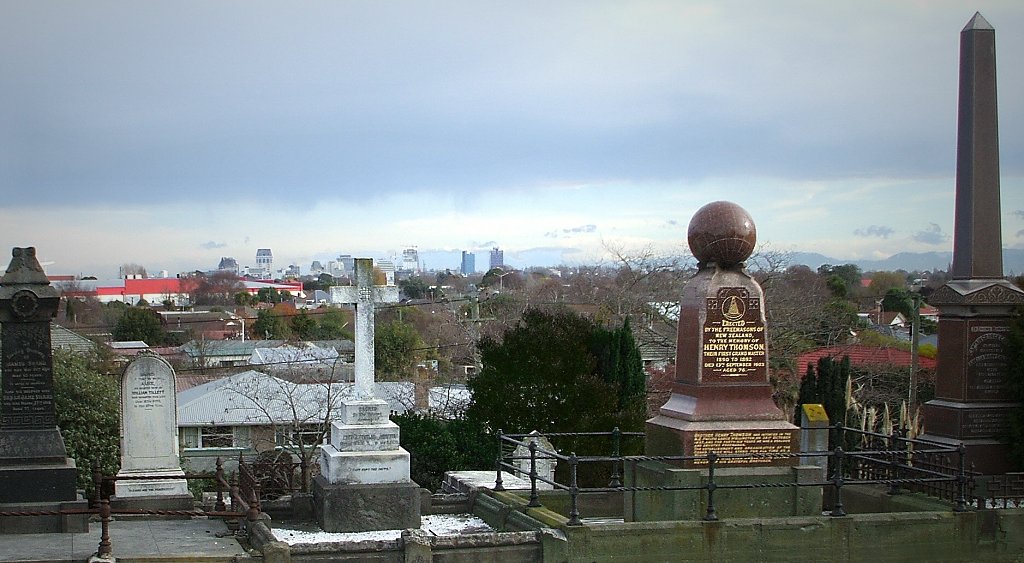
The tombs of many of the city's earliest settlers enjoy an elevated Westerly view of the central business district from the 1880 Linwood Cemetery.

Christchurch is somewhat flatter than the city known to its original inhabitants, only the old cemeteries retain the original contours.

Most of the graves evidence neglect and damage, but only the Jewish section of the cemetery shows the care and honour bestowed upon its founders by a subculture that continues to value its heritage.

See from where this photograph was taken.

Jun 1, 2008

Dollan Grave - Barbadoes Street Cemetery


John and Margaret Dollan, from Lanarkshire, arrived at Lyttelton aboard the British Empire in 1864.

John Dollan, aged 60, a printer's Compositor of Madras Street North, died on the 3rd of November, 1902. His wife, Margaret Fleming Baillie Dollan, aged 58, died on the 2nd of January, 1903.

Their grave records the burial of ten Dollan children, victims of the epidemics which swept 19th century Christchurch. These were:

Sarah, born 23 December 1864 - died 4 June 1875
Andrew G., born 10 July 1870 - died 18 May 1875
Robert, born 18 February 1872 – died 24 June 1872
Margaret, born 5 July 1876 - died 25 January 1877
Helen, born 10 July 1877 - died 20 March 1878
Mary, born 24 November 1878 - died 12 January 1879
Charles, born 26 January 1880 - died 21 February 1880
Ethel, born 28 May 1881 - died 15 December 1881
Alice, born 5 August 1882 - died 21 January 1885
Arthur, born 1 November 1885 - died 11 January 1886

Some Dollan offspring, among them John William (1870-1953) and Henry Neil (1874-1958), did survive. In the last decade or so of their lives John and Margaret saw their sons married and welcomed grandchildren into the world.

Obituary - Christchurch Star, September 10th 1958.
Henry Neil Dollan, born 19th of May 1874, died September 10th 1958, at Christchurch, aged 85 years. Husband of Elizabeth, father of Lillian, Phyillis and Harry, grandfather to Philippa and Robert.