Showing posts with label 1909. Show all posts

Aug 1, 2009

Now & Then: Christchurch Unchanged


There are few views of Christchurch that have not changed signficantly in the last century, but this south-westerly aspect of the Antigua Boatsheds and the Hospital footbridge from Cambridge Terrace can be counted among them. Glimpsed through the trees to the upper Left in the drawing is the spire of the hospital's original chapel and also the water tower, which was demolished in 1946.


The 1909 pen and ink drawing is by the English artist Sydney Robert Jones (1881-1966). A notable watercolourist, etcher and illustrator, Jones studied at the Birmingham School of Fine Arts and then worked for an architectural practice in that city. After the First World War Jones specialised in depicting rustic England. He toured the country with his wife, Frances, recording in pencil drawings and water colours, English villages, cottages, and manor houses. Jones also wrote several books on the English countryside, including Old English Country Cottages, The Charm of the English Village, The Manor Houses of England, London Triumphant, etc.

As yet we have been unable to locate an historical record that indicates that a 28 year-old Sydney R. Jones visited Christchurch.

Jul 23, 2009

100 Years Ago Today 23 July 1909: Lyttelton Larrikins, Linwood Library & Colonist's Collections


Idlers at the Post Office corner in Norwich Quay, Lyttelton, have in many years polished an area on a big telegraph post, and a band along the post office wall, by the constant rubbing of tired shoulders, and countless men have spat upon the footpath thereabouts.

Yesterday several men who were causing an obstruction at the corner were "moved on" by a constable, but as soon as he had passed four of them resumed their posts on the path. Three of them found the consequences this morning in the Lyttelton Police Court.

Sergeant Ryan stated that many complaints were made of the way in which idlers blocked the footpath at that corner, and also at the one opposite, and that great annoyance was caused to people, especially ladies, using the path for its legitimate purpose. In this case he did not press for a penalty, being desirous only of impressing those in the habit of lounging in the vicinity with the fact that the by-law should be observed.

Mr George Christopher Smith, J.P., was on the Bench, and the three men, Carl Davidson, Peter Peterson and Otto Neilson, having pleaded guilty, he fined each of them five shillings and costs.


Linwood Library Opened by the Mayor


Opening Day

The Linwood Public Library, which. has been established through the efforts of the Linwood Citizens' Association, occupies the neat wooden building that was in former years the Linwood Borough Council Chambers, on the corner of Worcester Street and Stanmore Road. The building is vested in the City Council, which has granted its use to the Library Committee, and has also made a grant towards the purchase of books. The amount thus granted has been judiciously expended, and there was a very fair assortment of books upon the shelves of the institution when it was formally opened yesterday.

Mr William Wilcox Tanner, president of the Linwood Citizens' Association, welcomed the Mayor of Christchurch, Mr Charles Allison, and thanked the Council for its assistance in establishing the library. He assured the Mayor that the institution would, grow, and that it would prove in the future of very great value to the residents of the eastern portion of Christchurch. The Mayor said that he heartily sympathised with any movement for the foundation of a library, and he must congratulate the Linwood people upon having at last obtained one. The success of the library would, to a great extent, depend upon the wisdom exercised in the selection of the books placed upon the shelves. Care must be taken that none of that numerous class of modern novels which were pernicious in their tendency were allowed a place upon the shelves.

Linwood was not making the use of its recreation ground which it could and should do, and he hoped that in regard to the library, the residents would see that it was to their best interests to make use of the opportunities which were now placed in their way. He declared the library open, and wished it a successful and useful career. (Applause).

Mr George Watts Russell, M.P., congratulated the people of Linwood upon the progressive step they had taken, and said that though the library was at present but a small one, he believed it was based on good, solid, progressive lines. In two years, he believed, it would have greatly increased its size, and justified its existence.

The City Council had voluntarily handed over the building for the library, from which it had been receiving revenue, and it had given a subsidy. That subsidy, he believed, would be made an annual one, in the same way as the subsidy given by the Council to the Sydenham Library. In regard to the Christchurch Library he was sorry to say that they could get no subsidy from the Council. The Mayor was as hard as a rock on that subject. He desired to thank Councillors Thomas N. Horsley and Henry John Otley, representing the Linwood Ward on the City Council, for their services in advancing the cause of the library, and also Mr W. W. Tanner, who had devoted a great deal of time to preparing documents and doing other secretarial work which, required the experience of a man of public affairs. The district was under a debt of gratitude to Mr Tanner in this matter. In conclusion. Mr Russell said he would be pleased to give the newly-opened library any assistance, in his capacity as chairman of the Board of Governors of Canterbury College, or as a member of Parliament. (Applause).

There was a very large attendance of residents at the opening ceremony, at the conclusion of which afternoon tea was dispensed by the ladies of the district.


Early Canterbury: The Museum Collection


A joint meeting of the Board of Governors of Canterbury College and the committee recently set up by a meeting of old colonists was held at Canterbury College yesterday afternoon in connection with the decision of the Board of Governors to establish a section at the Canterbury Museum for the collection of mementoes (sic) and records of the colonisation of Canterbury. Mr William Guise Brittan was voted to the chair pending the arrival of Mr G. W. Russell. M.P., chairman of the Board.

Mr Robert Speight, assistant curator at the museum, who was requested to report on the space available, said that it was intended to reserve a part of the statuary room for the collection, which would include documents, maps, portraits and pictures of the early days. Mr Brittan said he understood that considerable space would be required. Mr John C. Andersen said that even the official records would require a larger room than the Board room, and there would also be files of newspapers, maps and so on.

Mr Henry George Ell, M.P., said that the first thing was to collect, and the question of space would be one for the Board. It was sufficient at present that there should be a safe resting-place for documents as they were collected. Mr John D. Hall said that it would be important to frame conditions, to be attached to all documents, books or pictures handed over, to ensure their safety and preservation.

A. sub-committee consisting of Messrs G. W. Russell, M.P., H. G. Ell, M.P., J. D. Hall, A. C. Rolleston, Rockwood Charles Bishop and W. G. Brittan was appointed to draft conditions and to prepare a general appeal to the public for records of the history of Canterbury, and particularly early Canterbury. Mr G. W. Russell suggested that Mr Speight should .be secretary to the joint committees, and should take charge of the work on behalf of the board of Governors. The suggestion was agreed to.

Mr G. W. Thomas (Akaroa) wrote expressing his willingness to collect records of Akaroa and Banks Peninsula. It was resolved to write to the following gentlemen asking them to form local branches affiliated to the Central Committee :- Akaroa, Mr G. W. Thomas ; Kaiapoi; Mr Joseph Lowthian Wilson ; Geraldine, Mr Thomas Buxton, M.P. ; Timaru, Mr James Craigie, M.P.

In reply to Mr Ell, Mr Russell said that the collection of Maori history should be a separate project. It was not so important as the European history.


Editor's note
Articles from The Star newspaper of the 23rd of July, 1909.

Where known, individual's initials have been expanded in the first instance to their full names to assist researchers, etc.

Jul 22, 2009

100 Years Ago Today 22 July 1909: Cathedral Square Gathering


Gathering in the Square

At 2.30 p.m. a meeting of the unemployed was held in Cathedral Square. There was a large gathering, and a resolution was carried to the effect that a committee should be set up to hold a monster demonstration, to bring the needs of the unemployed before the public.

Mr Kilgour spoke at some length regarding the problem of unemployment, and said that Mr T. E. Taylor, M.P. had practically insulted the deputation in the morning, by saying that there were men who did not want work. Mr A. D. Hart, of the Trades and Labour Council Committee, was asked to speak, and said that if demonstrations were to be held, he would urge on the men the necessity of doing nothing that would bring them into disfavour.

It had been argued that there were any amount of men who were looking for work and praying that they would not find it, but it was undoubted that the problem was more acute this year than it had ever been. That was a disgraceful state of affairs, and it had been brought about by the mismanagement of the present Governnent. Sir Joseph Ward was touring the Old Country while there were women and children crying out for bread. The Dominion was paying for that tour, and it was not right that such a state of things should exist.

The members of Parliament were merely puppets, and the City Council had failed in its whole duty to the unemployed, while the Government had ignored their claims altogether. The men should see to it that they sent to Parliament at the next general election men who would study their interests. The only solution of such problems was a true Labour Party in the councils of the country.
The Star, 22 July 1909

Jan 2, 2009

Christchurch 1909

Exactly two hundred years ago, in the year that canned food was invented, the first Europeans landed in Lyttelton Harbour.  Little could they have realised that a century later men would fly across the sea, Marconi would win the Nobel Prize for the invention of Radio and that the city of Christchurch would take pride in having New Zealand's tallest building (the New Zealand Express Company's 1906 seven storey premises on the southeast corner of Manchester and Hereford Streets).

1909 saw the completion of The Press newspaper building in Cathedral Square (below) and also the extant D.I.C. department store on the southern side of Cashel Street near to the High Street triangle.


Mainly printed in Germany, the coloured postcard was beginning to replace its monochrome predecessors in popularity, here are some examples that depict the city of a century ago.


A major event of that year was the visit to Lyttelton of two Battle Cruisers of the Royal Navy's Australia Station. The Cressy Class HMS Euryalas (1904-1920) was Flagship of the Australia Squadron. Seen here about to berth opposite HMS Challenger, the naval vessels attracted large crowds to the Port's No.3 Wharf. That year also marked the arrival of the Harbour Board's new Steam Dredge Te Whaka. Now moored at Port Chalmers, she enjoys a prolonged wait for restoration. 1909 also marked the demise of the 78 year-old Marine Artist John Gibb, whose detailed paintings of the Port in the Victorian era are among its most treasured images. Gibb's Worcester Street home is now occupied the the politician Tim Barnett.


A southerly view of Colombo Street from Cathedral Square. To the Right, on what was first known as Skillicorn's Corner, at the Hereford Street intersection, and now shorn of its cornice, is the only building in this photograph to have survived.


An elevated north-westerly view of High Street at the junction of Lichfield and Manchester Streets. To the centre is the extant 1900 Strange's department store. Subsequent to a Ratepayer subsidised restoration in the 1980s, the building is once again in a dilapitated state, and is currently being offered for sale by its Korean owners.


The 1876 Canterbury Museum facing Worcester Street from Rolleston Avenue. Subsequently shorn of its spire and some of Benjamin Mountfort's architectural ornamentation, a recent attempt to impose further desecration upon this significant building has been thwarted by public opinion. Now reduced to little more than a cultural Mall, we look forward to the restoration of both the structure and the former ethos.


A luridly coloured depiction of two extant buildings in Cathedral Square. Now a tourist information centre and cafe, the 1879 Government building would have been the scene of long queues on Pension days in 1909. To the Right is the former Royal Exchange building of 1904, which had lost its southern tower by 1954.


A southerly view of Colombo Street from Victoria Square, looking towards Cathedral Square. To the Left at the corner of Armagh Street is the 1904 Oram's building. Occupied in 1909 by Ridley, the Draper on the ground floor, the Sarony photographic studio was situated on the upper level. To the Right is the late 1850s Chemist shop of Messrs. Cook and Ross, which would be successively demolished between 1927 and 1933.

Jun 10, 2008

The 1909 Steam Dredge Te Whaka photographed in late 1975


Built by Ferguson Brothers, Port Glasgow for the Lyttelton Harbour Board and steamed out to Lyttelton via the Suez Canal, Colombo, Djakarta, Fremantle and Melbourne.

The 324 ton Te Whaka was also equipped for towing when the 1907 tug Lyttelton was not available. Chartered in 1919 to deepen berths at Nelson. Steam steering gear fitted from whale chaser Star III in 1928.

Fitted with electric light and extra cabins built forward in 1948 for a trip to Wanganui. The original Scotch boiler was replaced in December 1965 with a slightly smaller one from the Greymouth tug Kumea. The original steam driven grab crane was also replaced that year, this time by a Priestman diesel crane.

The vessel was laid up from 1987 until 1993, when she was bought by the Te Whaka Maritime Heritage Trust and towed to Dunedin in March 1994. The intention is to convert the 126 foot vessel to a passenger carrying steamer for excursions on Otago Harbour.

Te Whaka at Lyttelton, 1910.

Jun 5, 2008

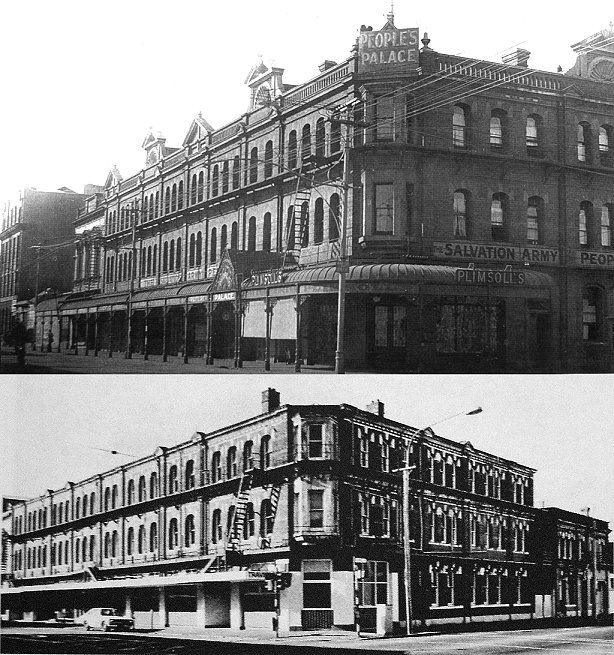
Canterbury's Largest Hotel


It's often been noted that a shrewd wife is a most useful adjunct to an aspiring commercial magnate...

Alfred Joseph White, a Currier from Devon, made good in the remote frontier town that became our Nation's first city. So good in fact that he was able to acquire most of the real estate in the block enclosed by High, Manchester, Tuam and St Asaph Streets. Sixty-one year old Alfred died in 1895, but the canny Eliza presided over the substantial growth of A J White's furniture warehouse and the family's wider commercial interests.

In the first decade of the last century Fred's widow was responsible for the construction of most of the substantial buildings within the block. At the South-east corner of Manchester and St Asaph Streets the city's largest hotel was built in 1909 for the Eliza White Trust.

Known as Cockayne's Leviathan Hotel it had 180 guest rooms and even a private dining room for Ladies. Situated on the principal thoroughfare that connected the inner city with the railway station, there was a row of small shops along the Manchester Street frontage.

The hotel was subsequently leased to the Salvation Army and became known as the People's Palace. However, that army's interests in the hospitality industry eventually focused in other directions and their Manchester street hostelry became the Railton Hotel.

Familiar to generations of Christwegians the poorly maintained Railton closed in 1970. The, by then, mismanaged Eliza White Trust offered the building for sale at $270,000, but there was no interest. The following year the City Council offered to lease the bare site and the hotel was demolished. Like the sites of too many of our city's heritage buildings, it has remained a car park ever since.

See where these photographs were taken.