Showing posts with label 1945. Show all posts

Mar 7, 2009

Renaissance


Barry King bought Christchurch's oldest bicycle shop for $200 in 1945 and continued to operate the business until 2008, when it was offered for sale by the 83 year-old as a potential redevelopment site.

Situated on the north-eastern corner of Barbadoes and Armagh Streets, the historically significant circa 1875 building has been remodeled rather than conserved. 

Close to half a dozen backpacker hostels, the shop reopened in February, 2009 as the "funky retro" Beat Street Café.  Case Ornsby and Tobin Smith's Form Architecture + Design Ltd now occupy the upper floor.

Nov 15, 2008

Our history may be somewhat closer than many of the more recent generations are aware...

As a child the Ngati Toa tribal chieftain Te Rauparaha (~1760-1849) remembered the visits of James Cook to New Zealand between 1769 and 1777. He also knew Edward Jollie (1825-1894), whose 1861 wedding was attended by this contributing Editor's Great Grandmother. Accordingly, there are no more than three degrees of separation between Captain Cook and living New Zealanders.

In the case of Canterbury there are still a few locals who knew the last survivor of the original settlers of 1850. Among them is 93 year-old Austen Deans, last surviving Great Grandson of John Deans who settled at Riccarton in 1843.


Richards Evans aged in 16 in 1864

Richard Evans (1848-1944) arrived aboard the Cressy as a two year old. The second to last survivor of the first four ships and a Patron of the Canterbury Pilgrims Association, he is remembered by Roger Ridley-Smith, who is thereby a remarkable link to the very beginnings of Christchurch.

The Reverend Frederick Brittan (1848-1945), last survivor of our first settlers, delivered a eulogy at Richard Evans' funeral.


Tea drinking 90 year-old Richards Evans seated beside a young Roger Ridley-Smith

Roger Ridley-Smith writes:
My father, E D R Smith, (1901-1975), a lawyer in Rangiora, knew Richard Evans. In 1938, the three of us went to the Bridle Track where there was a ceremony at the memorial there. It may have been the unveiling of it. Evans, who would have been aged ninety, sat in the back of my father's Chevrolet. and I recall him as a small man with a snow white beard. I was aged seven. Memory is fallible, but that is as I recall it.


Dilapidated and forgotten, this is the grave of Georgina Sophia and Richard Evans in St John's cemetery at Rangiora.


Canterbury Heritage is gratefully indebted to Sarndra Lees for the 1864 photograph of her Great Great Uncle and his grave. Also to Dr. Ridley-Smith for the 1938 photograph of his father's 90 year old friend.

We would also be very pleased to hear from anyone who can expand upon this interesting aspect of our history.

Sep 18, 2008

The Upham House, 1945

To promote the Christchurch City Libraries Retrospective: Christchurch life, architecture and design 1940s - 1970s photo competition, we're featuring a series of images from each decade. This week we look at the later 1940s.


32 Gloucester Street, 1945

(Built before 1878 the house was extensively remodeled by the architect T. G. Lucas in 1938).

The son of a civil servant, John Hazlitt Upham was born in London in 1867 and educated in England and France. After working on a Queensland sugar plantation he visited his older brother, the much-loved Winchester Street, Lyttelton doctor, Charles Hazlitt Upham (1863-1950). John stayed on in Canterbury, graduating in Law from Canterbury University College in 1902. He married Agatha Mary Coates, grand daughter of William Guise Brittan, two years later.

Upham eventually became a partner in the legal practice of Harper, Pascoe, Buchanan and Upham, which in 2008 is known as Anthony Harper and Company. He retired in 1949 and after a short illness, died on the 12th of June 1951. Seventeen years his junior John Upham's wife lived on until 1975, dying at the age of 91.

Named after his uncle, their only son Charles Hazlitt Upham was born on the 21st of September, 1908 in this extant family home on the southern side of Gloucester Street, between Montreal Street and Rolleston Avenue. Charles and his three sisters were reared in the English manner with a number of domestic servants.

Young Charles was sent to the Waihi School at Winchester before becoming a day pupil at Christ's College in 1923. Five years later he enrolled at the Lincoln Agricultural College, thereafter becoming a high country shepherd. By 1939 he was employed in the Vauation Department of the Christchurch City Council, before joining the Army at the outbreak of the Second World War. Without doubt his subsequent military career indicates that he was one of the most courageous leaders of any modern conflict.

Returning to the family home in 1945 Captain Charles Upham, V.C. and Bar wed his fiancée in June of that year. The couple had three children. The modest hero then resumed his farming career at Conway Flat, Hundalee, an isolated area of North Canterbury, where he died at the age of 86 in November 1994.

Sep 17, 2008

1940s Christchurch Floods

To promote the Christchurch City Libraries Retrospective: Christchurch life, architecture and design 1940s - 1970s photo competition to find key images of the city's post-war period, we're featuring a series of images from each decade. This week we'll reflect upon the 1940s.

The period of the Second World War and the years immediately following it were an era of a significant shortage of both local manpower and imported machinery, (there was also a shortage of photographic film - the 1940s only account for 1.4% of the images in our archive). One of the consequences of that situation was a neglect of the city's drainage sytem.

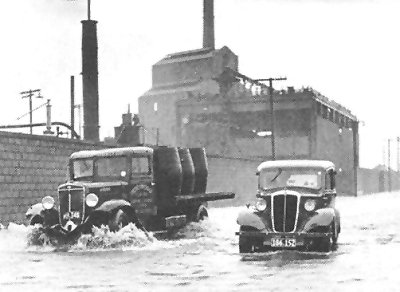
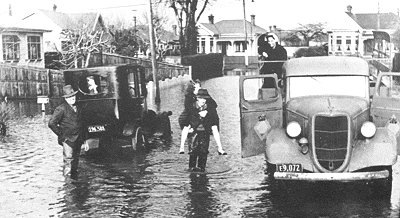
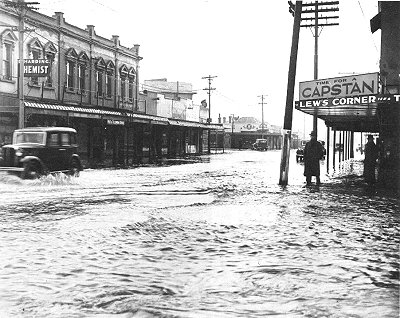
1945 was the worst year of that decade for drainage failure; between May and August there was severe flooding throughout city.


An easterly view of Carlyle Street, Sydenham
the Christchurch Gas Company's Coke furnace in the background.


Northery view towards Warrington Street, of Chancellor Street, Shirley
8 August 1945.


North-westerly view of the Beckenham shopping centre
from the  corner of Colombo and Tennyson Streets
19 May 1945

Sep 16, 2008

Christchurch 1945

To promote the Christchurch City Libraries Retrospective: Christchurch life, architecture and design 1940s - 1970s photo competition we're going to feature a series of photographs from each decade. This week we'll reflect upon the later 1940s.

1945 was a memorable year for Christchurch; the Second World War ended amid crowds processing up Colombo Street to the Square in celebration, the 1912 tower of the Sydenham Post office was demolished, there were floods in many parts of the city, the Majestic Theatre in Manchester Street burnt, the lowest air temperature of minus 7.1 degrees Centigrade was recorded and the Railway line to Picton was completed.

With the start of the 40 hour week, the city shops were closed on Saturdays until 1981, Hubert de Rie Flesher sold Avebury House along with 8 acres of grounds in Richmond to the Christchurch City Council and the Cora Wilding Youth Hostel was thereby established. Charles Upham was awarded his second Victoria Cross and his maternal Uncle, the last survivor of the 1850 first four ships emigrants, died.

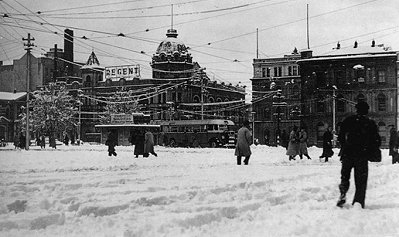
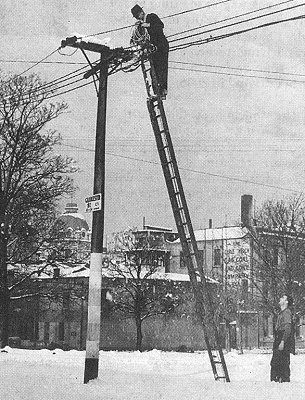
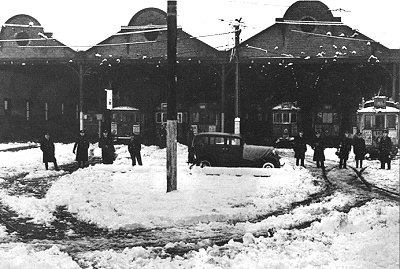
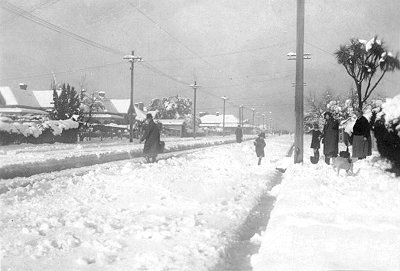
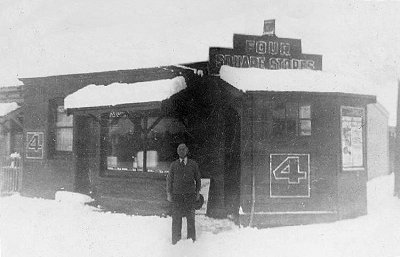
But what was probably the most photographed event occured on July the 14th when 45 Centimetres of snow fell on the city. There was extensive damage to Riccarton Bush, power and telephone lines came down and public transport ground to a halt. Here then are some photographs of that memorable event.


A south-westerly view across Cathedral Square to the Regent Theatre.


A south-easterly view from the north-west corner of Durham and Gloucester Streets.


A southerly view of the Trams sheds on Moorhouse Avenue near Falsgrave Street.


A southerly view along Barbadoes Street North towards the Edgeware Road intersection.


The Four Square shop on the corner of Station Road and Flavell Street, Heathcote.