Showing posts with label event. Show all posts

Apr 22, 2009

1887 Bicycle Race

As the restoration and geo-tagging of the ten thousandth vintage streetscape looms, the four dimensional model of Christchurch is acquiring a degree of accuracy, which now allows for the positive identification of virtually all historic images of the city.


The above photograph was taken just before seven o'clock on the morning of Monday, the 26th of September 1887 by Alfred Ernest Preece (1863-1946), who lived close to the lower Riccarton Road location. It comes from the collection of the Canterbury Museum (ref 10959).

The extant Standish and Preece photographic studio was situated at 218 High Street in that era. A regular photographer of cycling events, Preece was probably also the proprietor of the A. E. Preece Cyclists' Exchange in the second A1 Hotel building on the corner of Cashel and Colombo Streets.

The photograph shows the nine contestants at the start of the Pioneer Bicycle Club's fifty mile (80 Km) bicycle race from Christchurch to Leeston and back. The race was won by Richard Bargrove of Waverley Street, New Brighton, who started from scratch and completed the race in 3 hours and 35 minutes. Beating the record by 8 minutes, Bargrove finished 20 minutes before the field.

Seen to the Right at the beginning of Riccarton Road in this easterly view is the Riccarton Hotel. The once famed hostelry stood on the southern corner of Riccarton Road and Deans Avenue at the Riccarton roundabout until 2006.

Dating from 1851, when it was known as The Traveller's Rest, subsequently as the Plough Inn when reconstructed in 1865 and then as the Riccarton Hotel, followed by Nancy’s Hotel until its last ignominous incarnation as the Fat Lady's Arms.

An early favourite with the horse racing fraternity, the hotel's eastern facade (below) faced Hagley Park opposite the finish line of the Canterbury Jockey Club's original racecourse.

TE PAPA IMAGE OPENS IN A NEW TAB OR WINDOW
Restored detail from the National Museum of New Zealand's circa 1905 photograph

Jan 30, 2009

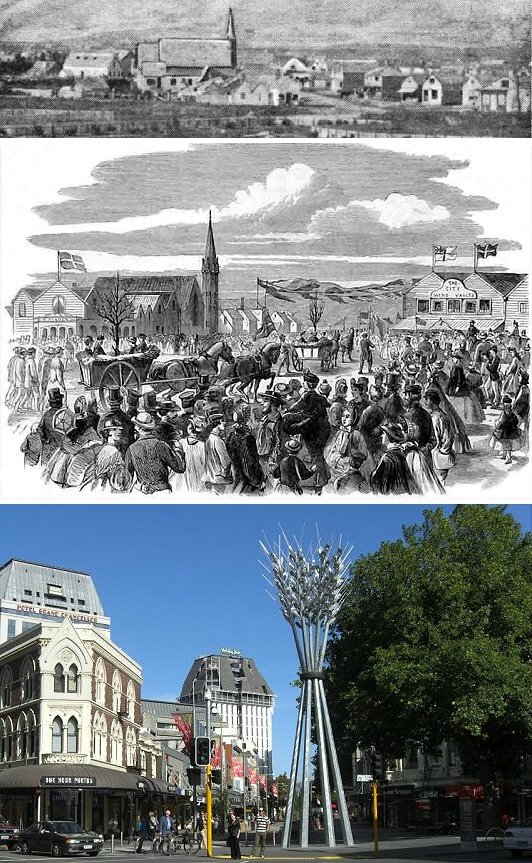
High Street 1860-2009


LARGE IMAGE OPENS IN A NEW WINDOW

Three views of High Street, between Hereford and Cashel Streets in 1860, 1863 and 2009.

The middle image is an engraving that appeared in the London Illustrated News and depicts the 9th of July, 1863, a red letter day for Christchurch, the occasion being in honour of the marriage of the Prince of Wales (later King Edward VII) to Alexandra, a princess of Denmark.

The town was en fete and a procession from Papanui Road at Bealey Avenue, passing through the cty streets to Ferry Road at Fitzgerald Avenue, was one of the main features of the event. But the engraving fails to show that the streets were inches deep in mud, owing to the torrential rain of the previous day. School children waded through mud along the whole of the route.

All trades were represented emblematically in the procession, and the Foresters and Oddfellows added a picturesque touch to the display. Commemorative trees were planted by the Misses Begley, Fitzgerald, Alport, Ollivier and Luck, and this ceremony was followed by a children's treat in William Barnard's Horse Repository in Cashel Street, where toys and refreshments were provided.

The Reverend James West Stack, of Kaiapoi, arranged for a cavalcade of Maori warriors from the Tuahiwi Pa to be included in the festivities, and they camped in Hagley Park. These Maori were specially entertained at the first Theatre Royal in Gloucester Street, Bishop Harper presiding and Canon Stack and Messrs John Ollivier, John Hall, Charles Obins Torlesse and William "Cabbage" Wilson acted as stewards. An address by Maka Makomako, the Ngai Tahu tribal chieftan, to Queen Victoria concluded in characteristic vein thus: "May God preserve you, O mother of the white and dark skinned races. May He keep you in joy and peace, and may your days equal those of the immortal Rehua, and may you see the happiness of your children's children and of the nations Jehovah has committed to your care."

The steeple in the earlier views, which was a Christchurch landmark visible from great distance, was that of the second Wesleyan Methodist church built on the High Street site in 1859. Superseded by the extant 1865 stone church in Durham Street, the old building lingered on into the mid 1880s as a Draper's shop.

Sep 16, 2008

Christchurch 1945

To promote the Christchurch City Libraries Retrospective: Christchurch life, architecture and design 1940s - 1970s photo competition we're going to feature a series of photographs from each decade. This week we'll reflect upon the later 1940s.

1945 was a memorable year for Christchurch; the Second World War ended amid crowds processing up Colombo Street to the Square in celebration, the 1912 tower of the Sydenham Post office was demolished, there were floods in many parts of the city, the Majestic Theatre in Manchester Street burnt, the lowest air temperature of minus 7.1 degrees Centigrade was recorded and the Railway line to Picton was completed.

With the start of the 40 hour week, the city shops were closed on Saturdays until 1981, Hubert de Rie Flesher sold Avebury House along with 8 acres of grounds in Richmond to the Christchurch City Council and the Cora Wilding Youth Hostel was thereby established. Charles Upham was awarded his second Victoria Cross and his maternal Uncle, the last survivor of the 1850 first four ships emigrants, died.

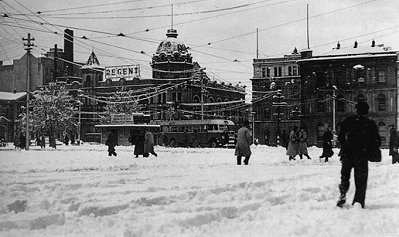
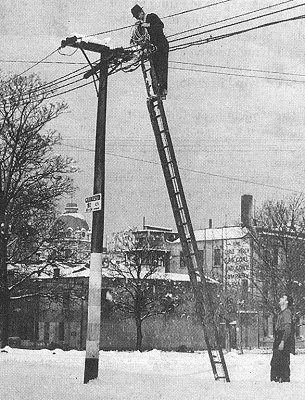
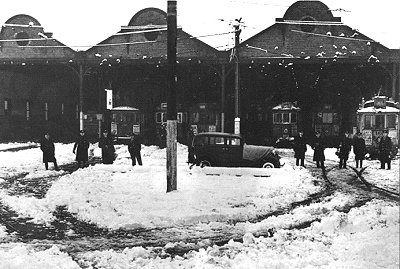
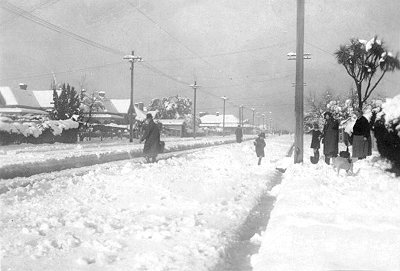
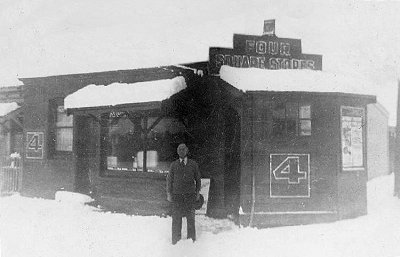
But what was probably the most photographed event occured on July the 14th when 45 Centimetres of snow fell on the city. There was extensive damage to Riccarton Bush, power and telephone lines came down and public transport ground to a halt. Here then are some photographs of that memorable event.


A south-westerly view across Cathedral Square to the Regent Theatre.


A south-easterly view from the north-west corner of Durham and Gloucester Streets.


A southerly view of the Trams sheds on Moorhouse Avenue near Falsgrave Street.


A southerly view along Barbadoes Street North towards the Edgeware Road intersection.


The Four Square shop on the corner of Station Road and Flavell Street, Heathcote.

Apr 11, 2008

The Royal Research Ship Discovery


Robert Falcon Scott's RSS Discovery photographed in the Lyttelton Graving Dock in December 1901. Arriving at the port on the 29th November, she was initially berthed at Gladstone Pier, later moving to the No. 2 (Ferry) Wharf.

With bands playing and crowds lining the wharves she departed for Antarctica on the 21st of December. Charles Bonner, a high spirited young seaman climbed the main mast above the crow's nest where he sat on the masthead waving to the crowds. Attempting to stand, he slipped and fell to his death. Bonner was buried when Discovery called at Port Chalmers.

107 years later the last wooden three-masted ship to be built in the British Isles is now on display at Dundee, Scotland, where she was built.


First in a series about surviving ships of signficance to Canterbury history.

Mar 7, 2008

Christchurch 1947

Large image opens in a new window

The South-west corner of Colombo at Cashel Street, February 1947. Ballantyne's department store just before the disastrous fire and the gutted shell being demolished.
Recent additions to the photographic archive

Feb 17, 2008

If You Go Down To The Woods Today...

On the 15th of February 1994 the city of Christchurch achieved a unique distinction within the wider historical record.

16,837 Teddy Bears (along with their friends) attended the World's largest Teddy Bears Picnic in North Hagley Park.