Showing posts with label 1935. Show all posts

May 21, 2009

Christchurch's A.1. Hotel 1857-1935


Founded in January 1851, the Lyttelton Times newspaper also published an evening edition known as The Star from 1868. More widely read in Sydenham than Fendalton in its heyday, the evening edition lingers on as a twice weekly giveaway, supported by no more than advertising and Christchurch City Council advertorials.

Sad to say that its reduced circumstances would seem to no longer allow for the expense of journalstic expertise, as further indicated by the above photograph, published under the heading The Way We Were on the 20th of May 2009, and erroneously captioned "The intersection of Cashel St and Colombo St in 1860, with Blake's Hotel and the A.I Hotel around the corner."

For the sake of the historical record we proffer the following alternative caption:

The A.1. Hotel was founded in 1857 on the Southeast corner of Cashel and Colombo Streets, a site now occupied by The Crossing bus terminus in the renovated former Beath's department store building of 1935. The original gabled hotel (below) was replaced in 1874 by the second A1 Hotel, a three storey building, which burnt down four years later.

In 1879 it was rebuilt as the two storey structure depicted in the above photograph. James Blake is known to have been the Publican of the A.1. Hotel by 1865, but there's no known reference to a Blake's Hotel in any local archive.


The Colombo Street facade of James Blake's first A.1. Hotel to the Left, with the Mechanic's Hotel to the Right and the Watchmaker's shop of Thomas Charles Barnard adjoining the A.1. Hotel.

By 1915 the ground floor of the third A.1. Hotel had been converted into shops


Beath's 1935 department store extension was originally designed to have six floors, but The Great Depression of the 1930s got in the way.


Beath's department store reincarnated as The Crossing bus terminus in 2003.

May 1, 2009

1935 Cycling Hazards

Entitled “Every Christchurch person who buys a car goes white-haired within a week,” this cartoon appeared in the June 1935 issue of The New Zealand Railways Magazine. Although cycling is less popular 74 years on, the subject is still quite topical.


Victoria Square 1949

Apr 17, 2008

Lost Christchurch


The Christian Science church was built in stages between 1929 and 1935 on the North side of Worcester Boulevard between Montreal Street and Cambridge Terrace. It was a period of a marked Georgian revival in Christchurch architecture.

With its pillared and pedimented portico, it was the only church building in Christchurch reminiscent of American Georgian style. The elegant church was substantially built of plastered brick and concrete to a design by Heathcote Helmore, better known for his houses.


In the early 1980s the church became too costly to maintain for its diminished congregation, which took new premises elsewhere and sold the building to a Chinese restaurateur. In a bid to give the building a clear identity as a Chinese restaurant the new owner had an entirely new facade built in 1984. Despite efforts to persuade him that the building could be given the identity he wanted, the original facade was destroyed.

Situated next to the Christchurch Art Gallery, the Chung Wah restaurant closed in early 2006. Initially offered for lease and then for sale by Hope Island Holdings Ltd, the building was acquired in April 2007 by Gordon Chamberlain; the man behind the Ibis Hotel in Hereford Street and Novotel development of Warners Hotel in Cathedral Square.


Photo by Greg O'Beirne of Christchurch

The former church was demolished in August, 2007 and plans were announced for a $23 million, 14 storey, four to five star apartment-style hotel, with the upper levels either as residences or to lease back to the hotel as visitor accommodation.


Gordon Chamberlain was subsequently reported as negotiating with Quest Hotels Inc. of Florida to lease and run the lower levels of the new building. Quest already has the 75 apartment hotel in the Cathedral Junction building.

In the meantime the former church site in the city's cultural preceinct continues to remain vacant...

Christchurch's State Cinema


The third building on the North-east corner of Colombo and Gloucester Streets is an unfortunate example of recycling defacing rather than preserving a building's character.

When the State Cinema opened in 1935 the city gained a fine example of Art Deco decoration. It was the work of a local architect, Francis Willis, who was the readiest in the Christchurch of the late 1920s and 1930s to experiment with decorative building design.

His experiments were not always entirely successful, but in the case of the State Cinema he attractively embellished a simple box of a building with curves, chevrons and lettering, all in slight relief. The effect was stylised, but the cinema was one of the best examples in Christchurch of decorative work of the 1930s.

When the cinema's lease expired in 1977, the building was converted to accommodate the growth of a duty free shop which had long occupied the ground floor. The exterior of the building was sheathed in white fibre glass panels intended to create a modern look compatible with the new Rural Bank building on the opposite corner. The result has reduced what had been a notable building to a boring white box.

Mar 10, 2008

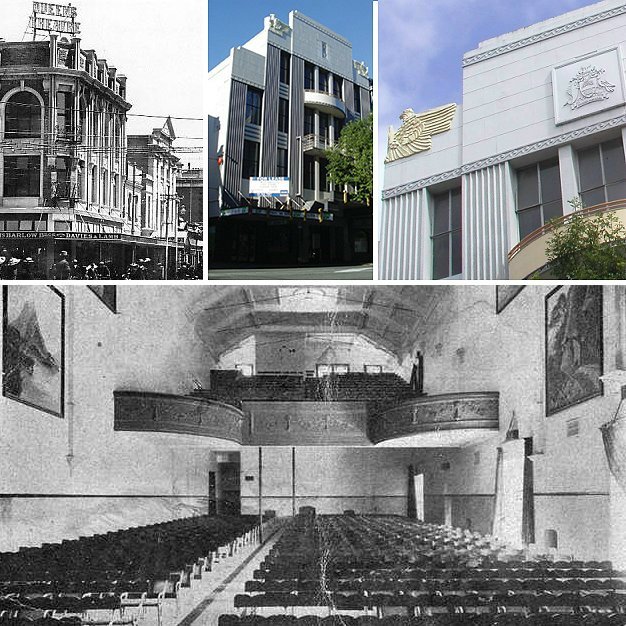
The Queen's Theatre

Large image opens in a new window

Opened on the 31st of October 1912 by the Mayor of Christchurch, the city's first purpose built cinema occupies the Hereford Street site of the 1853 home of William Sefton Moorhouse.

Owned by the Melburnian theatrical impresario James F MacMahon, a competition to a name the cinema was held by The Press newspaper, with a first prize of five Guineas. Seating 934 patrons, films were shown continuously from 11 am to 11 pm.

McMahon had exhibited the first projected motion picture shown to a paying Christchurch audience in November 1896. His Salon Cinématographe in High Street near the Cashel Street intersection almost certainly screened the 1896 Melbourne Cup race on that occasion.

In 1929 the twenty-five year-old Royal Exchange building in Cathedral Square was refurbished as the Regent Theatre, thereby obliging McKenzie & Willis Ltd to find new premises. The furniture retailers acquired the Queen's Theatre, which closed on the 5th of January 1929.

In 1935 the former cinema underwent significant redevelopment. Although the original ceiling and the stairway to the Dress Circle were left intact, a fourth floor was added and the Neo-classic Hereford Street frontage (to the Right in the top Left image) was replaced with the surviving Art Deco facade.

The long, narrow building was subsequently refurbished and linked to the Colombo Street Kincaid building in the 1950s as the McKenzie & Willis Arcade. More recently acquired by the Auckland Savings Bank, the ground floor is partially occupied by a 24/7 convenience store.

In 2003 the Theatre and Film Department of the University of Canterbury took the vacant upper floors as teaching, rehearsal and performance space. Residential facilities for post-graduate students are also provided.


See the Queen's Theatre location