Showing posts with label 1929. Show all posts

May 23, 2009

1929 Electric Railcar Service to Lyttelton


A 1929 English Electric Company's locomotive arriving at Lyttelton.

The service was inaugurated at 3 pm on Thursday, the 14th of February, 1929. Early Canterbury settlers and guests of the New Zealand Government Railways Department were issued with free passes on that day.

Twenty return services were provided each day, with the journey taking about seventeen minutes. Commenced in 1867, passenger services between Christchurch and Lyttelton ended in 1976.


Addendum (further to a reader's comment)

The southeast corner of Manchester & Tuam Streets


By 1872 the corner was occupied by the Timber & Coal merchant Robert England (1839-1919), father of the England brothers of architectural fame. By 1900 (above) the business was owned by Wood and Laurie


First established at Lyttelton in 1851, the premises of J. M. Heywood & Company Ltd were built on the corner between 1908 and 1910 (centre, middle distance). The Customs, Insurance, and General Commission Agent's building was demolished about 1986.


Situated immediately to the East of the Heywood building, at 224-226 Tuam Street, was the premises of the general merchants E. W. Pidgeon & Company. Its last incarnation was as Federal Motors, service and parts agents for Renault, Peugot and Daihatsu cars. The building was demolished about 1997.


1950 aerial photograph of the Heywood and Pidgeon buildings.


1984 aerial photograph of the Heywood and Pidgeon buildings.

May 2, 2009

Podcast: Migrant Passenger Lists


With specific reference to New Zealand and the lack of lists of migrants arriving via Australia, this 53 minute talk from the UK's National Archives, will be of particular interest to family historians.

In Every journey has two ends: using passenger lists, Chris Watts reveals the benefits of using both arrival and departure records when searching for details of our migrant ancestors, as well as demonstrating how the shortcomings of content, indexing and accessibility can be minimised.

Photo: attended by the extant 1907 tug Lyttelton, RMS Rangitiki (1928-1962) docks at Lyttelton's Gladstone pier after a five week maiden voyage from London via Curacao and the Panama Canal.

Apr 17, 2008

Lost Christchurch


The Christian Science church was built in stages between 1929 and 1935 on the North side of Worcester Boulevard between Montreal Street and Cambridge Terrace. It was a period of a marked Georgian revival in Christchurch architecture.

With its pillared and pedimented portico, it was the only church building in Christchurch reminiscent of American Georgian style. The elegant church was substantially built of plastered brick and concrete to a design by Heathcote Helmore, better known for his houses.


In the early 1980s the church became too costly to maintain for its diminished congregation, which took new premises elsewhere and sold the building to a Chinese restaurateur. In a bid to give the building a clear identity as a Chinese restaurant the new owner had an entirely new facade built in 1984. Despite efforts to persuade him that the building could be given the identity he wanted, the original facade was destroyed.

Situated next to the Christchurch Art Gallery, the Chung Wah restaurant closed in early 2006. Initially offered for lease and then for sale by Hope Island Holdings Ltd, the building was acquired in April 2007 by Gordon Chamberlain; the man behind the Ibis Hotel in Hereford Street and Novotel development of Warners Hotel in Cathedral Square.


Photo by Greg O'Beirne of Christchurch

The former church was demolished in August, 2007 and plans were announced for a $23 million, 14 storey, four to five star apartment-style hotel, with the upper levels either as residences or to lease back to the hotel as visitor accommodation.


Gordon Chamberlain was subsequently reported as negotiating with Quest Hotels Inc. of Florida to lease and run the lower levels of the new building. Quest already has the 75 apartment hotel in the Cathedral Junction building.

In the meantime the former church site in the city's cultural preceinct continues to remain vacant...

Apr 4, 2008

Historic Building Demolished


Without the benefit of community consultation Lincoln University's historic McCaskill building has been demolished.

The structure has been unoccupied and fenced off as an "earthquake risk" for a decade.

Built in 1929 as the Laboratory Block of the 1880 College of Agriculture it was renamed in the 1960s to honour Professor Lancelot McCaskill (1900–85), one of the country’s most influential conservationists.


Mar 10, 2008

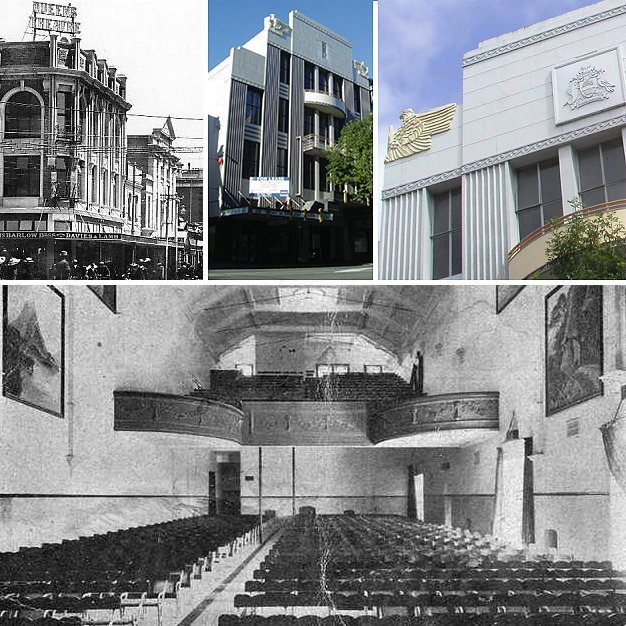
The Queen's Theatre

Large image opens in a new window

Opened on the 31st of October 1912 by the Mayor of Christchurch, the city's first purpose built cinema occupies the Hereford Street site of the 1853 home of William Sefton Moorhouse.

Owned by the Melburnian theatrical impresario James F MacMahon, a competition to a name the cinema was held by The Press newspaper, with a first prize of five Guineas. Seating 934 patrons, films were shown continuously from 11 am to 11 pm.

McMahon had exhibited the first projected motion picture shown to a paying Christchurch audience in November 1896. His Salon Cinématographe in High Street near the Cashel Street intersection almost certainly screened the 1896 Melbourne Cup race on that occasion.

In 1929 the twenty-five year-old Royal Exchange building in Cathedral Square was refurbished as the Regent Theatre, thereby obliging McKenzie & Willis Ltd to find new premises. The furniture retailers acquired the Queen's Theatre, which closed on the 5th of January 1929.

In 1935 the former cinema underwent significant redevelopment. Although the original ceiling and the stairway to the Dress Circle were left intact, a fourth floor was added and the Neo-classic Hereford Street frontage (to the Right in the top Left image) was replaced with the surviving Art Deco facade.

The long, narrow building was subsequently refurbished and linked to the Colombo Street Kincaid building in the 1950s as the McKenzie & Willis Arcade. More recently acquired by the Auckland Savings Bank, the ground floor is partially occupied by a 24/7 convenience store.

In 2003 the Theatre and Film Department of the University of Canterbury took the vacant upper floors as teaching, rehearsal and performance space. Residential facilities for post-graduate students are also provided.


See the Queen's Theatre location

Feb 22, 2008

Hay’s - a Christchurch Icon

Jim Hay (1888-1971) opened his Gloucester Street department store on Friday the 13th of December, 1929. In 1938 the shop expanded on to Colombo Street and four years later, with the purchase of the 1910 Hayward building, Hay acquired an Armagh Street frontage. His upper floor office in the top (1957) image overlooked Victoria Square.

Hay's subsequently became Haywrights in 1968 and then Farmers in 1987. The old building was demolished in 1997, but the new Farmers department store is but a fraction of the size of its famous predecessor. More on the Christchurch Libraries' Heritage web site.