Showing posts with label 1910s. Show all posts

May 9, 2009

Hack Circle or Pioneer Plaza?


LARGE IMAGE OPENS IN A NEW TAB OR WINDOW

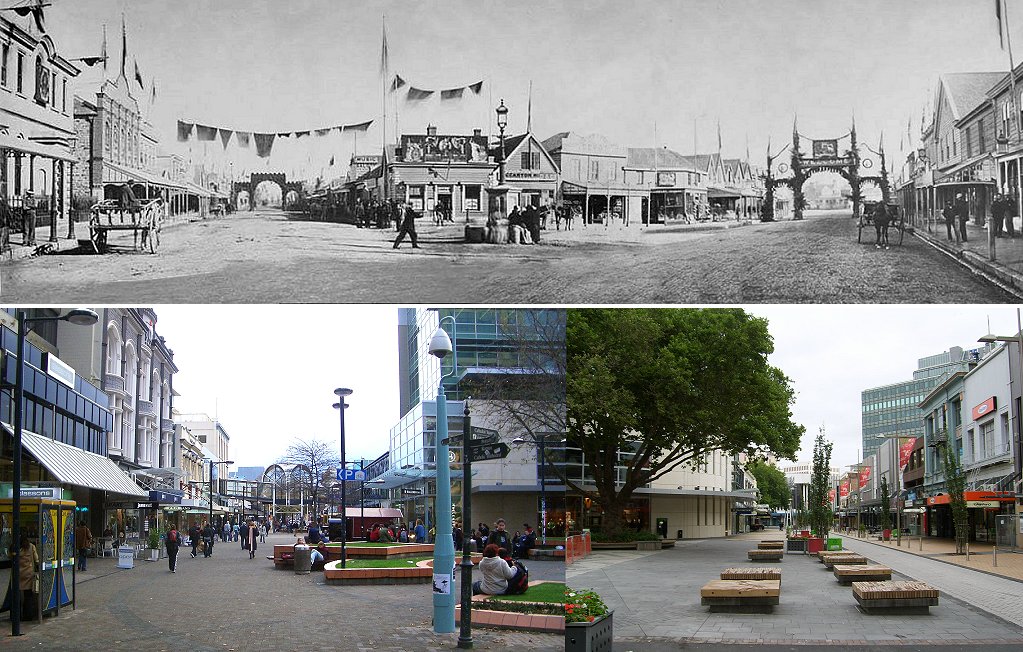
Nicknamed the Hack Circle from the 1990s, the former site of the 1989 amphitheatre at the intersection of High and Cashel Streets is to be renamed as part of an upgrade that will include an extension to the vintage tram route. A Christchurch City Council spokesman is reported as saying that public submissions on a new name for the area could be the basis for a popular vote.

Accordingly we suggest the name Pioneer Plaza for what is undoubtedly one of the most significant historic locations in the city. Above is a panoramic view of the junction on the morning of Thursday, the 22nd of April 1869 and below is a similar aspect in 2008.


Known simply as "The Triangle" for a century, the triangular junction was matched to the south-east by the "Clocktower" junction at High and Manchester Streets and "The Bottleneck" junction at the intersection of High, Hereford and Colombo Streets to the northwest.

"The Triangle" intersection was the origin of the city's commercial precinct. Here was the 1851 passenger terminus for coaches to the ferry at Heathcote, first hotel (The White Hart), first Restaurant (Birdsey's), first Chemist shop (Wallace & Co), first fire station and the Customs House.


Above: Cobb & Company's circa 1854 booking office on the site now occupied by the Hallenstein's building. From here coaches departed for Papanui, Riccarton and the outlying settlements at Kaiapoi, Rangiora and Oxford. By the mid 1860s Cobb's coaches were carrying passengers from here to Timaru and the goldfields of the West Coast.


From here could be hired horse-drawn passenger cabs and Carrier's carts. Hansom cabs were a familiar sight on the rank until 1944 (above), which continued as a taxi rank into the 1960s.


Above: because of its historical significance as the place where they first arrived in Christchurch, the surviving pioneers from the first emigrant ships of 1850 gathered here to be photographed in 1900.


In 1910 the original gas lamp standard was replaced by a triangular flower bed, with a fountain at the centre. This feature survived until the early 1980s, but was removed for the 1983 first stage of the City Mall.

Accordingly, we consider that in naming the revamped intersection Pioneer Plaza, this generation will be honouring the memory of those pioneers who founded our city.


The 1989 Hack Circle amphitheatre

May 8, 2009

The Limes Private Hospital 1880-1963


1883 NORTHERLY VIEW ACROSS VICTORIA SQUARE

A recent response from a regular reader concerned the last address of her GGG grandad John Kennedy, a 70 year old News Vendor who was living at 84 Kilmore Street, when he died in 1918. The reader understood that this was probably a house almost opposite the 1972 Town Hall. However the photographic record indicates that the presumed location continued to be occupied by early commercial premises until 1958 and further research indicated that number 84 was actually on the southern side of Kilmore Street on the site now occupied by the Town Hall's auditorium.

With a southern boundary on Cambridge Terrace, John Plank had built a two storey wooden boarding house facing Victoria Square on the quarter acre section by 1862. But in 1880 it was demolished and across the site and its adjoining section (originally occupied by the Blacksmith William Gosling), the newly arrived Dr James Irving built a substantial brick hospital, which was soon extended with a new wing to the east. The Limes Private Hospital derived its name from the trees which occupied the Cambridge Terrace river bank and although informally referred to as being in Victoria Square, the official address of The Limes Hospital Ltd was 84 Kilmore Street.

At the time of John Kennedy's demise the hospital was also providing care for invalid and convalescent soldiers from the Great War of 1914-1919.


The Scottish James Irving had arrived at Lyttelton as the ship's doctor aboard the Shaw Savill Line's sailing vessel Crusader in 1879, with eight children (subsequently enlarged to six sons and five daughters) and a Nanny. Prominent in the Social Purity Society, Beautifying Association, Chrysanthemum Society and New Zealand Medical Association, Irving was the Surgeon-Major of the Canterbury Mounted Rifles and also donated the Cathedral's High Altar in gratitude for his family's safe voyage from England. Aged sixty-four, Irving died suddenly at his hospital in the evening of the 26th of October 1900 and was buried in the Barbadoes Street Cemetery. Appended below is an excerpt from Dr Irving's letter book, which gives an interesting perspective of Christchurch in 1879.

James Irving's son William followed his father into the medical profession and was subsequently Honorary Secretary of the New Zealand branch of the British Medical Association, Medical Superintendent of the St Helens Hospital in Durham Street South and then with the St George's Hospital in Papanui. However, having been qualified for less than three years at the time of his father's demise, the superintendency of The Limes passed to the Edinburgh trained Dr Alexander Paterson who had come to Christchurch in 1897.

James Irving's daughter, Dr Hannah Margaret Irving (1881-1972) was the last burial in the Anglican section of the Barbadoes Street Cemetery.

Many local residents either began or ended their mortal span at The Limes, not the least being the twin brothers Dr David and Sir Hamish Hay, born in 1927.

In 1963 the Christchurch City Council purchased the old hospital and it was demolished in favour of a car park by 1965. In 1969 construction of the new Town Hall began, which includes the commemorative Limes Room conference facility.


An excerpt from Dr James Irving's letter book for Wednesday, the 24th of September 1879 (with the editor's comments in parenthesis).

We are being quietly tugged up the harbour of Port Lyttelton - a beautiful one - with precipitous hills on either side, green down to the water's edge, the scenery not unlike some parts of Wales and Scotland. The pilot came out to us in the night about two o'clock, the steam tug (ss Mullogh) soon followed, and we shall soon be alongside the wharf.

Evening: The medical officer of health came on board about ten - found us all healthy - congratulated me as medical officer in charge, and we went alongside the wharf at once. Off immediately to the train to go up to Christchurch, some seven miles, and whose face is the first seen but my brother, who came here some three weeks since; a very agreeable surprise for all, as we did not know that he was here.

We took a buggy and drove round and about Christchurch. It is a perfectly flat, square city, containing about 20,000 souls; within the town is a mile square, all the streets run at right angles and quite straight, except one which runs corner-wise. The Cathedral - so much of it as is built - is in the centre of the mile square, and all the streets are named after a Bishopric. Our hotel is in Hereford Street (the Occidental), with Latimer Square just in front, Cranmer Square being on the other side of the town.

The houses are mostly of wood and are very picturesque; the town has been divided into quarter-acre sections, hence most of the houses stand back from the street, in their section, with a verandah and flower garden in front. Many houses are only one storey, but there is a degree of neatness and comfort about them, which is quite refreshing after the dull brick of most of our English towns.

Appearances are studied here, but convenience and utility not sacrificed. In England appearance is seldom thought of; at least in and around Newark, though there are some exceptions. One part of the town is within what is called the "fire block" (probably Colombo from Hereford to Cashel Streets), there the houses are of brick or stone, and closer together; wooden erections are now prohibited. All the streets are wide. An open drain made of cement on each side of the road, next the footpath, with a continual stream from the artesian wells. The footpaths are broad, and one half of them is asphalted. The kerbing is of wood, 2½ by 9 or 11 (inches).

Many of the houses and shops have verandahs extending right over the footpath, some covered with corrugated iron, some with glass painted so as to subdue the light and diminish the heat. All paths are asphalted - no slabbing. As any further description of the country cannot be very interesting to strangers, I shall close here, and write what I have to say of the country and its prospects in a future letter.

The men wanted here are small working farmers with five or six hundred pounds. They do their own labour, have none to pay for, and consequently reap all the benefits of the products of rich land.

Apr 17, 2009

Early Christchurch Electric Vehicles

The diasporical and widely appreciated The New Zealand Journal has recently featured a short post entitled Christchurch City Council Belt-Tightening?, in which it's wondered if there might be any advantage to the Council ordering up from storage its electric truck fleet from the early 1920s, which could have the advantage of enabling the Council to meet its greenhouse gas emissions reductions. The post includes this Alexander Turnbull Library image by The Press newspaper photographer Samuel Heath Head.


LARGE IMAGE OPENS IN A TAB OR NEW WINDOW

By 1915 the Council's Municipal Electricity Department in Armagh Street was charging car batteries overnight, when cheaper off-peak rates were offered between 10 pm and 7 am. The two 100 Kilowatt generators were driven by a pair of steam engines powered by the Council's refuse destructor. In 1921, at the peak of their popularity, the M.E.D. was charging the batteries of 51 vehicles, of which 40 were privately owned, with the other 11 belonging to the Council. The City Council's Municipal Electricity Department even offered hire-purchase agreements to assist companies and individuals to purchase electric vehicles.


LARGE IMAGE OPENS IN A TAB OR NEW WINDOW

In this elevated westerly view of Bealey Avenue near the Carlton Mill Bridge can be seen the city's entire fleet of electric vehicles. The photograph can be dated to 1926 by the construction of the extent Fleming House at the corner of Park Terrace (Left).


Above: photographed on Park Terrace is the circa 1922 American Walker electric lorry of Wardell Brothers, the Cashel Street Grocers. To the Left is the extant 1915 Summers house. Below: also at the same location is the electric lorry of Sharpe Brothers, aerated water and cordial manufacturers. Both of these photographs were also taken by Samuel Heath Head.


Photo credits:

1926 electric vehicle fleet; Municipal Electricity Department archive, Orion New Zealand Ltd

Sharpe Brothers lorry; Alexander Turnbull Library, reference number: 1/1-011062-G

Wardell Brothers lorry; Alexander Turnbull Library, reference number: 1/1-007411-G

Apr 11, 2009

The Christchurch Bicycle Band

We've recently provided further identification information concerning a pair of photographs of the Christchurch Bicycle Band for the U.S. based The New Zealand Journal. A copy of the first is included in the online collection of the Christchurch Libraries and of the second in the online collection of the Alexander Turnbull Library.


LARGE IMAGE OPENS IN A TAB OR NEW WINDOW

Dating from 1898, this north-easterly view was taken on the parade ground of the Canterbury Militia's Drill Hall, which was situated on the north side of Cashel Street West, between Cambridge Terrace and Montreal Streets. The early 1860s Hall, which could accomodate 2,500, was frequently used as a public venue, as was its 1905 replacement, the King Edward Barracks (demolished in 1996).

The building to the far Left, with the roof skylight, is the city morgue, behind the Hereford Street Police Station of 1873 (both demolished in 1974).


LARGE IMAGE OPENS IN A TAB OR NEW WINDOW

This is an elevated westerly view of Kilmore Street from the Victoria Street intersection, looking past Cranmer Square toward Hagley Park. It was taken through the upper floor window of John Mummery's Britannia Hotel, which would later become the photographic studio of the extant centenarian photographer Gladys Goodall.

Certainly taken before 1906, it can be dated with reasonabe probability to the early afternoon of Monday, the 25th of May, 1903. Queen Victoria's birthday fell upon a Sunday that year, but the event, which was celebrated as a public holiday named Empire Day, was held on the following day. The procession is proceeding to the celebrations in the newly renamed Victoria Square, where a Bronze statue of the Queen was unveiled.

Only the circa 1870 two storey building in the distance still exists; formerly a convenience store and then a school tuck shop, it stands at the corner of Cranmer Square opposite the former Normal School.


The Christchurch Bicycle Band

Equipped with bicycles from the Adam brother's Manchester Street Star Cycle Company, the band was formed in 1895 by the brothers Joshua and Frederick Painter.

On an outdoor occasion an unwary cyclist crossed their path. The band took evasive action, the lady fell off her bike, but the music continued uninterrupted. Apart from street parades, they also performed on the stage of the extant Opera House in Tuam Street until the Band's demise in 1915.

Received history indicates that the band claimed to be the only one of its type in the world. However, bicycle bands are recorded as having been popular since 1881 and continue to be so.

Apr 7, 2009

Petrus van der Velden 1837-1913


Arriving from the Netherlands in 1890, and apart from five years at Sydney, the artist Petrus van der Velden lived in Christchurch until 1913.


Petrus and Sophia van der Velden in front of one of the two studios in the garden their house at the corner of Conference and Durham Streets, Christchurch, about 1893.


Left: the van der Velden house in 2009. Now much altered and converted into five flats, it would originally been of similar appear to its immediate neighbour (Right).

In spite of his 30 years of European experience as a professional artist his services were declined by the Canterbury College of Art. Accordingly, van der Velden received pupils for terms of thirteen lessons in two and a half hour sessions. He tutored some of Canterbury's most renowned artists, including Sydney Thompson and Raymond McIntyre.


LARGE IMAGE OPENS IN A TAB OR NEW WINDOW

During a visit to Auckland van der Velden contracted Bronchitis and died of heart failure on the 11th of November 1913. He was buried in an unmarked grave at Waikaraka cemetery three days later. The subsequent plaque (below) is of a somewhat later vintage.


LARGE IMAGE OPENS IN A TAB OR NEW WINDOW

In November 1963, to mark the fiftieth anniversary of van der Velden's death, one hundred of his paintings were exhibited at the Robert McDougall Art Gallery.

Championed by Vincent van Gogh, his paintings are exhibited in Amsterdam's Rijksmuseum, but it could be considered a sad reflection upon Christchurch culture that, although we would seem to have a predilection for erecting monuments to, and naming bridges and parks, etc. after politicians and commercial magnates, eminent artists so widely regarded as van der Velden go uncommemorated.


LARGE IMAGE OPENS IN A TAB OR NEW WINDOW

A photographic portrait of Petrus van der Velden taken on the 9th of July, 1896 by Francis Lawrence Jones of Dunedin (courtesy of Early Canterbury Photographers).


Further Reading
Rodney Wilson; Petrus van der Velden 1837-1913 Dictionary of New Zealand Biography.

Rodney Wilson; Petrus van der Velden: The Marken and Otira Series Art New Zealand.
Photo Credits
van der Velden grave: Sarndra Lee of Auckland - sarndra.com

Portrait: Alexander Turnbull Library; S. P. Andrew Collection (PAColl-3739),
Picture reference: 1/1-014987; G.

Studio: Robert McDougall Art Gallery;
A concise History of Art in Canterbury 1850-2000, Christchurch, 2000.

Apr 4, 2009

Christchurch's First Palace


Situated on the quarter acre Town Section 404, the first house on the western side of the Avon River was built in 1851 by Henry John Cridland (1821-1867), Superintendent of Public Works for the Canterbury Association from 1849. A New Zealand Company surveyor from 1843, Cridland was also an artist, architect, and like many of his lower middle class contemporaries, a political schemer and property speculator.


By 1856 a large extension had been added to the rear of the house. In December of that year the Cridland family moved to their farm at Hoon Hay and the house became the episcopal palace of Henry John Chitty Harper (1804-1893), first Bishop of Christchurch. Harper and his large family, who fetched water from the river, occupied the house until the completion in late 1858 of the much grander Bishopscourt on nearby Park Terrace.


Situated on Cambridge Terrace, equidistant between Worcester and Hereford Streets, the house was the only occupant of the block's river frontage until 1863 when the first Public Library building was completed at the Hereford Street corner and then the Canterbury Club to the Worcester Street corner 1874.


In later years the old house appears to have been occupied by staff of the Canterbury Club. Demolished between 1918 and 1920, the site became part of the Club's garden, which was replaced with a sealed car park by 1965. As such it remains.


Harper's residential predilection for the western side of the Avon River, rather than the extensive Anglican church lands in the vicinity of Cranmer Square, was probably instrumental in the development of the area as the salubrious suburb of West End, much favoured by the professional classes.

The subsequent development of the Canterbury University College on what had previously been a residential block attracted academics to the suburb from the mid 1870s. By the 1930s many of the grand homes had become private hotels and rooming houses for the College's students.

A thriving bohemian culture developed among the artists, writers, poets and musicians who occupied the quarter through the following decades. Toward the latter part of the twentieth century the bishops, accountants and lawyers moved on to suburban Cashmere, the University left the area and much of the built heritage was replaced high rise concrete.

The city's first suburb, which was subsequently associated with many of the most illustrious names in the New Zealand arts community of the twentieth century, lost its name, social cohesion and much of the former aesthetic.

Photo Credits: the Canterbury Museum, the Christchurch Public Library, the Christchurch Art Gallery and the Alexander Turnbull Library.

Mar 28, 2009

A Most Unlucky Ship


Of all the ships to have served Lyttelton Harbour the luckiest would have to be the extant steam tug Lyttelton of 1907, but at the other end of the scale was the unfortunate Manchester.

Launched for the Manchester Ship Canal Company by William Simons & Company at Renfrew, near Glasgow on Tuesday, the 15th of July, 1890, the Hopper Dredger was named Manchester. With a length of length: 55.3 metres (180.2 feet) and a beam of 12 metres (39.1 feet), Yard No 279 displaced 881 gross registered tons. Capable of dredging 700 tons per hour to a depth of 10.75 metres (35 feet) and fitted with electric lighting, she cost her owners £20,000.


The canal was completed in 1894 and four years later the twin screw vessel was offered for sale at £15,000. In June 1898 the Lyttelton Harbour Board offered £12,750  for the dredge and by September the sale had been completed.

Subsequent to undergoing repairs, the Manchester left Liverpool for Lyttelton on the 7th of February 1899.  Aboard was the brindle Bull Terrier of Andrew Anderson, son of the 1850 pioneer blacksmith and Mayor of Christchurch, who was visiting his parent's former homeland at the time. In what was probably the longest ever voyage to New Zealand, it would be another fourteen months before the Civil Engineer would see his dog again. In the meantime the Anderson's Lyttelton shipbuilding yard constructed a hopper barge to act in consort with the new dredge.

The Manchester made it as far as Ireland, where she put into Waterford for machinery repairs. Next stop was Gibraltar where she incurred further repair costs amounting to £700 during her month long stay. Crossing the Mediterranean, the dredge traversed the Suez Canal before sailing on to Singapore via Colombo in Sri Lanka.

Eagerly awaited in Lyttelton, where few of the larger ocean steamers were now making the township their final port of departure, owing to the risk when they were fully loaded, Captain John William Clark, the Lyttelton Harbour Master left by the Monowai for Brisbane in late January 1900 in order to meet and take charge of the Harbour Board's dredge.

Under Clark's command the Manchester sighted Cape Maria at 10.50 p.m. on the 9th of March 1900, and the North Cape next morning, when the gale abated. Owing to bad weather she called in at Whangamumu on the evening of the 10th, where it was discovered that the feed-pipe in her engine room was cracked. Repairs were effected at Auckland and on the 14th she sailed for Lyttelton, which she reached on the 22nd of that month.

Andrew Anderson was on the wharf to meet her arrival, but long before he could see anything he heard the joyous barks as his dog careered around the deck in a geat state of excitement. But the dredge had experienced a terrible voyage, most of which was spent undergoing repairs in ports along the way, and there was a great deal of discontent among the crew, as they had signed on for a fixed amount for the duration of what turned out to be a 408 day voyage.

On the 5th of April 1900, at a meeting of the Lyttelton Harbour Board, the chairman stated that the Board had suffered great loss in connection with bringing out the dredge from England. He reported that the persons who had been paid to protect the Board's interests had grossly abused their trust, and the expenses of the dredge, instead of being £24,000, had been £30,000. A special committee was set up to report on the expenses and delay incurred.

By the end of the following month the Manchester was deemed ready for service and a trial of the dredging machinery was undertaken while the vessel was moored between No. 7 wharf and the graving dock. In half an hour from fifty to sixty tons of highly tenacious, cement-like mud were raised from the harbour floor.

The Manchester's most significant contribution to the development of the port was the reclamation to the southern side of the graving dock, where the oil wharf and tank farm now stands, but during this time crew members succumbed to fatal accidents on two occaisions. In March 1912 she was replaced by the 1,117 ton suction hopper dredger Canterbury (1911-1968) and the Manchester was offered for sale at £20,000.

Sold to the Sydney Harbour Trust in 1912, Manchester departed from Lyttelton in the command Captain James Downie on the 3rd of April. Aboard were three of the original crew who had brought the vessel to New Zealand in 1900, one of whom had also served his apprenticeship with the builders of the dredge at Renfrew. The balance of the crew were local seamen. Sailing from Wellington for Sydney on the following day, after passing through Cook Strait the Manchester was never heard of again.

By the end of April the cruisers Challenger, Encounter and Pioneer were searching for the dredge, but beyond the discovery of three lifebuoys bearing the name Manchester, Lyttelton in the vicinity of the Manukau Heads and Hellensville between June and November, no trace of the vessel was found. Thus ended what is perhaps one of the most poignant of all Lyttelton's tales.


Photo Credit: Photograph of the Manchester moored on the Manchester Canal courtesy of the Manchester Ship Canal Society.

Dec 23, 2008

Photographic Excellence


LARGE IMAGE OPENS IN A NEW WINDOW

The main staircase of the Heritage Hotel in Cathedral Square at the southern corner of Worcester Street East.

Built in 1911 to the design of Joseph Clarkson Maddison (1850-1923) in the Italianate architectural style, the former Government departments building occupies the site of the Christchurch Tramways Company's tram sheds and the pre 1866 premises of George Tombs (1837-1904), a Bookbinder. Known as Whitcombe & Tombs from 1882, the enterprise (subsequent to a merger with the Printers Coull, Somerville and Wilkie) continues to trade as Whitcoulls Ltd.


LARGE IMAGE OPENS IN A NEW WINDOW

Photographs by Chris McKay of Christchurch.

Dec 7, 2008

Historic Christchurch House For Sale


Had one a spare three and a half million spondulicks clogging the Till, then the 1910 home of Thomas Tayspill Dowling could be a handy solution.

A Tasmanian Shagroon, Dowling (1841-1920) was a retired farmer of the Oakleigh Estate at Southbridge, and built his six bedroom house at north Fendalton (a.k.a. Bryndwr), from where his five sons attended the Presbyterian St Andrew's College in Papanui Road.


Situated among almost five hectares of grounds, the house passed to the General Practitioner Dr David MacMillan in 1928. The MacMillan family retained the property until five years ago, when it was sold to the current owners.

Now named Hatherley Park, with armorial bearings and interior desecration to match, the house has its own web site, which opens in a new window...

Sep 3, 2008

Publish and be Damned


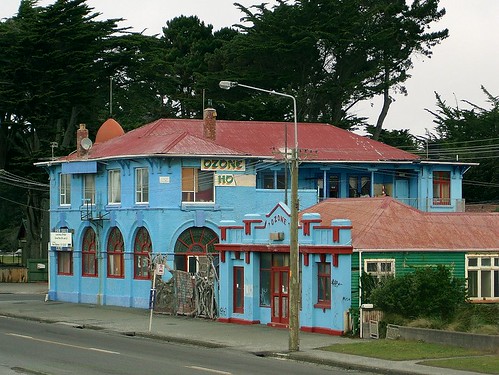
The vandalised Art Nouveau interior of the 1914 Ozone Hotel on Marine Parade at New Brighton.


Occupying a site of commercial development potential, the fate of the historically significant former convalescent home for World War I soldiers, would appear to be following an all too familiar pattern in the only New Zealand city not to afford protection for historic buildings.


Subsequent to a failure to undertake regular maintenance, the Ozone Hotel became vacant for an extended period. The next step in the sequence is to allow unrestricted access to the interior, which is then subjected to vandalism. In the case of the hotel this occured during the last weekend of August, 2008. Canterbury Heritage notified the owner's Agent of this unfortunate development, but the communication was ignored.

Like the 1870 Ti Kouka House on Cambridge Terrace, the next step is a suspicious fire, thereby justifying the building's demolition...

Illustrations from a photographic sequence by ars666


Update: 5 September 2008

A Canterbury Heritage field observer reports that today a caretaker was seen to be patching up the broken window on the front of the hotel. This caretaker also reports that the hotel failed to sell at yesterday's Mortgagee Auction. For now, at least, the historic building has been given a stay of execution.

Jul 21, 2008

Historic Church For Sale


Faced with a declining congregation and situated on what is now a valuable commercial site opposite The Palms shopping mall, the church which gave its name to the suburb of Shirley, is for sale.

Built on Craddock's Corner in 1919, the Normanesque tower was added nine years later. Both were designed by Joseph Salkeld (1866-1935), the son of an early Lyttelton Builder & Contractor. The architect was also the Choir Master of the Wesleyan chapel.

In the 1980s extensive alterations were made to the church and a new entrance was established. The exterior Sandstone facings were painted Pink, to be replaced by an equally unfortunate shade of Blue more recently.

Except for the 1938 pipe organ, the extensively modified chapel is of no particular architectural distinction and probably not worth saving. However, the 1928 tower, if restored, could prove a significant landmark as part of a commercial development of the extensive site. We trust that it will not be declared yet another "earthquake risk."

Conventional aesthetic considerations do not appear to be part of the restrictions upon exterior colour schemes within the realm of the local Council. Accordingly, something along these lines could be considered.

Further reading
Shirley Methodist Church One Hundred Years of Witness, 1966 Centennial History of the Parish (full text).

More Shirley Stories - The Press, 26 December, 1981.

Christchurch Library - Heritage: Shirley Methodist Church

Canterbury Heritage gratefully acknowledges the copyright of Jessica Park, the Methodist Church of New Zealand and New Zealand Newspapers Ltd with respect to the above images.

98 Year-Old Christchurch Tram


Built by Joseph Kitson Boon (1844-1935) at his surviving carriage works in Lower High Street (now Ferry Road), the tram entered service on the 9th of June 1910.

12.37 metres long and weighing about 15 tons, it's powered by two 600 Volt (DC) forty horsepower electric motors.


Withdrawn from service in 1952, the tram became a garden shed at South New Brighton. Rescued in August, 1969 (above), 23,000 man-hours of restoration were required before the project was completed in 1981.


The forty-eight passenger double-saloon car returned to service on the 4th of February, 1995.

Jul 10, 2008

Chocks Away Forever


More than ninety years of aviation history at Wigram, from first World War bi-planes to modern skydiving, will end in September, 2008.

The 250 hectare aerodrome, which has been operating since 1916, will make way for about 2,000 new houses and will incorporate a retail precinct, schooling and recreational facilities.

Owners Ngai Tahu Property Ltd sent a letter to all tenants this week informing them that the airfield will close on the 28th February, 2009, after being closed to air traffic from September, 2008.

Further reading:
Wigram air traffic to end - The Press, 10 July 2008

Council Short Sightedness -
Geekzone, 10 July 2008

May 28, 2008

Edwardian Entrance


The entrance to the 1910 Stewart Dawson's building at the corner of High and Cashel Streets.

The fourth building at this location, it was originally the site of the Customs Office of the Canterbury Provincial Government.

Apr 21, 2008

The Anzac Coves


For Australians and New Zealanders the 25th of April is Anzac Day; an annual commemoration of Antipodean soldiers who died in war.

Anzac Coves were not always beach inlets where valiant soldiers fought, there was a group of men who called themselves the Anzac Coves and dressed in Pierrot costumes.

These soldiers took temporary leave to perform sentimental songs to the troops and then went back to the trenches. Some were killed between shows.

The concert party subsequently performed "Direct from the Firing Line" from the 29th of April 1918 at the King's Theatre, Hammersmith, London.

Identified above are: Rannall Carlisle (manager) of Sydney, Harold Shaw (comedian) of Sydney, F H Crossley (comedian and raconteur) of Melbourne, Hugh Gannon (ragtime and light comedian) of Sydney, Fred Reade (light comedian and dancer) of Christchurch, NZ, Harry Ross (tenor) of Melbourne, Ben J Davies (second tenor) of Sydney, Jack L Davey (baritone) of Horsham, VIC, Leslie H Williams (bass) of Adelaide, A Roberts (comedienne) of Sydney, Ralph Sawyer (female impersonator and dancer) of Sydney, J Gibb (monologuist) of Sydney, Frank J Donovan (pianist) of Melbourne and W J Smith (mechanic).

Apr 8, 2008

Ecological Design Gym for Les Mills


The Les Mills Christchurch building was constructed in 1910 on the corner of Cashel Street and Woolsack Lane for Massey Harris, importers of agricultural machinery.

It's reported that the century old building will become the most ecologically designed gym in the world and will surpass anything New Zealand has ever seen when it's opened in early 2009.


Mar 15, 2008

Waiau Hotel


The Waiau Hotel in the Hurunui District was built in 1910 as a coaching inn on the route between Christchurch and Blenheim.

The ten bedroom hotel, now known as the Waiau Lodge, is currently for sale. The Real Estate Agent listing describes the historic hostelry as "totally restored to its former glory" ...

Mar 10, 2008

The Queen's Theatre

Large image opens in a new window

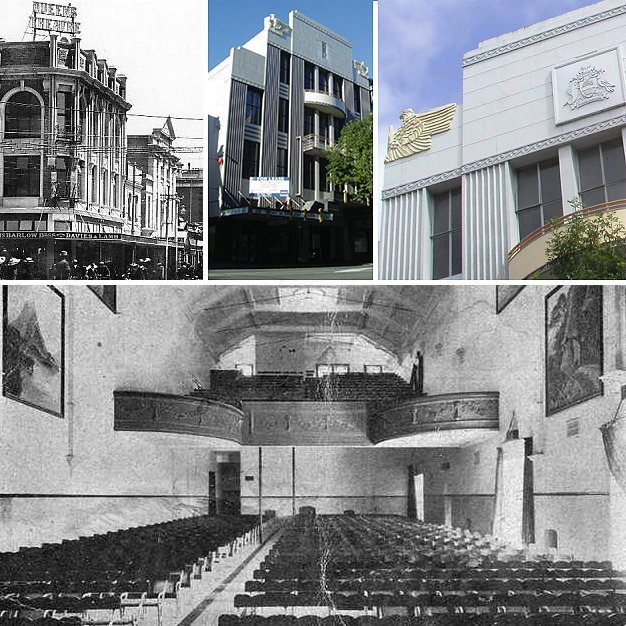
Opened on the 31st of October 1912 by the Mayor of Christchurch, the city's first purpose built cinema occupies the Hereford Street site of the 1853 home of William Sefton Moorhouse.

Owned by the Melburnian theatrical impresario James F MacMahon, a competition to a name the cinema was held by The Press newspaper, with a first prize of five Guineas. Seating 934 patrons, films were shown continuously from 11 am to 11 pm.

McMahon had exhibited the first projected motion picture shown to a paying Christchurch audience in November 1896. His Salon Cinématographe in High Street near the Cashel Street intersection almost certainly screened the 1896 Melbourne Cup race on that occasion.

In 1929 the twenty-five year-old Royal Exchange building in Cathedral Square was refurbished as the Regent Theatre, thereby obliging McKenzie & Willis Ltd to find new premises. The furniture retailers acquired the Queen's Theatre, which closed on the 5th of January 1929.

In 1935 the former cinema underwent significant redevelopment. Although the original ceiling and the stairway to the Dress Circle were left intact, a fourth floor was added and the Neo-classic Hereford Street frontage (to the Right in the top Left image) was replaced with the surviving Art Deco facade.

The long, narrow building was subsequently refurbished and linked to the Colombo Street Kincaid building in the 1950s as the McKenzie & Willis Arcade. More recently acquired by the Auckland Savings Bank, the ground floor is partially occupied by a 24/7 convenience store.

In 2003 the Theatre and Film Department of the University of Canterbury took the vacant upper floors as teaching, rehearsal and performance space. Residential facilities for post-graduate students are also provided.


See the Queen's Theatre location

Mar 5, 2008

Ozone Palace Demolition?


Isabella Huck's 1914 Ozone Palace private hotel and cafe at North New Brighton has been for sale since the beginning of March, 2008.

Listed as a "Beachfront Development Opportunity," the historic hotel was Canterbury's first invalid soldiers' home subsequent to the First World War.


See where these photographs were taken

Update: 1 September, 2008

We have received this email from a reader and acted up on it;

"I was down at Thompson Park yesterday afternoon and the kids down at the skate ramp informed me that 'the big blue house over the road' was empty and open. They took me for a look there - one of the side doors was apparently being held closed by a bunch of rubbish which the kids had moved...

I was wondering if it'd be worth getting in touch with the Real Estate Agency to get them to patch the place up - I'd hate to see it trashed or set fire to by some hoodrats."

Feb 18, 2008

Restored School Re-opened at Waimate

Douglas school was once a centre piece of the small community 17km South-west of Waimate. The school opened with a roll of 20 in 1912, closing in 1951. The old building was donated by Timothy Mehrtens, whose father Martin was a former pupil of the school.

Moved in 2005 by the Lions Group to the grounds of Waimate Museum, the Mayor addressed a crowd in a top hats and coat tails yesterday at the re-opening of the restored School.