Showing posts with label biographies. Show all posts

Jun 9, 2009

Epitaph: George Rhodes 1815-1864


24 year-old Henry Kirk arrived at Lyttleton in December 1863. Establishing himself a brick maker, one of his earliest commissions was to construct a large vault in the town's Anglican cemetery for the Rhodes family of Purau on the south-eastern side of the harbour. The vast monument that rose above it on the steep hill side continues to be amongst the port's most imposing tombs, but for all its grandiosity, only the mortal remains of a single member of that famed Canterbury dynasty lie within.


24 year-old George Rhodes had first come to what would eventually be Canterbury in November 1839, establishing a cattle station at Akaroa before returning to Sydney. Four years later George returned to take charge of land adjacent to his brother William's Banks Peninsula whaling station. The rest of the Rhodes Brothers's story is well documented history, but the only known image of George and his wife Elizabeth is this photograph (below), taken in front of their 1851 farm cottage near Timaru.


George and Elizabeth built an extant stone house (below) at Purau in 1854 and it was here that George died from Typhoid Fever on the 18th of June 1864.


Described by the Canterbury Association's local Agent as that cattle dealer and market gardener, he would be the founder of an immensely wealthly dynasty that would dominate the social life of the province for most of the following century.

But there's seasons in the affairs of families and the Rhodes flogged the Ranch and moved on to the big smoke, leaving poor George to lie alone beneath his neglected monument. Thus it is that in the current era the best known of his descendants is a certain Teddy Tahu Rhodes (below), that imposing 1.96 metre Opera singer and infrequent visitor to the land of his pioneering forebears.

Apr 21, 2009

George Lyttelton 1817-1876


On this day, the 21st of April in 1876, George William Lyttelton committed suicide by throwing himself over the first floor balustrade of his house at 18 Park Crescent, overlooking London's Regents Park.

Subsequently sharing collateral descent with Diana, Princess of Wales and the Jazz musician Humphrey Lyttelton, the 4th Baron Lyttelton was not the first of his kin to be described as suffering from gloomy delusions and unsatisfying wild, pompous fancies.

Under-Secretary of State for the Colonies, founding chairman of the short lived Canterbury Association (1848-1852), brother-in-law of Prime Minister William Ewart Gladstone and property speculator, George Lyttelton purchased 2,400 acres of land at Lyttelton, Christchurch, Geraldine and in the Selwyn county, which by 1882 was worth $9.427 million to his heir in today's money (his uncle, the 4th Earl Spencer, also bought 700 acres of land in the Christchurch district).

Apr 7, 2009

Petrus van der Velden 1837-1913


Arriving from the Netherlands in 1890, and apart from five years at Sydney, the artist Petrus van der Velden lived in Christchurch until 1913.


Petrus and Sophia van der Velden in front of one of the two studios in the garden their house at the corner of Conference and Durham Streets, Christchurch, about 1893.


Left: the van der Velden house in 2009. Now much altered and converted into five flats, it would originally been of similar appear to its immediate neighbour (Right).

In spite of his 30 years of European experience as a professional artist his services were declined by the Canterbury College of Art. Accordingly, van der Velden received pupils for terms of thirteen lessons in two and a half hour sessions. He tutored some of Canterbury's most renowned artists, including Sydney Thompson and Raymond McIntyre.


LARGE IMAGE OPENS IN A TAB OR NEW WINDOW

During a visit to Auckland van der Velden contracted Bronchitis and died of heart failure on the 11th of November 1913. He was buried in an unmarked grave at Waikaraka cemetery three days later. The subsequent plaque (below) is of a somewhat later vintage.


LARGE IMAGE OPENS IN A TAB OR NEW WINDOW

In November 1963, to mark the fiftieth anniversary of van der Velden's death, one hundred of his paintings were exhibited at the Robert McDougall Art Gallery.

Championed by Vincent van Gogh, his paintings are exhibited in Amsterdam's Rijksmuseum, but it could be considered a sad reflection upon Christchurch culture that, although we would seem to have a predilection for erecting monuments to, and naming bridges and parks, etc. after politicians and commercial magnates, eminent artists so widely regarded as van der Velden go uncommemorated.


LARGE IMAGE OPENS IN A TAB OR NEW WINDOW

A photographic portrait of Petrus van der Velden taken on the 9th of July, 1896 by Francis Lawrence Jones of Dunedin (courtesy of Early Canterbury Photographers).


Further Reading
Rodney Wilson; Petrus van der Velden 1837-1913 Dictionary of New Zealand Biography.

Rodney Wilson; Petrus van der Velden: The Marken and Otira Series Art New Zealand.
Photo Credits
van der Velden grave: Sarndra Lee of Auckland - sarndra.com

Portrait: Alexander Turnbull Library; S. P. Andrew Collection (PAColl-3739),
Picture reference: 1/1-014987; G.

Studio: Robert McDougall Art Gallery;
A concise History of Art in Canterbury 1850-2000, Christchurch, 2000.

Mar 23, 2009

Christchurch Pantheon


Unveiled on the 18th of March 2009 in front of the neo-Gothic Arts Centre in Worcester Street is a crescent of Bronze caricatures erected by the privately funded Twelve Local Heroes charitable trust.

Said to be of worthies who are among those whose achievements in the second half of the twentieth century are remembered with pride and pleasure by the people of Christchurch, we note with interest that more than half of those enshrined gained this alleged distinction through the world of commerce.

Top row, Left to Right (with the monumental inscriptions)
Sir Angus Tait (1919-2007). Father of the electronics and radio-communications industry in Christchurch, lifelong supporter of research and development, generous benefactor of educational opportunities for others.

William (Bill) Alexander Sutton (1917-2000). Artist, painter and craftsman, student and teacher at Canterbury College and University, pre-eminent painter of Canterbury landscape and people.

Sir Robertson Huntly Stewart (1913-2007). Businessman and industrialist, founder of PDL group of companies, pioneering exporter, generous host and benefactor to many causes.

Sir Tipene O'Regan (b. 1939) Rakatira, kaumatua, writer, orator and teacher, principal negotiator of the Ngai Tahu settlement which brought many positive results for all of Canterbury.
Middle Row
Diana, Lady Isaac. Quarrying and construction company co-founder, dedicated conservator of native birds, preserver of historic buildings, philanthropic benefactor to Canterbury

Elsie Violet Locke (1912-2001). Political, social and local community activist, well-loved historian and writer, determined and doughty fighter for the rights of the under dog, active to the end.

Sir Richard John Hadlee (b. 1951). World-class international cricketer, premier fast-bowler and all-rounder, first bowler to capture 400 test wickets, longstanding supporter of sports, youth development and health.

Frank Dickson. First chief executive of the Canterbury Savings Bank 1962-1988, leader and inspirer of the team which created over $300 million of funds for the Canterbury Community Trust.
Bottom Row
Emeritus Professor Donald Ward Beaven. Doctor, research specialist and teacher, loved and respected as the founder of diabetes research and care in New Zealand, tireless promoter of the healthy life.

Margaret Mahy (b.1936). Christchurch children's librarian, world-famous writer of magical stories and verse for children and young adults, giver of the gift of imagination.

Charles Luney (1905-2006) Master builder of many of the foremost buildings of Christchurch, upright and respected contractor and employer for the 75 years of his working life.

Sir Miles Warren (b. 1929). Eminent architect, at the forefront of building design for over 50 years, generous supporter of the arts and tireless worker for the betterment of Christchurch.

Photo Credit

We are greatfully indebted for the above thumbnails, which are from a photographic essay entitled Twelve Local Heroes, to Bob Hall of Christchurch (link opens in a new tab or window).

Sep 28, 2008

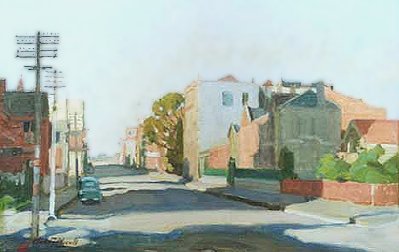
Sumner circa 1950


LARGE IMAGE OPENS IN A NEW WINDOW

An elevated westerly view across Sumner and the Avon-Heathcote estuary to the Southern Alps from Scarborough Head.

Considered one of New Zealand's most important portrait painters, Frank Nicoll was a man of strong personality and decided opinions. A physical handicap acquired during the First World War prevented him from painting the more rugged and inaccessible parts of New Zealand, but his seascape and pastoral landscapes around Christchurch, though strongly influenced at first by the academic discipline of his Edinburgh College of Art training, became sunlit scenes marked by a sureness of touch and a warmth and freshness of colour.


Archibald Francis Nicoll, O.B.E. (1886-1953) attended Springston school and then Christchurch Boys' High School. Working as a shipping clerk in the Cashel Street, Christchurch offices of the Union Steam Ship Company, he attended evening classes at Canterbury College School of Fine Arts under Sydney Thompson. He subsequently studied art in Britain for three years from 1911. Nicoll was a member of the council of the Canterbury Art Society, of which he was president for two years, and was on the advisory committee of the McDougall Art Gallery and the committee of management of the National Art Gallery and the New Zealand Academy of Fine Arts.

Although unrecorded in any known catalogue the above painting is believed to be currently in the archive of the Auckland Public Art Gallery.


Above: also painted by Frank Nicoll in 1950 is this easterly view of Christchurch's Hereford Street from the corner of Montreal Street (current location unknown).

May 21, 2008

Podcast: Joyce Grenfell

Sir Bernard Fergusson (1911-1980), Baron Ballantrae of the Bay of Islands, was Governor-General from 1962 to 1967. His father, Sir Charles Fergusson, was Governor-General from 1924 to 1930, his father-in-law, the Earl of Glasgow, was governor from 1892 to 1896, and his grandfather, Sir James Fergusson, was governor from 1873 to 1874.

The New Zealand link continues with Bernard's son Geordie, British High Commissioner since 2006.

Sir Bernard's sister-in-law was the renowned actress and comedienne Joyce Grenfell (1910-1979). Joyce and Reggie Grenfell were a regular guests at Wellington's Government House and are fondly remembered by a generation of dinner guests, in an era before the decline into political patronage changed the Vice-regal milieu forever.


From the BBC's Great Lives series, comic performer Arabella Weir nominates Joyce Grenfell, whose comic monologues were a huge influence on her, growing up. Joyce's family friend and biographer Janie Hampton supplies the inside information in this 28 minute program.

Feb 20, 2008

Lyttelton 1866

The 1866 Residential Directory includes biographical notes. Compiled from data extracted from the Stevens and Bartholomew's New Zealand Directory for 1866-67, published at Melbourne, 1st August, 1866. The directory's statistical data has a cut-off point of June 30, 1865. Accordingly there's a strong possibility that the information relates to the latter part of that year.

The 1866 Yellow Pages, extracted from the same source, lists all agencies of government and commercial enterprises at the port.


Feb 12, 2008

A Revised Index of Volume 3 (Canterbury) of the 1903 Cyclopedia of New Zealand

The 4,449 entry revised index includes further biographical data extracted from the Canterbury Heritage Biographical Index, which currently exceeds forty-eight thousand early settler biographies.