Showing posts with label 1890s. Show all posts

Apr 11, 2009

The Christchurch Bicycle Band

We've recently provided further identification information concerning a pair of photographs of the Christchurch Bicycle Band for the U.S. based The New Zealand Journal. A copy of the first is included in the online collection of the Christchurch Libraries and of the second in the online collection of the Alexander Turnbull Library.


LARGE IMAGE OPENS IN A TAB OR NEW WINDOW

Dating from 1898, this north-easterly view was taken on the parade ground of the Canterbury Militia's Drill Hall, which was situated on the north side of Cashel Street West, between Cambridge Terrace and Montreal Streets. The early 1860s Hall, which could accomodate 2,500, was frequently used as a public venue, as was its 1905 replacement, the King Edward Barracks (demolished in 1996).

The building to the far Left, with the roof skylight, is the city morgue, behind the Hereford Street Police Station of 1873 (both demolished in 1974).


LARGE IMAGE OPENS IN A TAB OR NEW WINDOW

This is an elevated westerly view of Kilmore Street from the Victoria Street intersection, looking past Cranmer Square toward Hagley Park. It was taken through the upper floor window of John Mummery's Britannia Hotel, which would later become the photographic studio of the extant centenarian photographer Gladys Goodall.

Certainly taken before 1906, it can be dated with reasonabe probability to the early afternoon of Monday, the 25th of May, 1903. Queen Victoria's birthday fell upon a Sunday that year, but the event, which was celebrated as a public holiday named Empire Day, was held on the following day. The procession is proceeding to the celebrations in the newly renamed Victoria Square, where a Bronze statue of the Queen was unveiled.

Only the circa 1870 two storey building in the distance still exists; formerly a convenience store and then a school tuck shop, it stands at the corner of Cranmer Square opposite the former Normal School.


The Christchurch Bicycle Band

Equipped with bicycles from the Adam brother's Manchester Street Star Cycle Company, the band was formed in 1895 by the brothers Joshua and Frederick Painter.

On an outdoor occasion an unwary cyclist crossed their path. The band took evasive action, the lady fell off her bike, but the music continued uninterrupted. Apart from street parades, they also performed on the stage of the extant Opera House in Tuam Street until the Band's demise in 1915.

Received history indicates that the band claimed to be the only one of its type in the world. However, bicycle bands are recorded as having been popular since 1881 and continue to be so.

Apr 7, 2009

Petrus van der Velden 1837-1913


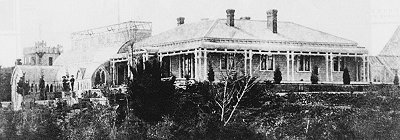
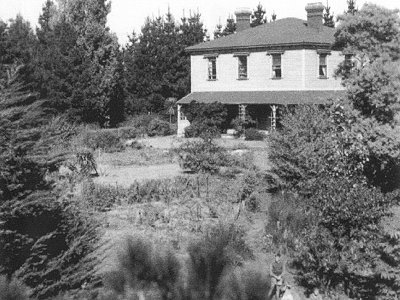
Arriving from the Netherlands in 1890, and apart from five years at Sydney, the artist Petrus van der Velden lived in Christchurch until 1913.


Petrus and Sophia van der Velden in front of one of the two studios in the garden their house at the corner of Conference and Durham Streets, Christchurch, about 1893.


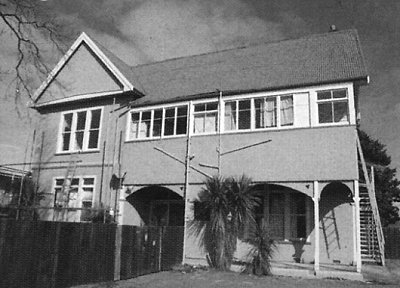
Left: the van der Velden house in 2009. Now much altered and converted into five flats, it would originally been of similar appear to its immediate neighbour (Right).

In spite of his 30 years of European experience as a professional artist his services were declined by the Canterbury College of Art. Accordingly, van der Velden received pupils for terms of thirteen lessons in two and a half hour sessions. He tutored some of Canterbury's most renowned artists, including Sydney Thompson and Raymond McIntyre.


LARGE IMAGE OPENS IN A TAB OR NEW WINDOW

During a visit to Auckland van der Velden contracted Bronchitis and died of heart failure on the 11th of November 1913. He was buried in an unmarked grave at Waikaraka cemetery three days later. The subsequent plaque (below) is of a somewhat later vintage.


LARGE IMAGE OPENS IN A TAB OR NEW WINDOW

In November 1963, to mark the fiftieth anniversary of van der Velden's death, one hundred of his paintings were exhibited at the Robert McDougall Art Gallery.

Championed by Vincent van Gogh, his paintings are exhibited in Amsterdam's Rijksmuseum, but it could be considered a sad reflection upon Christchurch culture that, although we would seem to have a predilection for erecting monuments to, and naming bridges and parks, etc. after politicians and commercial magnates, eminent artists so widely regarded as van der Velden go uncommemorated.


LARGE IMAGE OPENS IN A TAB OR NEW WINDOW

A photographic portrait of Petrus van der Velden taken on the 9th of July, 1896 by Francis Lawrence Jones of Dunedin (courtesy of Early Canterbury Photographers).


Further Reading
Rodney Wilson; Petrus van der Velden 1837-1913 Dictionary of New Zealand Biography.

Rodney Wilson; Petrus van der Velden: The Marken and Otira Series Art New Zealand.
Photo Credits
van der Velden grave: Sarndra Lee of Auckland - sarndra.com

Portrait: Alexander Turnbull Library; S. P. Andrew Collection (PAColl-3739),
Picture reference: 1/1-014987; G.

Studio: Robert McDougall Art Gallery;
A concise History of Art in Canterbury 1850-2000, Christchurch, 2000.

Mar 28, 2009

A Most Unlucky Ship


Of all the ships to have served Lyttelton Harbour the luckiest would have to be the extant steam tug Lyttelton of 1907, but at the other end of the scale was the unfortunate Manchester.

Launched for the Manchester Ship Canal Company by William Simons & Company at Renfrew, near Glasgow on Tuesday, the 15th of July, 1890, the Hopper Dredger was named Manchester. With a length of length: 55.3 metres (180.2 feet) and a beam of 12 metres (39.1 feet), Yard No 279 displaced 881 gross registered tons. Capable of dredging 700 tons per hour to a depth of 10.75 metres (35 feet) and fitted with electric lighting, she cost her owners £20,000.


The canal was completed in 1894 and four years later the twin screw vessel was offered for sale at £15,000. In June 1898 the Lyttelton Harbour Board offered £12,750  for the dredge and by September the sale had been completed.

Subsequent to undergoing repairs, the Manchester left Liverpool for Lyttelton on the 7th of February 1899.  Aboard was the brindle Bull Terrier of Andrew Anderson, son of the 1850 pioneer blacksmith and Mayor of Christchurch, who was visiting his parent's former homeland at the time. In what was probably the longest ever voyage to New Zealand, it would be another fourteen months before the Civil Engineer would see his dog again. In the meantime the Anderson's Lyttelton shipbuilding yard constructed a hopper barge to act in consort with the new dredge.

The Manchester made it as far as Ireland, where she put into Waterford for machinery repairs. Next stop was Gibraltar where she incurred further repair costs amounting to £700 during her month long stay. Crossing the Mediterranean, the dredge traversed the Suez Canal before sailing on to Singapore via Colombo in Sri Lanka.

Eagerly awaited in Lyttelton, where few of the larger ocean steamers were now making the township their final port of departure, owing to the risk when they were fully loaded, Captain John William Clark, the Lyttelton Harbour Master left by the Monowai for Brisbane in late January 1900 in order to meet and take charge of the Harbour Board's dredge.

Under Clark's command the Manchester sighted Cape Maria at 10.50 p.m. on the 9th of March 1900, and the North Cape next morning, when the gale abated. Owing to bad weather she called in at Whangamumu on the evening of the 10th, where it was discovered that the feed-pipe in her engine room was cracked. Repairs were effected at Auckland and on the 14th she sailed for Lyttelton, which she reached on the 22nd of that month.

Andrew Anderson was on the wharf to meet her arrival, but long before he could see anything he heard the joyous barks as his dog careered around the deck in a geat state of excitement. But the dredge had experienced a terrible voyage, most of which was spent undergoing repairs in ports along the way, and there was a great deal of discontent among the crew, as they had signed on for a fixed amount for the duration of what turned out to be a 408 day voyage.

On the 5th of April 1900, at a meeting of the Lyttelton Harbour Board, the chairman stated that the Board had suffered great loss in connection with bringing out the dredge from England. He reported that the persons who had been paid to protect the Board's interests had grossly abused their trust, and the expenses of the dredge, instead of being £24,000, had been £30,000. A special committee was set up to report on the expenses and delay incurred.

By the end of the following month the Manchester was deemed ready for service and a trial of the dredging machinery was undertaken while the vessel was moored between No. 7 wharf and the graving dock. In half an hour from fifty to sixty tons of highly tenacious, cement-like mud were raised from the harbour floor.
The Manchester's most significant contribution to the development of the port was the reclamation to the southern side of the graving dock, where the oil wharf and tank farm now stands, but during this time crew members succumbed to fatal accidents on two occaisions. In March 1912 she was replaced by the 1,117 ton suction hopper dredger Canterbury (1911-1968) and the Manchester was offered for sale at £20,000.

Sold to the Sydney Harbour Trust in 1912, Manchester departed from Lyttelton in the command Captain James Downie on the 3rd of April. Aboard were three of the original crew who had brought the vessel to New Zealand in 1900, one of whom had also served his apprenticeship with the builders of the dredge at Renfrew. The balance of the crew were local seamen. Sailing from Wellington for Sydney on the following day, after passing through Cook Strait the Manchester was never heard of again.

By the end of April the cruisers Challenger, Encounter and Pioneer were searching for the dredge, but beyond the discovery of three lifebuoys bearing the name Manchester, Lyttelton in the vicinity of the Manukau Heads and Hellensville between June and November, no trace of the vessel was found. Thus ended what is perhaps one of the most poignant of all Lyttelton's tales.


Photo Credit: Photograph of the Manchester moored on the Manchester Canal courtesy of the Manchester Ship Canal Society.

Mar 8, 2009

Old Lyttelton (for Richard)

These are old survey maps and photographs of the intersection of Lyttelton's Winchester and Canterbury Streets.

A north-easterly view across the intersection in 1858.


An 1860 survey map.


The north-west corner about 1865.


A survey map showing the extant buildings in 1867.


A circa 1890 elevated north-easterly view (above). At the north-eastern corner, the home of the Tobacconist William Wales Junior was completed with the addition of a western wing by 1901. The same house photographed in 2007 (below).


Hatherly's grocery shop on the southwest corner in 1901.


The 1860 Anglican church of the Holy Trinity and the 1880 vicarage at the southeast corner, photographed prior to 1906.

Major Christchurch Restoration


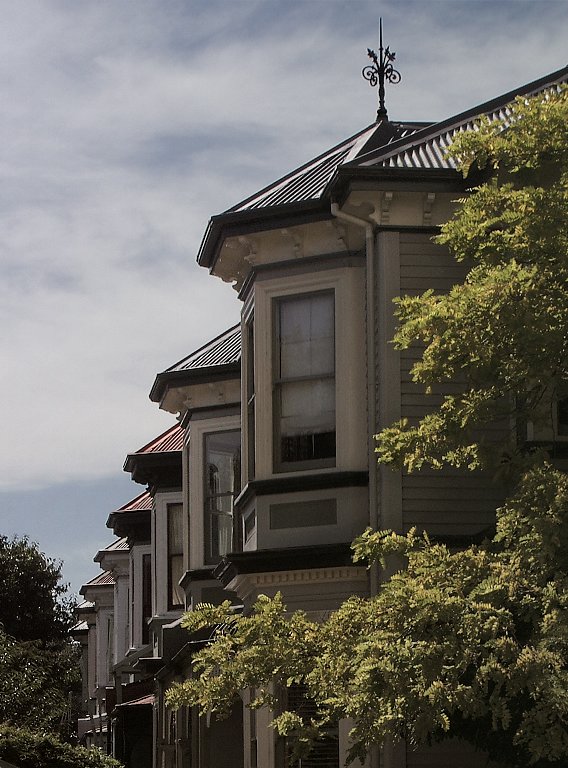
A comprehensive restoration is currently underway of a row of nine late Victorian terraced town houses on the south side of Worcester Street, between Barbadoes Street and Fitzgerald Avenue.


Unfortunately, we've been unable to locate a pre-restoration view of the terraced town houses, but they appear to the Right in this circa 1905 photograph.

Jan 27, 2009

Christchurch Now & Then: The Temperance Hotel

Subsequent to a reader's enquiry concerning the location of Christchurch's Temperance Hotel, we're pleased to have been able to ascertain the following.

What would become 145-151 Cambridge Terrace was originally a triangular shaped quarter acre town section at the south-west corner of Cambridge Terrace and Gloucester Street. The first building on the site was a single storey villa, with two extended bays facing the river.

Built across this site in the late 1880s, Lodge's Temperance Hotel and Boarding House was demolished in 1963. The Canterbury Horticultural Society's Hall was subsequently built over the garden and the extant Warren House five storey office building constructed at the street corner in 1965.

The Horticultural Hall and the adjacent Synagogue in Gloucester Street were demolished in 1984. These sites have remained car parks ever since. The street level of Warren House is currently occupied by the Santorini Greek Restaurant.

Jan 22, 2009

'cisco in Chch


LARGE IMAGE OPENS IN A NEW WINDOW

Built in the classic style of late 19th century San Francisco is this row of substantial Christchurch townhouses on the southern side of Chester Street East at Madras Street.

Dec 17, 2008

James Glanville, Architect.

Avebury House, Richmond, 1972

James Glanville (1841-1913), was a builder of St Asaph Street, Christchurch, who also practiced as an Architect.

Avebury House (above) was built in 1885 for William James Flesher (1837-1889), a Yorkshire shoemaker who prospered as a Grain Merchant and then as a Real Estate Agent of Cashel Street.

Originally a 25 acre part of the Avebury Farm of Dr John Seager Gundry (1807-1886), the land was purchased by Flesher for £500 in 1871 and the 4,289 square metre dwelling was probably a replacement for an adjacent and extant house of about 1873  (to the Left in the above photograph).

After Flesher’s sudden death aboard the steamship Tarawera on a return passage from Melbourne, the house passed to his son James Arthur Flesher, O.B.E. (1865-1930), a Solicitor and Mayor of New Brighton 1915-1917 and then Mayor of Christchurch 1923-25.

James Flesher died in 1930 and Avebury passed to his son Hubert de Rie Flesher. Hubert lived on until 1989, but sold his house and eight acres to the Crown in 1945.  The area kept for the park was purchased by the Christchurch City Council for £1,250 in 1948 and by 1951 the house had also been acquired by the  Council.

Barry and Lesley Brown were the last residents of Avebury House before its conversion into a youth hostel. Lesley was a descendent of the Glanville family and Barry worked as a supervisor and later foreman at the Botanic Gardens. Their son has published a set of nine photographs (opens in a new window) of the exterior and interior of the house in the early 1960s.

Avebury became the Cora Wilding Youth Hostel in 1965 and the land was established as a park. In 1997 the hostel closed and the house faced the prospect of demolition.  Restoration began in 2000 and two years later Prime Minister Helen Clark opened the rejuvenated building as the Avebury House Community Centre.


The Flesher family were prominent members of the Free Methodist church and donated generously to the nearby Richmond Chapel, which was built in Stanmore Road on what had been part of the Flesher Estate. Although the current church, which dates from 1878, cannot yet be attributed to a particular architect, the adjoining brick and stone hall of 1886 (above) is to the design of James Glanville.

Hidden from view behind the 1878 wooden church is the original chapel, although much altered over time, the remnants of its architectural style would appear to indicate a probable date of construction from the 1850s to early 1860s.


In 1899 James Glanville designed the extant, but now relocated, Leinster House for Andrew Fuller Carey (1863-1937), a partner in the Drapery of Tonycliffe and Carey at the northeast corner of Colombo and Gloucester Streets.

Originally situated on the corner of Papanui and Leinster Roads at Merivale, Leinster House bears a strong resemblance to Glanville's earlier dwelling for William Flesher.


Also in Glanville's American influenced architectural style were a pair of houses on the eastern side of Latimer Square, between Worcester and Gloucester Streets. Demolished between 1973 and 1990, the sites of these large dwellings are occupied in 2008 by townhouses and an extension to the Latimer Lodge Motel.


By 1904 Granville had relocated his architectural practice to offices in the 1864 Torlesse Building at 9 Cathedral Square (where the ANZ Bank building is now situated). A long time resident of the New Brighton district, in later life he was Mayor of that Borough (to be succeeded by James Flesher of Avebury House in that role) . 

Another member of his family, William Leonard Glanville, a career army officer, purchased the McHaffie homestead on acreage at the corner of Pages Road and Shortland Street in the early 1920s.  William Glanville and his wife used the large house to provide foster care for many children over the next twenty five years. The late 1880s house, along with 5 acres of its former grounds, became the Aranui Motor Camp in 1947 until it was demolished in 1975.  The site is now occupied by McHaffie Place off Shortland Street. 

A collection of twenty five photographs of the former McHaffie house during the time of its occupation as the Glanville's children's home opens in a new window.

Nov 20, 2008

Townsend Observatory 1896


A rare photograph of the newly completed biological laboratory and observatory tower of the Canterbury College of the University of New Zealand about June, 1896.

The dome was originally constructed of canvas and wood. The observatory is the only part of the Arts Centre still owned by the University of Canterbury. Each year the Department of Physics and Astronomy appoints a student as the Townsend Observer. Public viewing is held during the months of the year when there is no daylight saving.

Nov 11, 2008

Cultrural Vandalism?


An historic Christchurch house is currently threatened with demolition.

Situated on the Northwest corner of Riccarton Road and Deans Avenue, and marketed as far afield as Asia and Britain, the substantial two storey brick dwelling is being offered for sale by Tender as a redevelopment site, apparently suitable for yet another nondescript motel (thank goodness that economic recession is a two edged sword and might thereby offer a respite in this instance).

Although The Press newspaper reports that Christchurch residents are shocked by the potential loss, theirs is the only New Zealand city not to provide statutory protection for its built heritage.

To date none of the media reports pertaining to the house have been able shed light upon its history. In pursuit of its preservation, here then are our preliminary research findings.

Occupying a part of what was a large Wheat field in 1869, the one acre section at the southeast corner of the 1843 Riccarton Farm was sold by the Deans family on the 10th of March, 1879 for £1,000 to a Mr Kelsey, an Ironmonger of Manchester Street, Christchurch. Mr John Deans requested that the name Township of Riccarton be given to the area, prior to this time Riccarton Road had been known as the Great South Road and Deans Avenue as West Belt. Kelsey erected a wooden house on the site, which was subsequently replaced prior to 1890 with the current brick house by a Mr Hamilton (possibly the Builder Hugh Richard William Hamilton (1850-1934).

Before 1900 Hamilton sold the house to Professor Francis William Chapman Haslam (1848-1923). A scholar at St. John's College, Cambridge, Haslam's most famous pupil was the author Rudyard Kipling. Born in Sri Lanka, where his father was a translator of the Bible into Sinhalese, Professor Haslam arrived at Christchurch in 1879 to replace the renowned John Macmillan Brown in the chair of Classics at the Canterbury College of the University of New Zealand.

By 1920 Frank Haslam had sold the house to Richard Ernest James (1873-1970), who lived there with his unmarried sister; Miss N James. Richard James sold the corner of his garden to the council for a nominal 10 cents in order that New Zealand's first traffic roundabout could be developed at the intersection. Antique furniture from the house, donated by Mr and Miss James, now graces Fendalton's Mona Vale homestead.

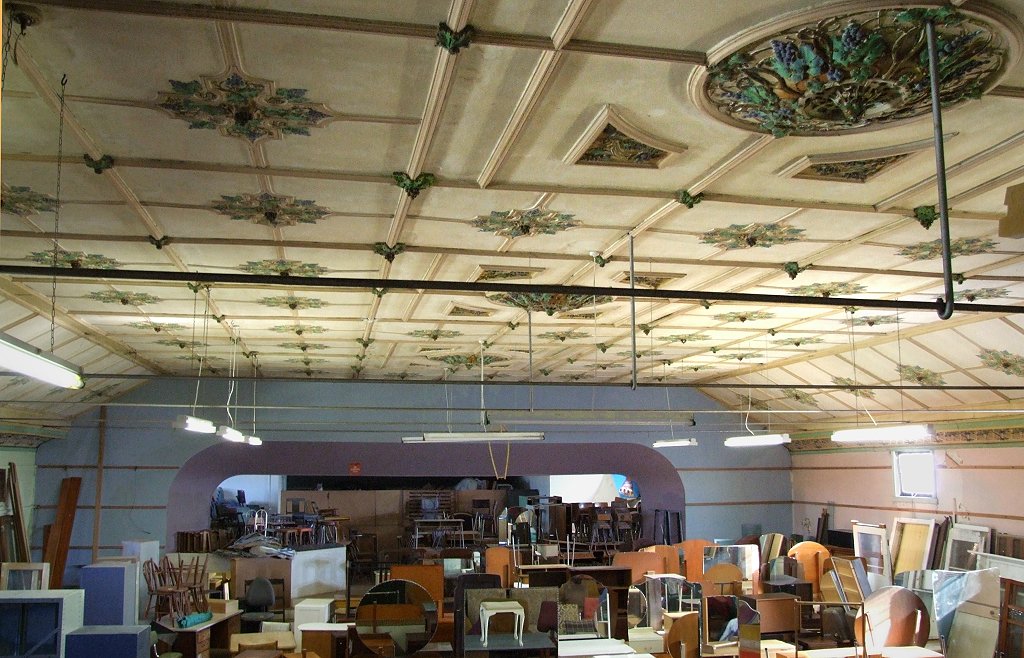
By 1978 the house and its surrounding half an Hectare had come into the possession of its current owners; Hunter Lounge Suites (Christchurch) Ltd. The company conducted its furniture-making and sales business from the site, but now operates from a refurbished former Mitre 10 hardware store on Moorhouse Avenue. Hunter Lounge Suites is largely owned by Christchurch businessman Lionel Hunter, who does not wish to comment on this matter.


We'll continue to update this article as further historical information and/or developments come to hand.

Sep 18, 2008

1940s Wainoni

Generally regarded as little better than a desert, the area originally known as the Sand Hills district, between Christchurch and New Brighton, was flat land humped up into a series of low, shifting sand hills, barren except for a few hardy native plants.

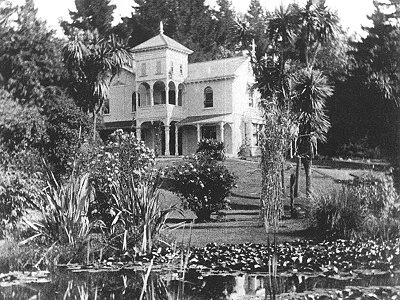
In 1875 the Architect and Christchurch City Surveyor Cornelius Cuff (1837-1901) purchased all of the area that would become known as Wainoni. Cuff built a substantial two-storey house, with a large conservatory attached to its eastern side. Named Sandilands it was sold to Henry Slater a Lawyer of Lichfield Street. Last occupied by the widowed Ellen Susanna Slater in the 1950s, it became derelict and was demolished about 1963 to make way for Vancouver Crescent.

From the early 1880s Cuff subdivided much of his land into rural-recreational blocks of 20 to 30 acres. All of the six grand houses built between 1882 and 1907 survived into the 1950s, but only two have made it to the 21st century.

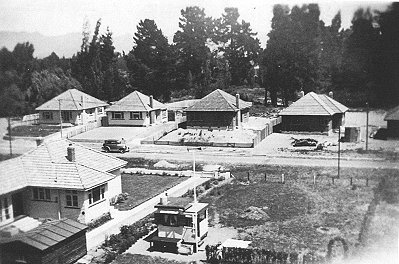
With the advent of sewerage connections from the later 1940s Wainoni quickly developed as a suburb of predominantly three-bedroom weather board houses on quarter acre sections.


An elevated westerly view of Ottawa Road in 1946, with the extensive grounds of Cornelieus Cluff's 1870s house in the background. Originally a sandy track to Bickerton's Fireworks factory, it became known as Onslow Street in the late 1880s (after a Governor General), the name was changed to Ottawa Road in 1933 to mark the visit of a Canadian Prime Minister.


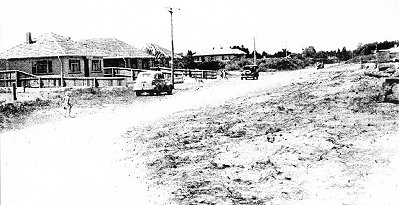
A 1948 south-easterly view towards Pages Road of Shortland Road (now Street) from the corner of Wainoni Road. Shortland Street was probably named after Dr Edward Shortland (1812–93), Physician, early South Island explorer, Māori scholar and linguist.


The Grand Houses of Wainoni


Littleover House was built in 1882. It was demolished in 1963 to be replaced by a Milk Transfer Station in what became Tahuna Street.


Alexander Bickerton's 1885 house was called Wainoni after the original Māori name for the bend in the Avon River, which it overlooked. The house stood above the since leveled eastern corner of Wainoni Road and Bickerton Street.

Evening Post, April 1914.
Wainoni Park, near Christchurch, known for several years past as an open-air pleasure resort, was offered for sale by auction recently. The property was first submitted as a going concern, but the best bid received was £30,00, at which figure it was passed in. The movables on the property were then disposed of. Chief interest centered in the disposal of the menagerie. All the animals and birds were sold, the principal buyer being Mr. J. J. Boyd, who was acting for the Onehunga Zoo. Prices received for the principal lots were; Malayan bear £3. Japanese bear 1 £5, twenty-two monkeys 10 shillings each, three black wallabies £1 each, two kangaroos £5, rat kangaroo £1, golden pheasant £3, black lemur £2, African monkey £1.


On Pages Rd was the late 1880s home of the Tuam Street merchant and racing horse owner Gilbert Hamilton McHaffie (1861-1905). By the early 1920s the house had become the children's foster home of the Glanville family, until it was purchased in 1947 by Horace Papps who turned the house and five acres of grounds into the Aranui Motor Camp. The house was demolished 1975 and is now the site of McHaffie Place (off Shortland Street).

A 24 image photographic essay of the house in the 1930s and 1940s by a Glanville grandson opens in a new window.


161 Pages Road was built in the early 1890s on 23 acres by Thomas Cheal Norris (1848-1921). It survives on one acre as the He Waka Tapu Maori Health Centre. It was a very fast tram ride into the city from here; by 1911 The Evening Post was reporting that electric trams were pushing 60 Kilometres an hour along Pages Road.


To the design of A H. Hart, this house was built in 1907 by W. C. Evans, at the corner of Pages Road and Shortland Street, for Henry Francis Stevens (1859-1931), an Wholesale Druggist of Worcester Street. Although the house and its former stables survive, it has been converted into six flats, and a row of concrete home units now occupy the Pages Road frontage.


To promote the Christchurch City Libraries Retrospective: Christchurch life, architecture and design 1940s - 1970s photo competition, we're featuring a series of images from each decade. This week we look at the later 1940s.

Sep 12, 2008

Fendalton 1899


To the Tudoresque Arts and Crafts design of Joseph Clarkson Maddison (1850-1923), the subsequently much enlarged and photographed Mona Vale House under construction for the Christchurch Accountant Frederick Waymouth (1849-1914).

Jul 16, 2008

Cecil Walkden Wood


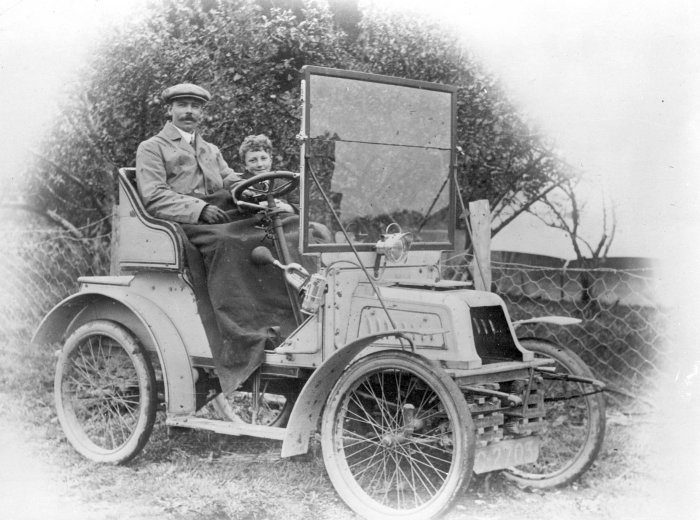
Cecil Walkden Wood (1874-1965) in his third home-built car about 1910. The body is by the Wheelwright and Coach Builder John James Grandi (1858-1913), Mayor of Timaru from 1896. The passenger is Wood's son, Cecil Walkden Wood Junior (1902-1991).


Born at Timaru in March, 1874 Wood served for a time as a mechanical engineer at Lyttelton, and ultimately turned his attention to the cycle trade in Christchurch, where he worked as an Apprentice at the Tourist Cycle Works from 1892. Returning to Timaru he founded C. W. Wood & Company, Bicycle & Motor Engineers in 1894.

Cecil Wood was the first person in New Zealand to build an internal combustion engine, making his own spark plugs, carburettors and crankshafts plundered from old tobacco tins and cast-iron irrigation pipes.

Between 1897 and 1902 Wood built the country's first motorbike, first car built in New Zealand and a two-cylinder, 25 horsepower petrol engine for the March 1903 flight of the self-built monoplane of the reclusive Richard Pearse (1877-1953).

Top image: Reference number: 1/2-018732-F. Collection: Photographic Archive, Alexander Turnbull Library.

Jul 10, 2008

The Grim Reaper Awaits...


A pair of derelict, but historically significant, late Victorian semi-detached town houses at the south west corner of Christchurch's inner city Worcester and Barbadoes Streets.

The style is strongly reminiscent of the circa 1883-1892 houses situated along Steiner Street on Alamo Square in San Francisco. Also known as Postcard Row, it would be inconceivable that houses of such heritage significance would be considered demolishable in the city from where the style originates.

Photographed by Hayley Badock

Apr 14, 2008

The 1874 Barque James Craig


Launched in 1874 as the Clan Macleod, the vessel began her career on the South America run, subsequently carrying British emigrants to Australia. However, within a decade her kind had been superseded by steamers that didn't require three to four months for a voyage to the Antipodes.

As a New York based general cargo vessel she became a familiar sight at Canterbury ports from the later 1880s. Much of the enameled Granite Ware saucepans, pie dishes and kettles, etc. now keenly sought by antique collectors, arrived in the province via Cape Horn aboard the Clan Macleod.

Acquired by the Craig Line of Auckland at the turn of the century and renamed James Craig five years later, she worked the Tasman carrying timber to Australia, returning with hardwood railway sleepers and general cargo.

Sold to Sydney in 1911, she ended her working career as a Tasmanian coal hulk. Rescued in 1973, restoration began in 1981 and the vessel is once again registered at Sydney. Although still bearing the James Craig name, the $12.5 million "restoration" has not included the distinctive Craig Line livery.

The Craig Line's Louisa Craig of 1876 ended her career as the Lyttelton coal hulk Raupo and now lies beached on Quail Island.

Fourth in a series about surviving ships of significance to Canterbury history.

Apr 13, 2008

The General Cargo Vessel Balclutha


A regular visitor to Lyttelton in the last decades of the nineteenth century was the Balclutha. At Gladstone Pier she would load wool and tallow for London via the tip of South America.

Renamed Star of Alaska in 1902, she became a floating Salmon cannery on the Alaskan coast. In this trade she accommodated more than two hundred crew and passengers, as compared to a complement of twenty six carried on the New Zealand run.

Renamed Pacific Queen in 1933, she appeared in the film Mutiny on the Bounty, with Clark Gable and Charles Laughton.

Acquired by the San Francisco Maritime Museum in 1954, the Balclutha is now a designated National Historic Landmark.


Third in a series about surviving ships of significance to Canterbury history.

Apr 5, 2008

Temuka Town Hall


The Temuka Town Hall was built in the 1890s by Daniel McInnes (1866-1932), a member of the Temuka Borough Council for 24 years and Mayor between 1907 and 1912. In 1922 the Hall became the Dominion Theatre. Subsequently the Elite Cinema, it has been a second hand shop since 1970.

Mar 6, 2008

Cathedral Square 1970

Large image opens in a new window

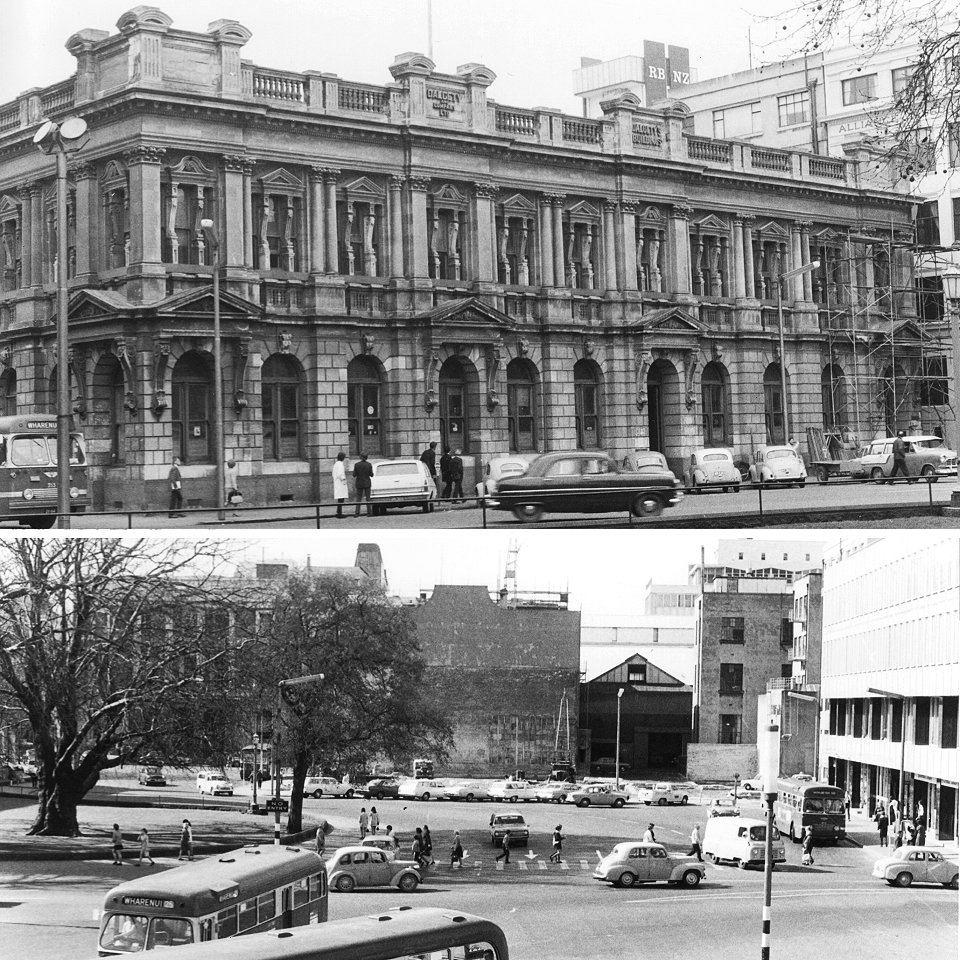
Easterly aspect of Cathedral Square showing the 1898 Dalgety building, subsequently the site of the Millennium Hotel from 1976.

The upper photograph was taken on 22nd of July, 1970 and the photo of the bare site is dated 28th August of the same year.

Recent additions to the photographic archive.

Feb 18, 2008

Minson's of Christchurch

Enlarged image opens in a new tab or window

A nondescript facade on the East side of Colombo Street between Gloucester and Armagh Streets belies the story of what was once a fondly remembered Christchurch institution.

In 1892 forty-eight year-old William Minson arrived in the city with a young family. Settling at the "The Hollies," on the banks of the Heathcote river in Opawa, he purchased a hardware shop originally established in 1857 by William Neeve. As Minson & Company he turned the business into a replica of the old family crockery and glassware emporium at St Ives in Cornwall.

With what was probably the best range and quality in the city, Minson flourished to the extent that he moved the shop further up Colombo Street into the 1882 three-storied Compton House. In 1912 he extended the premises through to Gloucester Street. Succeeded by Arthur William, the oldest of his three sons, Minson died in 1925 aged 81 and now lies in Linwood Cemetery.

Carville Stewart recalled Minsons in the late 1920s: '... a long narrow shop on Colombo Street, north of Cathedral Square, that sold good quality china, cutlery and glassware - they kept a great deal of their stock on island displays alongside a central aisle that ran down the length of the store. The floor was wooden and when you walked down that very long aisle, every piece of china, on every one of those island displays, rattled alarmingly. It sounded as if every piece of expensive china was going to fall off and break into a thousand pieces - quite terrifying for a shy little boy who just wanted to see the Micro Models at the back of the store."

Alas commercial acumen is not an inheritable trait and its fourteenth decade the venerable store declined into extinction, but shorn of its elaborate facade in the 1940s the old premises survives as a dilapidated ghost of its former glory.


Feb 17, 2008

Christchurch Central Fire Station 1899-1913

Bearing almost no resemblance to its first incarnation, this was the Central Fire Station from 1899 to 1913.

From here horse-drawn fire engines, with steam-powered pumps, sped along Lichfield Street to quell the Great Fire of Christchurch; sixteen substantial inner city buildings were gutted that Summer's evening, a century ago.

On the South-west corner of Madras and Lichfield Streets, the building was remodeled in 1927 by the remarkable Charles Luney (1905-2006) and occupied by Radley Brothers, Produce Auctioneers, for the next four decades. Herbert Edward (Bert; 1902-1975) and Geoffrey Radley's business soon became the city's largest wholesale produce market.

By the early 1970s the introduction of supermarkets and processed food effectively brought an end to the produce markets, which had been a feature of this area since the days when "Cabbage" Wilson had his market gardens here in the late 1850's (William Barbour Wilson was also the city's first Mayor).

With a Taekwondo Centre upstairs, Turner's Car Auctions subsequently occupied the street level until 1993. Since then the old Fire Station has been the city depot of Ricki Shaw's Apex Car Rentals.