Showing posts with label 2007. Show all posts

Mar 27, 2009

Looters Ransack Historic Site


The Rising Sun hotel was built on what had been the garden of Dr. Augustus Florance in 1865 by Frank Innes, who had arrived at Lyttelton aboard the Sebastopol two years earlier. 

Situated in the Christchurch suburb of St Albans and more infamously known as the Rising Hell, the much altered and extended hotel became the Caledonian in 1878. As such it continued to enjoy something of a louche reputation until closing in late 2007.

The extensive site was undergoing evaluation by archaeologists from the University of Otago when the dig was raided during the night of the 26th of March, 2009. Artefacts and layers of information critical to archaeological analysis were destroyed as the looters picked over the site, upon which it's reported that sixty town-houses are to be built.
video 

Mar 8, 2009

Old Lyttelton (for Richard)

These are old survey maps and photographs of the intersection of Lyttelton's Winchester and Canterbury Streets.

A north-easterly view across the intersection in 1858.


An 1860 survey map.


The north-west corner about 1865.


A survey map showing the extant buildings in 1867.


A circa 1890 elevated north-easterly view (above). At the north-eastern corner, the home of the Tobacconist William Wales Junior was completed with the addition of a western wing by 1901. The same house photographed in 2007 (below).


Hatherly's grocery shop on the southwest corner in 1901.


The 1860 Anglican church of the Holy Trinity and the 1880 vicarage at the southeast corner, photographed prior to 1906.

Dec 13, 2008

Now and Then

The east side of Christchurch's Cranmer Square between Chester and Kilmore Streets in 1940, 1959 and 2007. The cottage to the Left in the earlier photographs dates from the early 1870s, but had been demolished by 1965.


In this drawing the early 1870s cottage is to the Right. At the far Left is the extant mid 1870s shop at the corner of Kilmore Street, which had become the Tuck Shop of the adjacent Normal School by the 1950s. Next to the shop is an extant mid 1850s cottage. The two storey house to the Right of the this cottage was the pre 1877 home of William Wilson, Headmaster of the Methodist Church School in Durham Street. 


In 1900 the Methodist church in St Asaph Street burned down, with the adjacent church hall suffering minor damage. In an area that was becoming increasingly industrial, it was decided not to rebuild the church. The hall was dismantled and rebuilt as a school behind Wilson's house, across the boundary to the gable roofed dwelling next door. This early 1860s house was also part of the school, which had five teachers and 75 pupils, including 12 boarders by 1904 (above). Demolished by 1975, the site of William Wilson's house has been a car park ever since.


1959 photo by wiselark of Wellington.

Nov 8, 2008

Now & Then


This is the North-west corner of Colombo and Lichfield Streets in 1870.


Edward Reece (1834-1887) founded his Hardware business on this site in 1856, erecting new premises in brick and stone to the design of Samuel Charles Farr in 1870, with an extension in 1878.


The interior of Reece's Ironmongery in 1903


The building survived until 2006, when it was demolished by the proprieters of Ballantyne's variety store to make way for the current edifice.

Update

Built before 1897 for James Howey (1856-1933), to the design of Collins and Harman, was the former City Buffet Private Hotel on the northwest corner of Colombo and Lichfield Streets. Modified beyond recognition, the facade of Edward Reece's Ironmongery can be seen to the Right in the 2001 photograph (above).

1897

Jul 7, 2008

Decline and Fall


John Azariah Slater Royds (1840-1919) from England's industrial north made a name for himself after settling at Invercargill. The Royds family prospered and two of his sons set up as produce merchants at Christchurch (a later Royds produce merchant recently made a bit of a splash for keeping his girlfriend on ice).

In 1857 the Wood brothers built a seven storey windmill in Antigua Street. It soon became apparent the ferocious Christchurch winds were too much for the structure and in 1860 they leased (and later bought) land on the 1843 Deans farm at Riccarton. Here they erected a water driven flour mill on the Avon River. By 1900 the city was enjoying one of the peaks in its unstable economy and demand for lifestyle acreage had turned lower Riccarton into valuable real estate.

The Wood family sold a portion of their land, between the upper Avon and a tributary stream, to John Ingledew Royds (1870-1949). In 1908 the ardent Prohibitionist built Royden, a substantial house overlooking the river, with Tennis courts and a horse paddock fronting on to Straven Road.

About 1937 Royds sold the house to Ernest Edward Coombes (1900?-1968). Within two years Coombes had split the acreage into residential sections, developing Royds Street across the former horse paddock.

Royden's penultimate owner sold the house to what he believed to be a heritage Family Trust. That trust turned out to be a property developer, who demolished the house in May, 2007 upon the justification that "It was extremely Borer-ridden. I could have honestly pushed that thing over with my digger, sideways. It was very, very rotten and very unstable." However, a regular visitor to Royden before the advent of the developer, and who knew every room, got quite the opposite impression from the then owners.

Construction of three luxury townhouses then commenced on the site, which is now in the suburb of Fendalton, rather than the less salubrious Riccarton of an earlier era. In July, 2008 The Press newspaper reported that the development appeared to have been abandoned at a mid-construction phase.

Had the citizens of Christchurch yet further need of example that the City Council allows heritage buildings to be demolished by a strange type of stealth through the Resource Management Act, then the vacant site of the former Tivoli Theatre will suffice.

Marking the end of the grand movie theatre facades that were once dotted around Cathedral Square, the former theatre was also demolished in May, 2007. Without the impediment of an heritage listed building, the 2,700 square metre vacant site is now for sale by its property developer owner.

Further reading

Construction halted on Royden homestead site
The Press, 07 July 2008.

Royden - Our Building Legacy
The Press, 26 January, 2008.

Canterbury Heritage acknowledges the copyright of the Christchurch City Council and Fairfax Media Ltd in respect the above images.

May 5, 2008

Podcast: The Literature of New Zealand


The author of fourteen books, Norbert Elliot is Professor of English in the Department of Humanities at the New Jersey Institute of Technology.

In this eleven minute lecture Dr Elliot refers to the following works:

Allen Curnow, The Skeleton of the Great Moa in the Canterbury Museum, Christchurch
Janet Frame, The Day of the Sheep
Patricia Grace, And So I Go
Witi Ihimaera, His First Ball

Download the 7.8 MB mp3 File

Apr 6, 2008

Christchurch Heritage Disaster


Built in 1915 as the Everybody's Theatre and renamed in 1934 as the Tivoli Cinema and then the Westend in 1971, the theatre was speedily demolished in May, 2007.

Christchurch City Councilor and heritage advocate Anna Crighton is reported as having said the demise of the cinema marked the end of the grand movie theatre facades that were once dotted around Cathedral Square. It was extremely disappointing that the facade had not been listed for protection in the city plan.

Crighton's comment might be considered somewhat hypocritical as her Council did nothing to stop the destruction of the 1880 neo-Gothic Sunnyside Hospital at Addington.

Update: June 12, 2008

Property developer David Henderson is selling the Chancery Lane precinct site, which comprises 2,700 square metres in six titles. It includes the heritage-listed 1914 Sevicke Jones building and a vacant site formerly the Tivoli/Westend cinema as well as the buildings facing onto the lane. A July 31 deadline is set for the sale but no price tag is mentioned.

Henderson is reported as saying, "Chancery Lane was a redevelopment site where the concern was that we've got a heap of redevelopment sites and working on it would detract from other projects."

Update: 2 August 2008

The Christchurch City Council refuses to confirm it is considering buying central city properties from developer Dave Henderson.

Councillors and officials are staying silent about a mystery property purchase discussed by the council behind closed doors last week.

Several sources have told The Press newspaper that the council is considering a deal on Henderson's Chancery Lane development property.

Feb 10, 2008

Canterbury University College 1877-1891

A recently restored photographic sequence showing the architectural development of the former Canterbury College of the University of New Zealand from 1877 to 1891.

Originally a residential area, the 1933 purchase of Llanmaes House (subsequently the Student Union and now the Dux de Lux restaurant), completed the acquisition by the University of the block enclosed by Worcester, Hereford, Montreal Streets and Rolleston Avenue.

The Medieval Gothic Revival buildings have comprised the Christchurch Arts Centre since 1991.

From the top; 1877, 1878, 1882, 1891 & 2007.

Christchurch Arts Centre
Christchurch Now & Then #17

Feb 9, 2008

Christchurch Now & Then 1947-2007


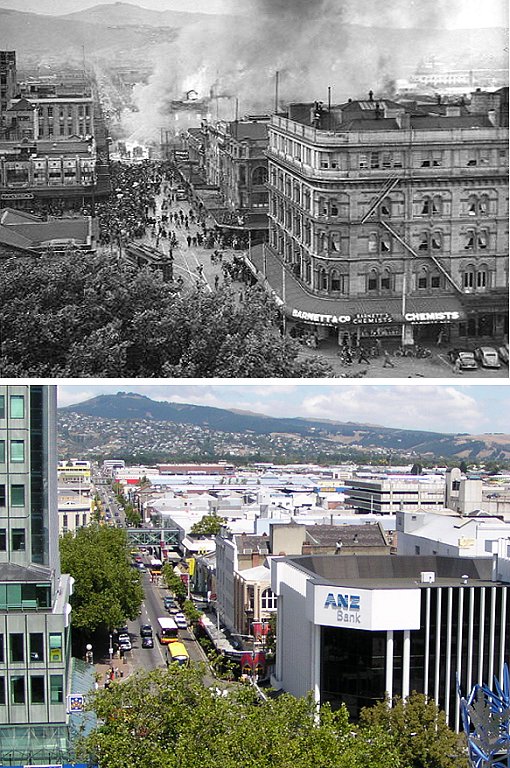
A pair of elevated Southerly views down Colombo Street from the Cathedral tower taken on the 26th of February 1947 and the same day sixty years later.

The older photograph shows Dunstable House at the corner of Colombo and Cashel Streets burning, with a loss of 41 lives.