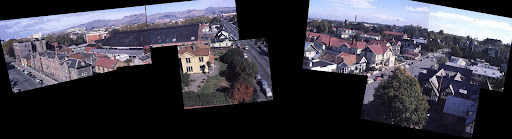
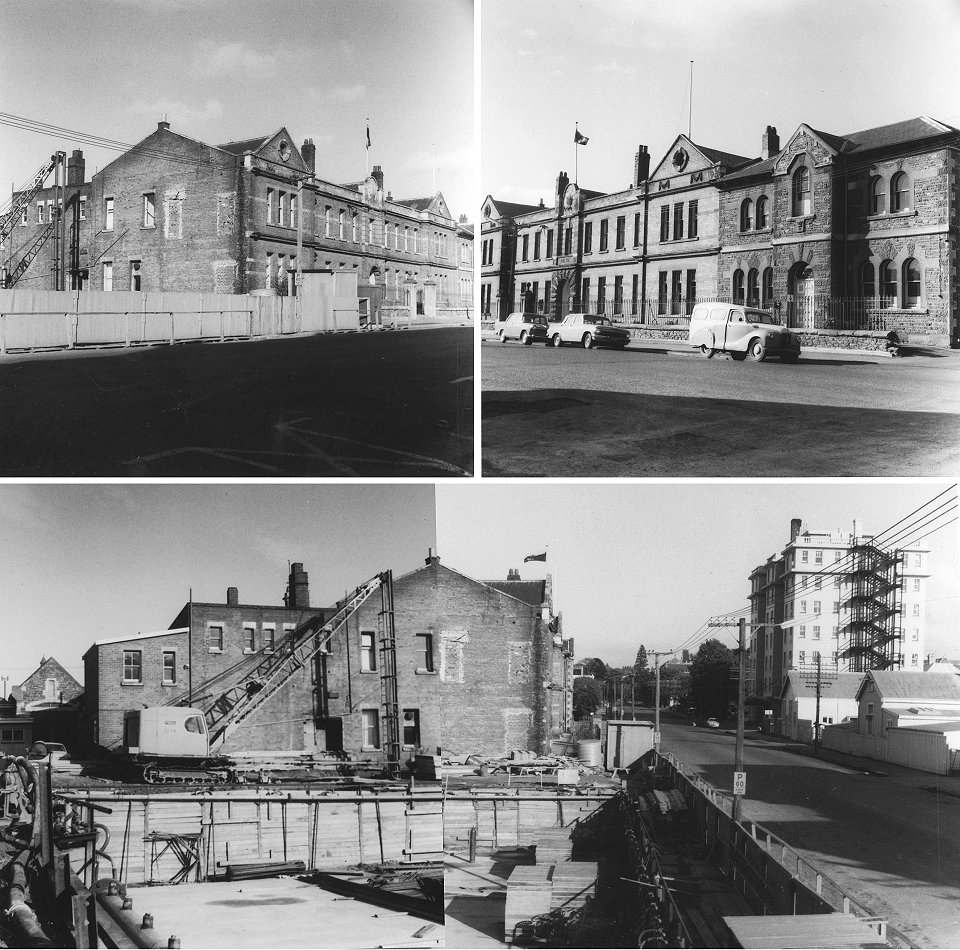
There are no known specific photographs of the city morgue, but it does appear in sufficient elevated views of the area as to enable us to purvey the following diversion for assorted Goths and sundry others enjoying a proclivity to the taphophilic
The city's first purpose built morgue stood on the southeast corner of Manchester and Armagh Streets, where the 1939 Art Deco Municipal Electricity Department building now stands. It's successor, which probably dated from 1873, was accessed by a long cast-iron fenced and gated service lane on Montreal Street, which ran between the Canterbury Militia's parade ground on Cashel Street and the Hereford Street Police Station's 1865 accommodation barracks and stables.
Having something of the appearance of a small chapel and built of brick on a north-south axis, with a wooden shingle roof, there was a tall ornamented chimney on the northern wall, which faced Hereford Street. In what was a somewhat less appealing situation than the city's more salubrious locales, a porticoed entrance on the eastern wall faced the Police Station Lockup.
The morgue probably consisted of four rooms; a waiting room, post mortem room, a coroner's room and a special room for the reception of bodies. The coroner's and post mortem rooms would possibly have been connected by a glazed sliding door, which, in the case of a body being in an advanced state of decompositon, could be kept closed, and yet allow a jury be in a position to view the cadaver. With concrete floors and a plentiful water supply from the adjacent tank stand, the rooms for the reception of bodies and post mortems could be flushed out whenever required.
By 1907 the morgue's location had become the back garden of the Police Matron's residence and it could be likely that from about that time it was superseded by the morgue at the Christchurch Public Hospital. In 1970 the old morgue was designated as a garage on a survey map compiled before the demolitions on what had become the site of a large assortment of buildings, both big and small.
Since 1974 the whole site has been a car park for the central Police Station and the adjoining site of the 1905 King Edward Barracks has been a public car park since 1996. With the current redevelopment of the former Post Office sorting centre on Hereford Street as the new headquarters for the Christchurch City Council, it could be hoped that both car parks might be combined to form a piazza worthy of the reconstructed building that will face them.
Photo: a circa 1955 view, with the roof of the morgue to the foreground and the 1909 Police Sergeant's House, facing Hereford Street, in the background (and the extant 1930 St Elmo Courts in the distance).
The city's first purpose built morgue stood on the southeast corner of Manchester and Armagh Streets, where the 1939 Art Deco Municipal Electricity Department building now stands. It's successor, which probably dated from 1873, was accessed by a long cast-iron fenced and gated service lane on Montreal Street, which ran between the Canterbury Militia's parade ground on Cashel Street and the Hereford Street Police Station's 1865 accommodation barracks and stables.
Having something of the appearance of a small chapel and built of brick on a north-south axis, with a wooden shingle roof, there was a tall ornamented chimney on the northern wall, which faced Hereford Street. In what was a somewhat less appealing situation than the city's more salubrious locales, a porticoed entrance on the eastern wall faced the Police Station Lockup.
The morgue probably consisted of four rooms; a waiting room, post mortem room, a coroner's room and a special room for the reception of bodies. The coroner's and post mortem rooms would possibly have been connected by a glazed sliding door, which, in the case of a body being in an advanced state of decompositon, could be kept closed, and yet allow a jury be in a position to view the cadaver. With concrete floors and a plentiful water supply from the adjacent tank stand, the rooms for the reception of bodies and post mortems could be flushed out whenever required.
By 1907 the morgue's location had become the back garden of the Police Matron's residence and it could be likely that from about that time it was superseded by the morgue at the Christchurch Public Hospital. In 1970 the old morgue was designated as a garage on a survey map compiled before the demolitions on what had become the site of a large assortment of buildings, both big and small.
Since 1974 the whole site has been a car park for the central Police Station and the adjoining site of the 1905 King Edward Barracks has been a public car park since 1996. With the current redevelopment of the former Post Office sorting centre on Hereford Street as the new headquarters for the Christchurch City Council, it could be hoped that both car parks might be combined to form a piazza worthy of the reconstructed building that will face them.
Photo: a circa 1955 view, with the roof of the morgue to the foreground and the 1909 Police Sergeant's House, facing Hereford Street, in the background (and the extant 1930 St Elmo Courts in the distance).