Showing posts with label exhibition. Show all posts

May 6, 2009

The Artists of the Canterbury Museum

There can be few visitors to our museum who fail to appreciate the contributions of local artists to the displays, but of the artists themselves there would appear to be little known.


Thirty-four year-old Ray Jacobs joined the staff of the museum as a Preparator in 1940. Son, father and grandfather of Taxidermists, Ray constructed the much admired recreation of a Victorian period Christchurch street (above). In addition to being an outstanding Taxidermist he also constructed the foregrounds and painted the diorama backdrops for all of the habitat groups in the 1956 Edgar Stead Hall of New Zealand birds. Ray retired in 1972 and died in 1974, about six weeks after a bedside investiture by the Governor General as an Officer in the Civil Division of the Most Excellent Order of the British Empire.


Above: Ray Jacobs creating the diorama of the Waitangituna Stream at Okarito in South Westland for the hall of New Zealand birds. White Herons (Kotuku) and a similar estaurine habitat would have been familiar to the hunters who first inhabited the confluence of the Avon and Heathcote rivers from about 1350. Much sought after for their feathers, the Heron was almost exterminated and is still a rare sighting in the Christchurch district.
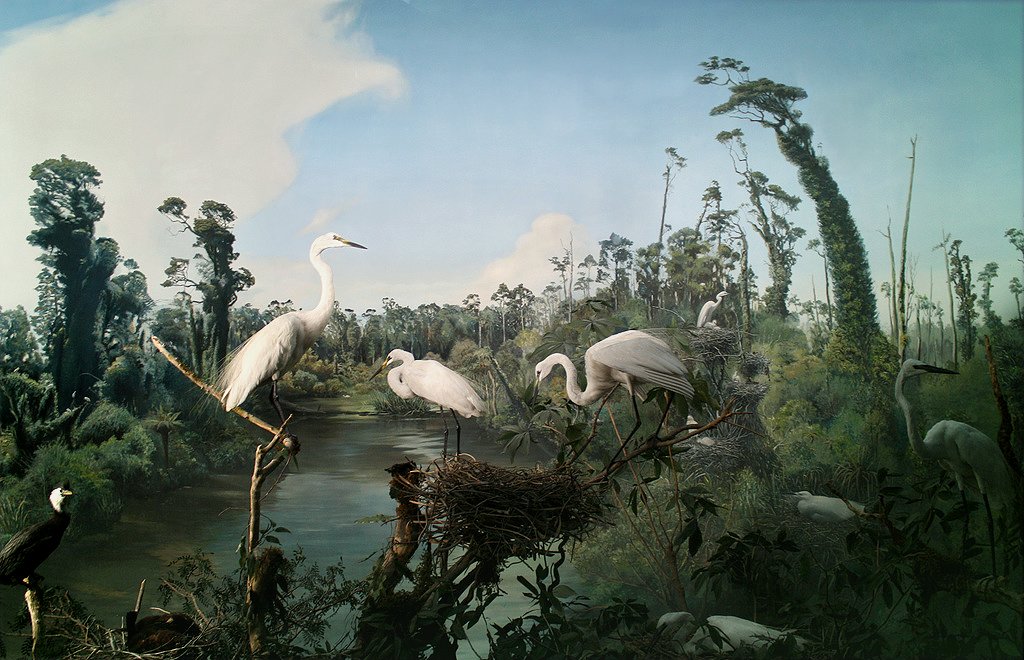

The completed diorama
LARGE IMAGE OPENS IN A NEW TAB OR WINDOW


Leo J Cappel was also a Preparator at the Canterbury Museum. Subsequently author of A Guide to Model Making and Taxidermy: A Comprehensive Manual for Sportsmen and Teachers, for Model Railway Enthusiasts and Other Hobbyists, Leo created the Museum's Moa Hunter diorama (above) before transfering to the Auckland Museum in 1964. Now in his mid-seventies and widely renowned as a writer, sculptor, composer and award winning playwright, Leo lives on Kawau Island in Auckland's Hauraki Gulf.


Commissioned to paint three large dioramas of wildlife studies for the museum's Hall of Antarctic Discovery in 1977, Wing Commander Robert Maurice Conly (1920-1995) also published Ice on my Palette in the same year. The large format book includes 27 sketches and 26 colour plates of his Antarctic impressions.

For 54 years Maurice Conly was the last Royal New Zealand Air Force Official Artist. Beyond his works of art and postage stamp designs, Conly's designs for our twenty cent and one dollar coin are familiar to all New Zealanders.


Appreciation: thanks to Cheryl Bernstein for the precipitative query and also to Sarndra Wilson of the Auckland Museum, the polymathic Leo Cappel and Terry Jacobs (youngest son of Ray Jacobs) of The Taxidermist Ltd.

Apr 14, 2009

1906 Christchurch Panorama


LARGE IMAGE OPENS IN A TAB OR NEW WINDOW

Photographed from the southern tower of the New Zealand Exhibition building is this easterly 1906 panorama of Christcurch. Restored from three photographs, across the foreground is Park Terrace.

1. The house to the extreme Left was constructed by George Braund Woodman in 1858. Originally a carpenter, Woodman (1826-1890) became a partner in the road contracting enterprise of Woodman & Wright, using much of the profit to make pastoral investments in the Ellesmere district.

Woodman was also the first Publican of the Devonshire Arms Hotel, original home of Latimer Square's Christchurch Club. Dating from 1852, the Devonshire Arms on the south-east corner of Durham and Peterborough Streets was rebuilt in 1876 as Barrett's Family Hotel to the design of the renowned William Barnett Armson. Subsequently renamed the Gladstone Hotel, it was one of the city’s oldest hostelries, being demolished in 2005 to make way for an office building. Parts of the 1876 structure have been incorporated in the new building.

2. Set in spacious grounds to its Right, at the corner of Kilmore Street, is the much enlarged Macfarlan house of 1864.

3. The dwelling on the opposite corner is yet to be identified, but above it is Cranmer Square and on the sky line can be seen the tall chimney of the Christchurch City Council's 1903 refuse destructor near to the corner of Manchester and Armagh Streets. The incinerator not only generated the city's first electricty supply (with a pair of 100 Kilowatt generators driven by two steam engines), but also heated the adjacent 1908-1947 swimming baths in Manchester Street.

4. To the centre foregound, at the northern corner of Park Terrace and Chester Street, is the Reginald Cobb house of 1871. Cobb was a partner with Henry Sawtell in Cobb, Sawtell and Company, general, wine and spirit merchants and agents for the New Zealand Loan and Mercantile Agency. In 1916 it would become Helen Connon Hall, a hostel for 70 university students until 1974. Sold by the University of Canterbury to the 1881 Cathedral Grammar School and renamed Chester Hall, it was demolished in 2001. The site is now occupied by the relocated 1886 St Saviour’s church from Lyttleton.

5. On the other corner of Chester Street is the 1880 home of the Reverend William Henry Elton (1845-1914), Cathedral Precentor. Elton's house was later purchased by the Church Property Trustees to become the Cathedral Grammar School. It was demolished in September 1985.

6. Next to it is the much smaller Sanders house, built in 1880 and demolished 1977.

7. To the far Right, at the corner of Rolleston Avenue and Armagh Street is the extant 1867 house built for the lawyer George Harper, fourth son of the city's first Bishop. It has been owned by the nearby Christ's College since 1918.

Mar 29, 2009

Christchurch Art Gallery


Christchurch's first suburb was originally known as West End. Long forgotten as such, in the 21st century its centre is now the city's cultural precinct. Dominating this locale is what has been charitably described as a warehouse in a tutu.  Little more than a museum of artistic relics from bygone eras, it is the official Christchurch Art Gallery, but it's not a place where art happens.


On the other hand, and opposite side of Hagley Park, is another Christchurch Art Gallery. Situated in the long derelict livestock saleyards at lower Riccarton, it's a location where art actually takes place. As such it might well deserve equal recognition as a cultural precinct.


A photographic essay by Brendon Keenan of the Canterbury Saleyards art collection, where cameras are allowed, opens in a new tab or window.

Mar 13, 2009

For the Record...


Photographed on the 28th of December, 2008 by 29 year old Nickmard Khoey of Auckland, this embalmed Mãori head is displayed in the Oceania rooms of the Royal Museum for Art and History at Brussels' Cinquantenaire Museum.

Mr Khoey writes,
Enbalmed (sic) and shrunken head of a 19th century Maori warrior. Maori people are the indigenous people of New Zealand (where I was born/raised).

This head was on display in a musuem in Brussels I visited but can't remember the name of it. I believe it is part of a French collection that is was on loan for a pacific (sic) orientated exhibiton.
The tattoo on the warriors face is called moko or toi moko and is still practised by the Maori people in New Zealand today. However, very few on this kind of scale.

These heads are sacred and need to retruned (sic) to New Zealand.


For the sake of the historical record it should probably be noted that the early 19th century Mãori did a roaring trade in preserved heads for guns. 

The only culture believed to have farmed its own species for fresh meat, they would tattoo the heads of slaves to give them a chiefly appearance. After removal, the heads would be given an antique patina using juice derived from the Konini tree (the world's largest Fuschia).

The guns thus acquired perpetuated a vicious circle that was only broken by extensive European settlement. 

That the often repeated allegation these heads are sacred and therefore need to be returned to New Zealand is, in our unfashionable opinion, little more than ethnocentric hypocrisy.


Photo Credits

Top:
a 2008 photograph by Nickmard Khoey of Auckland.

Bottom: Major General Horatio Gordon Robley with his collection of Maori heads, an illustration from
Medicine Man: The Forgotten Museum of Henry Wellcome, British Museum Press, 2003.

Jun 8, 2008

Christchurch to Host Prestigious Garden Show


New Zealand’s premier garden event, the Ellerslie International Flower Show, will be hosted in Christchurch from March 2009.

The City Council purchased the Flower Show in November in 2007 for an undisclosed price. Hosting a Flower Show of this calibre will serve to further enhance Christchurch’s internationally recognised image as New Zealand’s Garden City and to celebrate the city’s rich cultural heritage.

When the gates open for the first Christchurch-hosted event, from 11 to 15 March 2009, the Show is expected to attract similar numbers to those attending previous shows in Auckland and inject more than $14 million into the local economy annually. There will be more than 250 exhibitors and 30 garden displays.

Ellerslie International Flower Show is already recognised internationally and Christchurch will built on past successes as it works to develop Ellerslie as one of the top five flower shows in the world.

From March 2009, the five-day floral extravaganza will be held in North Hagley Park, drawing a global audience of garden designers, garden lovers and international media.

The event will champion the best of garden design, garden trends and new products – and being held in Autumn, the Show will celebrate the harvest season with a feast of food, wine and entertainment.

The Ellerslie International Flower Show 2009, as one of the most prestigious garden events in the world, is guaranteed to stimulate the senses with loads of fresh and exciting ideas to create vibrant garden spaces.

Web site: Ellerslie International Flower Show

Mar 8, 2008

McCahon at the Gallery

Considered one of the most influential modernists in the Australasian region, Colin John McCahon (1919-1987), was a member of the Christchurch art collective The Group.

His early figurative work of the 1940s and 1950s was dominated by images drawn from religious paintings, often set in the New Zealand landscape.

Along with Rita Angus and Toss Woollaston he is credited with introducing modern styles to New Zealand art in the early twentieth century.