Showing posts with label UNIVERSITY. Show all posts

Jul 13, 2009

The University of Canterbury's New School of Music


Designed by the beknighted Miles Warren, in what might appear to be a ponderous derivative of 1970s architectural style, is the proposed University of Canterbury's National Conservatorium of Music building.

The intended site is part of the renaissance medieval Gothic Arts Centre complex bounded by Worcester, Hereford, Montreal Streets and Rolleston Avenue.

Not previously built upon, it was originally the recreational ground of the 1881 Christchurch Boys' High School and a part of the rear garden of the 1883 Llanmaes House (much enlarged, the house became the University's Student Union building in 1929 and is now the Dux de Lux Restaurant & Bar).

The proposed site is to be seen below near the centre of this 1940 aerial photograph.


Below: in 1941 the Army erected a large radio aerial on the site, but other than that it's always been a recreational reserve, that is until the good burghers of Christchurch managed to turn it into yet another car park.


The predictable pre-construction media release advises us that the new building will be "in a style that complements existing buildings, none of which would be impacted by the new structure."

We beg to disagree; it could seem that the 80 year-old architect may be a little out of touch with more recent advances in architectural engineering. If the site must be built upon, and that's debatable, then perhaps something along the lines of this new building for the medieval centre of the Estonian city of Tallinn, might be more cost effective and inspiring.


In what might seem to be a conflict of interest, the venerable architect had more than a finger in the pie of his bronze likeness being erected in the grounds of the Arts Centre complex. Might we respectfully suggest that it could be time for him to consider bowing out gracefully in favour of a more imaginative architect among whose principal qualifications is not membership of our old-boy network.

Further reading:
Richard Sinke's extensively illustrated Save Our Arts Centre web site.

Arts Centre site 'only city option' The Press newspaper, 10 July, 2009.

The University of Canterbury's self-congratulatory new School of Music web site.
Photo credit: top image; detail from Wellington artist Ian Stantiall's perspective of the new School of Music building.

Apr 14, 2009

1906 Christchurch Panorama


LARGE IMAGE OPENS IN A TAB OR NEW WINDOW

Photographed from the southern tower of the New Zealand Exhibition building is this easterly 1906 panorama of Christcurch. Restored from three photographs, across the foreground is Park Terrace.

1. The house to the extreme Left was constructed by George Braund Woodman in 1858. Originally a carpenter, Woodman (1826-1890) became a partner in the road contracting enterprise of Woodman & Wright, using much of the profit to make pastoral investments in the Ellesmere district.

Woodman was also the first Publican of the Devonshire Arms Hotel, original home of Latimer Square's Christchurch Club. Dating from 1852, the Devonshire Arms on the south-east corner of Durham and Peterborough Streets was rebuilt in 1876 as Barrett's Family Hotel to the design of the renowned William Barnett Armson. Subsequently renamed the Gladstone Hotel, it was one of the city’s oldest hostelries, being demolished in 2005 to make way for an office building. Parts of the 1876 structure have been incorporated in the new building.

2. Set in spacious grounds to its Right, at the corner of Kilmore Street, is the much enlarged Macfarlan house of 1864.

3. The dwelling on the opposite corner is yet to be identified, but above it is Cranmer Square and on the sky line can be seen the tall chimney of the Christchurch City Council's 1903 refuse destructor near to the corner of Manchester and Armagh Streets. The incinerator not only generated the city's first electricty supply (with a pair of 100 Kilowatt generators driven by two steam engines), but also heated the adjacent 1908-1947 swimming baths in Manchester Street.

4. To the centre foregound, at the northern corner of Park Terrace and Chester Street, is the Reginald Cobb house of 1871. Cobb was a partner with Henry Sawtell in Cobb, Sawtell and Company, general, wine and spirit merchants and agents for the New Zealand Loan and Mercantile Agency. In 1916 it would become Helen Connon Hall, a hostel for 70 university students until 1974. Sold by the University of Canterbury to the 1881 Cathedral Grammar School and renamed Chester Hall, it was demolished in 2001. The site is now occupied by the relocated 1886 St Saviour’s church from Lyttleton.

5. On the other corner of Chester Street is the 1880 home of the Reverend William Henry Elton (1845-1914), Cathedral Precentor. Elton's house was later purchased by the Church Property Trustees to become the Cathedral Grammar School. It was demolished in September 1985.

6. Next to it is the much smaller Sanders house, built in 1880 and demolished 1977.

7. To the far Right, at the corner of Rolleston Avenue and Armagh Street is the extant 1867 house built for the lawyer George Harper, fourth son of the city's first Bishop. It has been owned by the nearby Christ's College since 1918.

Apr 4, 2009

Christchurch's First Palace


Situated on the quarter acre Town Section 404, the first house on the western side of the Avon River was built in 1851 by Henry John Cridland (1821-1867), Superintendent of Public Works for the Canterbury Association from 1849. A New Zealand Company surveyor from 1843, Cridland was also an artist, architect, and like many of his lower middle class contemporaries, a political schemer and property speculator.


By 1856 a large extension had been added to the rear of the house. In December of that year the Cridland family moved to their farm at Hoon Hay and the house became the episcopal palace of Henry John Chitty Harper (1804-1893), first Bishop of Christchurch. Harper and his large family, who fetched water from the river, occupied the house until the completion in late 1858 of the much grander Bishopscourt on nearby Park Terrace.


Situated on Cambridge Terrace, equidistant between Worcester and Hereford Streets, the house was the only occupant of the block's river frontage until 1863 when the first Public Library building was completed at the Hereford Street corner and then the Canterbury Club to the Worcester Street corner 1874.


In later years the old house appears to have been occupied by staff of the Canterbury Club. Demolished between 1918 and 1920, the site became part of the Club's garden, which was replaced with a sealed car park by 1965. As such it remains.


Harper's residential predilection for the western side of the Avon River, rather than the extensive Anglican church lands in the vicinity of Cranmer Square, was probably instrumental in the development of the area as the salubrious suburb of West End, much favoured by the professional classes.

The subsequent development of the Canterbury University College on what had previously been a residential block attracted academics to the suburb from the mid 1870s. By the 1930s many of the grand homes had become private hotels and rooming houses for the College's students.

A thriving bohemian culture developed among the artists, writers, poets and musicians who occupied the quarter through the following decades. Toward the latter part of the twentieth century the bishops, accountants and lawyers moved on to suburban Cashmere, the University left the area and much of the built heritage was replaced high rise concrete.

The city's first suburb, which was subsequently associated with many of the most illustrious names in the New Zealand arts community of the twentieth century, lost its name, social cohesion and much of the former aesthetic.

Photo Credits: the Canterbury Museum, the Christchurch Public Library, the Christchurch Art Gallery and the Alexander Turnbull Library.

Nov 20, 2008

Townsend Observatory 1896


A rare photograph of the newly completed biological laboratory and observatory tower of the Canterbury College of the University of New Zealand about June, 1896.

The dome was originally constructed of canvas and wood. The observatory is the only part of the Arts Centre still owned by the University of Canterbury. Each year the Department of Physics and Astronomy appoints a student as the Townsend Observer. Public viewing is held during the months of the year when there is no daylight saving.

Sep 24, 2008

Black Friday 1953

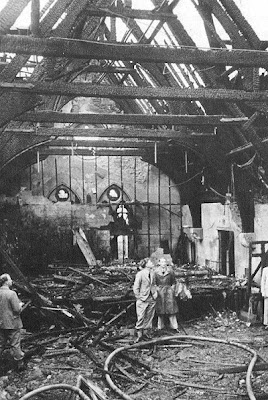
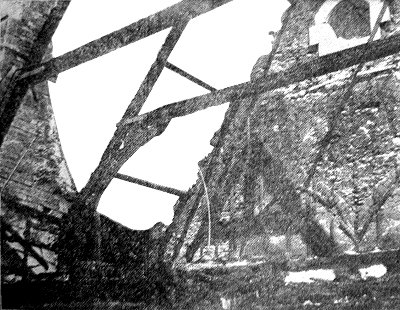
Friday the 13th hasn't been particularly inauspicious in the history of Christchurch, but Friday the 13th of February, 1953 was the day that the University burnt.


At 3.43 a.m. on that morning a street alarm at the corner of Hereford and Montreal Streets summoned seven units from the Lichfield Street, Sydenham and St Albans Fire Stations to what is now the Worcester Boulevard frontage of the Arts Centre. The fire began in the south-east corner of 1879 extension, which had been occupied by the Christchurch Boys High School from 1881 to 1926. The Shelley Theatre of the Canterbury University College Drama Society and part of the Department of Geology were completely gutted. There was also considerable water damage to the departments of Civil Engineering, Economics and Psychology.


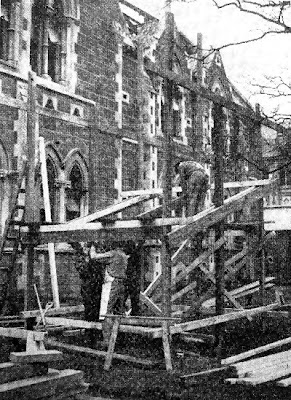
Above: wooden scaffolding being erected prior to rebuilding. A total insurance loss, restoration took six months.


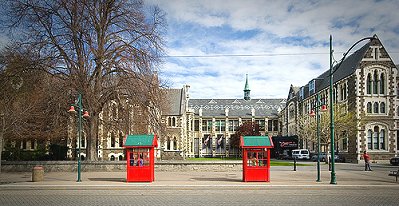
Above: the fire damaged area is to the Left in this contemporary photograph.


To promote the Christchurch City Libraries Retrospective: Christchurch life, architecture and design 1940s - 1970s photo competition, we're featuring a series of images from each decade. This week is the 1950s and next week we'll take a look at the 1960s.

Aug 29, 2008

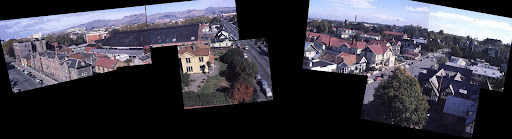
Christchurch 1961 Panorama


Since early August, 2008 the Christchurch City Libraries has been posting historic images on flickr.com. Among the most recent posts has been a sequence of undated photographs taken from the roof of the 1930, seven storey, St Elmo Courts, Art Deco apartment building in Hereford Street at the Montreal Street corner.

Above is an east-west partial panorama constructed from some of the Libraries' photographs.

To the extreme Left is the corner of Cambridge Terrace and Hereford Street, with the 1908 YMCA building on the site. Next to it (along Cambridge Terrace) can be seen the rear of the YMCA's Gordon Hall of 1885. To the Right of the Gordon Hall is a pale green two storey wooden building. Demolished in 1998, this was the 1940 headquarters of the NZ Army's Southern Military District. Clearly visible is the fire damaged roof of this building, which burnt in February, 1961.

Demolished in 1968, the 1908 YMCA building was replaced by the current Police Station in 1973. Along the range from Cambridge Terrace to Montreal Streets are the buildings of the 1863 Police Barracks and the 1873 & 1906 Police Stations. These were progressively demolished between 1973 and 1984 for a car park. At the corner of Montreal Street is the 1909 residence of the Chief Inspector of Police.

Between Montreal Street and Rolleston Avenue is a range of houses dating from circa 1880-1900. The most conspicuous of these is the vastly expanded Hereford Private Hotel ($10 a night and $1.50 for breakfast in 1984).

To the Right are the buildings of Canterbury University (now the Arts Centre). In the foreground can be seen the former 1883 Llanmaes House, subsequently the Student Union building from 1929, it is now the Dux de Lux Restaurant & Bar.

Feb 10, 2008

Canterbury University College 1877-1891

A recently restored photographic sequence showing the architectural development of the former Canterbury College of the University of New Zealand from 1877 to 1891.

Originally a residential area, the 1933 purchase of Llanmaes House (subsequently the Student Union and now the Dux de Lux restaurant), completed the acquisition by the University of the block enclosed by Worcester, Hereford, Montreal Streets and Rolleston Avenue.

The Medieval Gothic Revival buildings have comprised the Christchurch Arts Centre since 1991.

From the top; 1877, 1878, 1882, 1891 & 2007.

Christchurch Arts Centre
Christchurch Now & Then #17