Jun 8, 2008

Old Railway Station Revitalisation?


8 June, 2008.

Science Alive is the science learning centre based in the 1957 Railway Station building on Moorhouse Avenue.

The centre has outgrown the building and is seeking new and innovative premises on a large block of land in the city. If they can't find a suitable city site then they intend moving the centre to a suburb.

The directors of Science Alive have been overseas looking at similar developments, and are apparently planning something special to expand the promotion of Science as a vital part of life. They propose to be developing the project within a year or so.

Could the Railway Station be heading for a new lease of life as a rail hub for the city, surrounded by dense apartment living, entertainment and commercial activity? Could this be the big one in the redevelopment of the south of the city centre?

The $240 million reported in The Press newspaper is probably only going to get a line up and running, which might have eight to twelve stations. The cost of having a good system would be at least four times that. There still hasn't been much mention of light rail, which would probably cost a further few hundred million to set up.

The old station had one main platform running through from east to west and had dock platforms at either end for use by suburban trains and other services. The railway line now runs along a corridor as two tracks 30-50 metres to the south of the old station and is now hemmed in by ugly developments on either side.

Word on the street indicates that there's a lot going on behind the scenes, with most enthusiasm coming from the Christchurch City Council and the Selwyn and Waimakariri District Councils, but with scepticism mixed with intrigue coming from Environment Canterbury. The opinion of the group of councils probably counts most.

We shall just have to wait and see...

1913 Postcard


Update: 19 June 2008

Science Alive is looking to establish a state-of-the-art science centre with the University of Canterbury as a partner.

Science Alive chief executive Neville Petrie and the university's pro-vice- chancellor of science, Professor Ian Shaw, have confirmed plans to build a new centre on the university's campus.

Christchurch to Host Prestigious Garden Show


New Zealand’s premier garden event, the Ellerslie International Flower Show, will be hosted in Christchurch from March 2009.

The City Council purchased the Flower Show in November in 2007 for an undisclosed price. Hosting a Flower Show of this calibre will serve to further enhance Christchurch’s internationally recognised image as New Zealand’s Garden City and to celebrate the city’s rich cultural heritage.

When the gates open for the first Christchurch-hosted event, from 11 to 15 March 2009, the Show is expected to attract similar numbers to those attending previous shows in Auckland and inject more than $14 million into the local economy annually. There will be more than 250 exhibitors and 30 garden displays.

Ellerslie International Flower Show is already recognised internationally and Christchurch will built on past successes as it works to develop Ellerslie as one of the top five flower shows in the world.

From March 2009, the five-day floral extravaganza will be held in North Hagley Park, drawing a global audience of garden designers, garden lovers and international media.

The event will champion the best of garden design, garden trends and new products – and being held in Autumn, the Show will celebrate the harvest season with a feast of food, wine and entertainment.

The Ellerslie International Flower Show 2009, as one of the most prestigious garden events in the world, is guaranteed to stimulate the senses with loads of fresh and exciting ideas to create vibrant garden spaces.

Web site: Ellerslie International Flower Show

Jun 7, 2008

1879 Christchurch Panorama


A 2167 x 491 pixel enlargement opens in a new window

Canterbury Heritage is a recognised authority on the identification of historic images of the province. As such it regularly assists a wide range of museums, libraries and galleries throughout the Australasian region.

This service is also available, without expense, to private individuals. Please contact the Editor if you have photographs, etc. requiring identification.

From the archives of the National Library of Australia came four unrelated photographs, which when assembled form a previously unknown 1879 Christchurch panorama.

An elevated South to Northwest panorama of the former Christchurch Common, subsequently Market Place from 1853 and then Victoria Square since 1904.

Viewed from the watch tower of the second Fire Station of 1876 (now The Plunket Society building), with the slate tiled roof of the previous Oxford Hotel to the immediate foreground (on the site of the original Maori Hostel).

Included in this image are views of Armagh, Chester, Gloucester & Colombo streets, Whatley Road (subsequently Victoria Street) and Oxford & Cambridge terraces.

The former Palace Hotel and the adjacent second Theatre Royal (both extant) in Gloucester Street can be seen in the far Left middle ground, behind Dr William Deamer's brick, two-storey Surgery and contiguous dwelling in Armagh Street (built 1865) .

To the Right of the Surgery and next door but one can be seen the veranda of the first house in Christchurch to be erected by a Settler. This was the prefabricated home of George Gould constructed in February, 1851.

See from where this panorama was taken.

Jun 6, 2008

Reader's Comments

Four months have now elapsed since the inauguration of the Canterbury Heritage 'net presence.

In that time the web site has generated a significant body of correspondence relating to the province's history. Much of it has been of value to the historic record and individual postings have been updated accordingly.

Subsequent to popular request, and further to the pursuit of both open discussion and crowdsourcing, a facility to allow reader's comments is now enabled.

Obit. David Studholme


The second child of Edgar Studholme (1866-1949), Michael David Studholme was the last surviving grandchild of Michael Studholme (1833-1886), the first European settler at Waimate.

David was born at Te Waimate and his early schooling was at home and later at Christ's College. He left school in 1929 to commence a 50 year a farming career. An early pioneer of Border Romney sheep, in 1968 David went into partnership to buy Braemar Station in the Mackenzie country, which he farmed until 1975.

On his retirement David became an enthusiastic and widely recognised expert on the restoration and construction of earth buildings. In recognition of this he was awarded the Queen's Service Medal in 1992, a Rotary foundation Paul Harris Fellow medal and NZ Historic Places Trust certificate of meritorious service in 2004.

David supervised the restoration of The Cuddy, built in 1854 in the grounds of Te Waimate. This was soon followed by the restoration of other buildings including the original Molesworth Station homestead, Acheron accommodation house, Top House (Nelson), Paterson's cottage in Kurow and the Waimate museum's new earth building.

The last years of his life were spent at the Bishopspark Retirement Village in Christchurch. David's farewell service was held on a warm autumn day at his birthplace in the garden he loved so much. He is survived by his children Jane, Nicola and Michael, seven grandchildren and two great-grandchildren.

Further reading:
Death of leading historian and South Canterbury farmer, The Timaru Herald, 06 June 2008

Profile: David Studholme,
Heritage New Zealand, Winter 2005

Jun 5, 2008

Canterbury's Largest Hotel


It's often been noted that a shrewd wife is a most useful adjunct to an aspiring commercial magnate...

Alfred Joseph White, a Currier from Devon, made good in the remote frontier town that became our Nation's first city. So good in fact that he was able to acquire most of the real estate in the block enclosed by High, Manchester, Tuam and St Asaph Streets. Sixty-one year old Alfred died in 1895, but the canny Eliza presided over the substantial growth of A J White's furniture warehouse and the family's wider commercial interests.

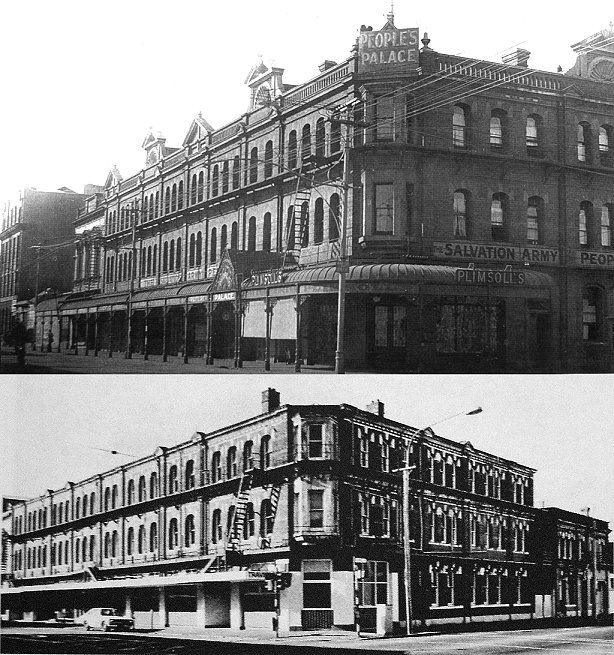
In the first decade of the last century Fred's widow was responsible for the construction of most of the substantial buildings within the block. At the South-east corner of Manchester and St Asaph Streets the city's largest hotel was built in 1909 for the Eliza White Trust.

Known as Cockayne's Leviathan Hotel it had 180 guest rooms and even a private dining room for Ladies. Situated on the principal thoroughfare that connected the inner city with the railway station, there was a row of small shops along the Manchester Street frontage.

The hotel was subsequently leased to the Salvation Army and became known as the People's Palace. However, that army's interests in the hospitality industry eventually focused in other directions and their Manchester street hostelry became the Railton Hotel.

Familiar to generations of Christwegians the poorly maintained Railton closed in 1970. The, by then, mismanaged Eliza White Trust offered the building for sale at $270,000, but there was no interest. The following year the City Council offered to lease the bare site and the hotel was demolished. Like the sites of too many of our city's heritage buildings, it has remained a car park ever since.

See where these photographs were taken.

Jun 4, 2008

New Regent Street Restoration


New Regent Street 1932

A distinctive rows of forty shops on New Regent Street are to benefit from a $500,000 Christchurch City Council grant. The project will include strengthening the buildings, reinstalling the original decorative tiles that some shops still feature beneath the front windows, and tidying modern additions to the street.

Built on the site of the massive Colosseum, which had been used as a skating rink, theatre, boot factory and finally a garage, the street was first proposed in 1929 by merchant George Gould II (1865-1941) and was opened by the Mayor Dan Sullivan on the first of April, 1932.

The street was the work of a local architect, Harry Francis Willis (1893-1972), who also designed the now concealed 1934 Art Deco facade of the nearby State Cinema at the northeast corner of Gloucester and Colombo Streets. Willis was the readiest in the Christchurch of the late 1920s and 1930s to experiment with decorative building design.

The distinctive Spanish Mission architectural style is unique on such a scale in New Zealand and was one of few big construction projects in the South Island during the Great Depression period.

Based on 2007 figures, the upgrade is likely to cost about $1.4 million for the whole street, with the cost for each property varying. Of this, the Council can provide grant money of up to 40% of the cost per property. The Council is expecting this to total about $500,000 over the life of the project.

A Council heritage conservation projects planner says the money will be used to repaint the street based on the original colour scheme, which is understood to be Cream, Ochre and a light Terracota.

Further reading:

Revamp planned for picturesque street, The Press, 04 June 2008

Press Release, Christchurch City Council. 5 June 2008

Jun 3, 2008

Centenarian Christchurch Photographer

The photographs of Gladys Goodall form an important visual record of the province for the three decades from 1950. Above is a southerly view of the Bridge of Remembrance, one of her early images of Christchurch.

Approximately 10,940 colour transparencies and 950 postcards by Goodall are held within the photographic archive of the Alexander Turnbull Library at Wellington.

Gladys Mary Goodall was born on the 2nd of June, 1908, the second eldest of eight children and grew up on a remote north Otago farm. After training to become a nurse, she worked at Timaru and Christchurch until 1952.

Goodall took her small Agfa camera with her on alpine tramping expeditions, capturing the scenery on film. When her tour bus driver husband Stan showed some of the photographs to his tourists, he found they were enormously popular. So, at age 44, Gladys left her nursing career and set up shop as an independent scenic postcard photographer, operating out of an upstairs studio of an 1860s house at 73a Kilmore Street (at the corner of Victoria Street) in Christchurch. The small business boomed through the 1950s, and her reputation as a scenic photographer flourished.

In 1960 Gladys negotiated an exclusive contract with Whitcombe and Tombs to provide colour photography for their postcards, colour transparencies and calendars, "I wouldn't go into it until I had a written agreement that I would be their only photographer. Otherwise I would have gone bankrupt in three months. This was in the days when women didn't say no to General Managers. Eventually he agreed and got the shock of his life when he found that he had to keep to the contract."

In her new role she created a fascinating record of this country in the postwar period, populated by mid-length polyester walk shorts, grandiose municipal flowerbeds and unreconstructed Kiwiana Kitsch. Her photographic aesthetic, with its plain formality and geometry that seemed to reflect her formidable Puritan work ethic, was ideal for the subject matter.

While the publisher's contract gave her the chance to create a new career for herself in an age colour photography, it was far from being an easy ride. All her expenses; travel, accommodation, paying pilots for aerial shots and so on, had to come out of the royalty payments she received from card sales. She traveled the country alone on primitive roads in her trusty yellow Mark III Ford, which clocked up more than 160,000 kilometres until it was written off in an accident, which left her in Thames hospital for a month.

She'd be away from home for up to four months at a time, effectively having to re-photograph the entire country every few years, to keep the postcards up to date, "That's why mine were selling so well, because they were new and all the new things were in them. But you had to re-photograph places when they changed. Wellington was changing every month, we'd get one postcard printed and it'd be out of date in no time."

Goodall's photographs were sold not just as postcards, but also in the popular Panorama series of booklets. Perhaps the secret of her popularity was tactic of tapping into local knowledge of local sights: "I always went to the people in the shops which sold postcards and asked what tourists asked for in the area. I did my research and never took a photo until I'd spoken to the people who were going to sell them. There's no point in taking the most beautiful photograph in the world if it won't sell."

Her photography helped define affluent postwar New Zealand's image of itself as a scenic wonderland. Not all of her cards were spectacular tourist shots, however. Her photographs of the main roads of small towns such as Waimate and Geraldine inevitably recall British photographer Martin Parr's Boring Postcards books. Nevertheless, in the very mundaneness of these images of provincial towns, there is a degree of realism which makes them all the more authentic and appealing.

Gladys Goodall (photographed by Maree Henry, 2001)

Gladys Goodall Q.S.M., J.P. retired in 1980, continuing to drive her car and remaining active with the Age Concern Canterbury organisation until the age of 91. The centenarian now lives at Avonhead, a quiet dormitory suburb of Christchurch. "There comes an end to things. I felt that I had given everything I had, I'd photographed everything I could think of."


Commemorative Postcard

Jun 2, 2008

A Lost Institution


Like the renowned philanthropist Thomas Edmonds (1858-1932), George Robert Fail (1866-1937) was a native of suburban Poplar in London's East End. By the age of fifteen he was the cook aboard the Suffolk, a steam tug that towed sailing vessels from Dungeness at the mouth of the Thames river to the docks to the east of the city.

Twenty-two year-old George arrived in Christchurch in 1884 and in 1897 married Akaroa born Annie Ethel Cashmere (1882-1935). Annie's father was French labourer and her mother was Irish. Annie bore four sons and five daughter, of whom seven survived into adulthood. By 1906 they were living in William Street (now part of the Christchurch Polytechnic site), moving to Salisbury Street by the following year.

Listed as the keeper of a fish shop in 1894, by 1898 George had opened a Fish, Game and Poultry restaurant on the ground floor of the Colonial Mutual Life building on the eastern side of High Street near the Cashel Street corner (the old building is still there).

Business was good and in 1907 they moved to larger premises on the south side of Cashel Street near the Durham Street corner. Originally known as the Rio Grande, the flourishing restaurant's premises were substantially enlarged and the bespoke dinner ware was made by W H Grindley & Co of Tunstall, Stoke-on-Trent in England.

George and Annie occupied the upper floor as an apartment. It's understood that at some time they also had a house in the same street where George had an astronomical observatory, apparently the telescope was commandeered by the Army in World War II.

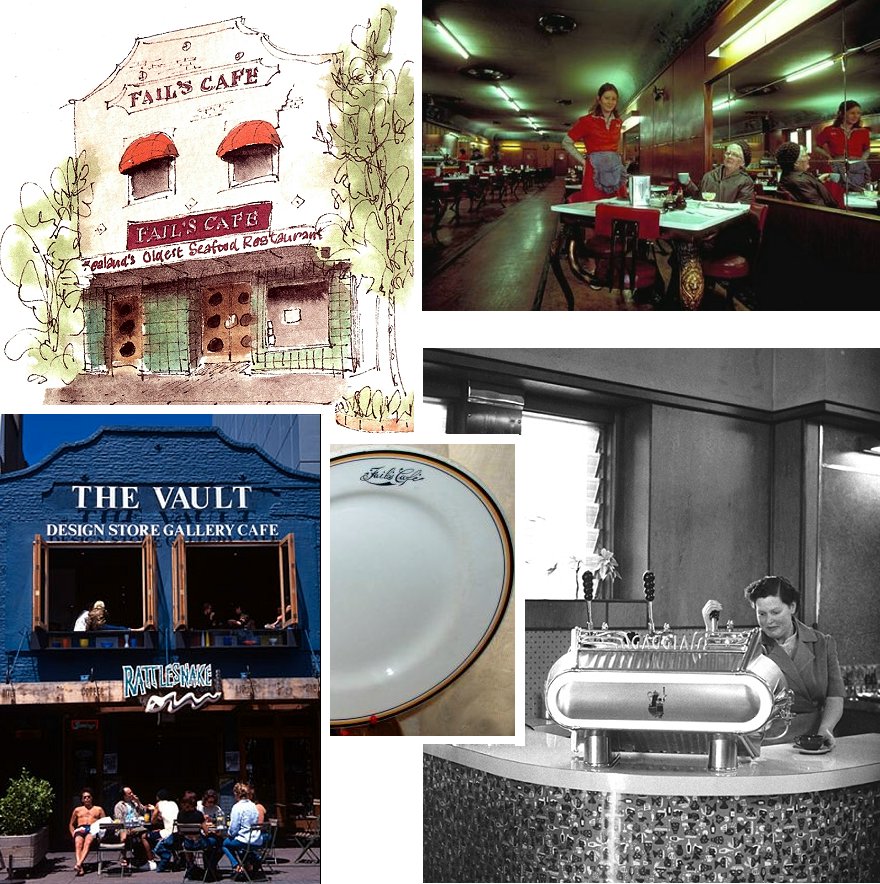
"Pop" Fail died in 1937 and his eldest surviving son Robert Mather Fail (Bob) took over the management of the restaurant. Renamed Fail's Café, the ground floor facade and interior of the early 1870s building was remodelled to the Art Deco style.

Famous for its fish and unique chairs, New Zealand's oldest Seafood restaurant was a much loved Christchurch institution. However, by the late 1980s tastes in restaurant dining had undergone significant change and the business closed. The distinctive furnishings and dinner ware fell to the Auctioneer's hammer.

82 Cashel Street has subsequently undergone a number of morphoses. Now sporting an inappropriate paint job and much structural alteration, the historic building is currently the premises of The Bog.

Credits
Gordon Collingwood, for historical information.

The Auckland War Memorial Museum for Robin Morrison's 1979 interior of the restaurant (top Right).

Derrick F Donovan of Albany, Auckland for his illustration from New Zealand Odyssey by Euan Sarginson (top Left).

Christchurch Public Library, Heritage Photograph Collection for the circa 1955 photograph of a waitress serving expresso coffee (bottom Right).

See where these pictures were taken.

Jun 1, 2008

Dollan Grave - Barbadoes Street Cemetery


John and Margaret Dollan, from Lanarkshire, arrived at Lyttelton aboard the British Empire in 1864.

John Dollan, aged 60, a printer's Compositor of Madras Street North, died on the 3rd of November, 1902. His wife, Margaret Fleming Baillie Dollan, aged 58, died on the 2nd of January, 1903.

Their grave records the burial of ten Dollan children, victims of the epidemics which swept 19th century Christchurch. These were:

Sarah, born 23 December 1864 - died 4 June 1875
Andrew G., born 10 July 1870 - died 18 May 1875
Robert, born 18 February 1872 – died 24 June 1872
Margaret, born 5 July 1876 - died 25 January 1877
Helen, born 10 July 1877 - died 20 March 1878
Mary, born 24 November 1878 - died 12 January 1879
Charles, born 26 January 1880 - died 21 February 1880
Ethel, born 28 May 1881 - died 15 December 1881
Alice, born 5 August 1882 - died 21 January 1885
Arthur, born 1 November 1885 - died 11 January 1886

Some Dollan offspring, among them John William (1870-1953) and Henry Neil (1874-1958), did survive. In the last decade or so of their lives John and Margaret saw their sons married and welcomed grandchildren into the world.

Obituary - Christchurch Star, September 10th 1958.
Henry Neil Dollan, born 19th of May 1874, died September 10th 1958, at Christchurch, aged 85 years. Husband of Elizabeth, father of Lillian, Phyillis and Harry, grandfather to Philippa and Robert.