Showing posts with label research. Show all posts

Mar 8, 2009

Old Lyttelton (for Richard)

These are old survey maps and photographs of the intersection of Lyttelton's Winchester and Canterbury Streets.

A north-easterly view across the intersection in 1858.


An 1860 survey map.


The north-west corner about 1865.


A survey map showing the extant buildings in 1867.


A circa 1890 elevated north-easterly view (above). At the north-eastern corner, the home of the Tobacconist William Wales Junior was completed with the addition of a western wing by 1901. The same house photographed in 2007 (below).


Hatherly's grocery shop on the southwest corner in 1901.


The 1860 Anglican church of the Holy Trinity and the 1880 vicarage at the southeast corner, photographed prior to 1906.

Jan 23, 2009

Maori from Taiwan 5,200 years ago

New research into language evolution suggests that the Maori originated in Taiwan around 5,200 years ago. Scientists at The University of Auckland have used sophisticated computer analyses on vocabulary from 400 Austronesian languages to uncover how the Pacific was settled.

The results, published in the latest issue of the prestigious journal Science, show how the settlement of the Pacific proceeded in a series of expansion pulses and settlement pauses. The Austronesians arose in Taiwan around 5,200 years ago. Before entering the Philippines, they paused for around a thousand years, and then spread rapidly across the 7,000km from the Philippines to Polynesia in less than one thousand years. After settling Fiji, Samoa and Tonga, the Austronesians paused again for another thousand years, before finally spreading further into Polynesia eventually reaching as far as New Zealand, Hawaii and Easter Island.

Further reading: Science Daily


Jan 18, 2009

Podcast: Vegetation Cuts City Crime


From the University of Illinois, and of timely relevance to Christchurch, is research that indicates that there are fewer occurrences of crime against both people and property when buildings are surrounded by trees and greenery.

Compared with buildings that had little or no vegetation, those with high levels of greenery had 48 percent fewer property crimes and 56 percent fewer violent crimes. Even modest amounts of greenery were associated with lower crime rates. The greener the surroundings, the fewer the number of crimes that occurred.

From Australia's All in the Mind series comes Greening the Psyche, a 30 minute podcast;

"Intuitively we sense that nature relaxes us; even small pockets of green in the concrete urban jungle seem to make a difference. But finding good scientific evidence for how and why has been more difficult, until now. Crime rates, academic performance, aggression and even ADHD; could a bit of greening make all the difference? And, ecology on the couch; a self described 'ecotherapist' with novel techniques."

LISTEN NOW

DOWNLOAD AUDIO

READ TRANSCRIPT

Jan 15, 2009

1858 Canterbury Provincial Government Building


LARGE IMAGE OPENS IN A NEW WINDOW

The first part of the Canterbury Provincial Government building, on the eastern side of Durham Street between Armagh and Gloucester Streets, was built by 30 year-old Frederick Jenkins, a builder of Ferry Road.  The foundation stone was laid on the 6th of January, 1858 and the  total cost was £5,757, inclusive of Benjamin Mountfort's architect's fees and Aaron Whincop's interior decoration expenses.


In May of the following year a second contract was let for the addition of a tower to the street frontage, an extension to the southern wing with a pair of dormer windows in the roof of the new section and a council chamber to the east. 

Below: 1859 photograph of the rear of the building by Dr. Alfred Charles Barker (1819-1873) taken from the balcony of his house at the corner of Worcester Street and Oxford Terrace.


Later in 1859, using the traditional cruck frame method of construction, Jenkins added the first Provincial Council chamber to the back of the building (below).


Credits: 1859 photographs; Dr. A. C. Barker Collection, Canterbury Museum.

Jan 10, 2009

Extinct Moa to be brought back to life?


A few years ago a minor furore was created when Maori claimed exclusive genetic copyright to the Moa, which they had hunted to extinction about 500 years ago.

In January, 2009 the New Scientist magazine published a list of 10 extinct animals that could walk the Earth again as a consequence of recent advances in DNA technology. The list includes the Moa, of which the two largest species, Dinornis robustus and Dinornis novaezelandiae, reached about 3.6 metres (12 feet) in height with neck outstretched, and weighed about 250 kg (550 lb).

There is plenty of Moa DNA to be found in well-preserved bones and even eggs in New Zealand, so obtaining a Moa genome should not be difficult. Although only distantly related to Ostriches, it may be possible to boot up the Moa genome in an Ostrich egg.

We trust that our current fashions in racialism will not be allowed to impede this interesting possibility.

Further reading

New Scientist: Ten extinct beasts that could walk the Earth again.

Photo credit: The J. Paul Getty Museum, Los Angeles. Elephantine Moa (Dinornis elephantopus), an Extinct Wingless Bird, in the Gallery of Fossils, British Museum, [1854–58]. Photographer; Roger Fenton (British, 1819–1869).

Nov 12, 2008

Surname Genetics

From the Department of Genetics at the University of Leicester comes an item which may be of particular interest to family Genealogists.

New research looking at 500 British surnames suggests that there's a 70% to 87% chance that you are distantly related to a man who shares your surname. That's the findings relating to people of British origin who bear a same surname, which is not occupationally derived – and the key is in our genes.

It's not just names that are passed from father to son, because for a male to be male, he has to inherit 'male genes'. These genes are all stored on the Y chromosome, meaning that all related men will have the same Y chromosome.

This information led Oxford geneticist Bryan Sykes to start investigating his own surname. After writing to every Sykes in the phone book and looking at their genes, he found that 70% had the same distant ancestor.

Since this discovery, Turi King from the University of Leicester has expanded the study to include 500 British surnames.

Nov 8, 2008

The Lapita Voyage


An epic 6,000 Kilometre voyage is to be undertaken to discover the origins and migration routes of the ancestors of ancient Polynesians and their animals.

The voyage will be the first ever expedition to sail in two traditional Polynesian double canoes, which attempts to re-trace the genuine migration route of the ancient Austronesians.

From November, 2008 to April, 2009, the voyage will depart from the Southern Philippines, via southern Solomon islands en-route into the Pacific.

The expedition will be undertaking research work along the way, taking hundreds of samples from animals such as dogs, cats, chickens and pigs to use in the ongoing investigations into the origin of these important farmyard animals, which the ancient Polynesians carried with them into the remote Pacific.

Called the Lapita Voyage, it will be crewed by two Polynesians, two scientists, a cameraman and the initiators James Wharram, Hanneke Boon (catamaran-designers) and Klaus Hympendahl (author and organiser of the project).

At the end of the voyage the two double canoes will be presented to the inhabitants of the small Polynesian islands of Tikopia and Anuta, acknowledging the debt owed by Western yachtsmen to the Polynesian inspiration for their modern catamarans.

Further reading: The Lapita Voyage

Jun 7, 2008

1879 Christchurch Panorama


A 2167 x 491 pixel enlargement opens in a new window

Canterbury Heritage is a recognised authority on the identification of historic images of the province. As such it regularly assists a wide range of museums, libraries and galleries throughout the Australasian region.

This service is also available, without expense, to private individuals. Please contact the Editor if you have photographs, etc. requiring identification.

From the archives of the National Library of Australia came four unrelated photographs, which when assembled form a previously unknown 1879 Christchurch panorama.

An elevated South to Northwest panorama of the former Christchurch Common, subsequently Market Place from 1853 and then Victoria Square since 1904.

Viewed from the watch tower of the second Fire Station of 1876 (now The Plunket Society building), with the slate tiled roof of the previous Oxford Hotel to the immediate foreground (on the site of the original Maori Hostel).

Included in this image are views of Armagh, Chester, Gloucester & Colombo streets, Whatley Road (subsequently Victoria Street) and Oxford & Cambridge terraces.

The former Palace Hotel and the adjacent second Theatre Royal (both extant) in Gloucester Street can be seen in the far Left middle ground, behind Dr William Deamer's brick, two-storey Surgery and contiguous dwelling in Armagh Street (built 1865) .

To the Right of the Surgery and next door but one can be seen the veranda of the first house in Christchurch to be erected by a Settler. This was the prefabricated home of George Gould constructed in February, 1851.

See from where this panorama was taken.

May 7, 2008

Lyttelton's Grubb Cottage Reƫvaluated


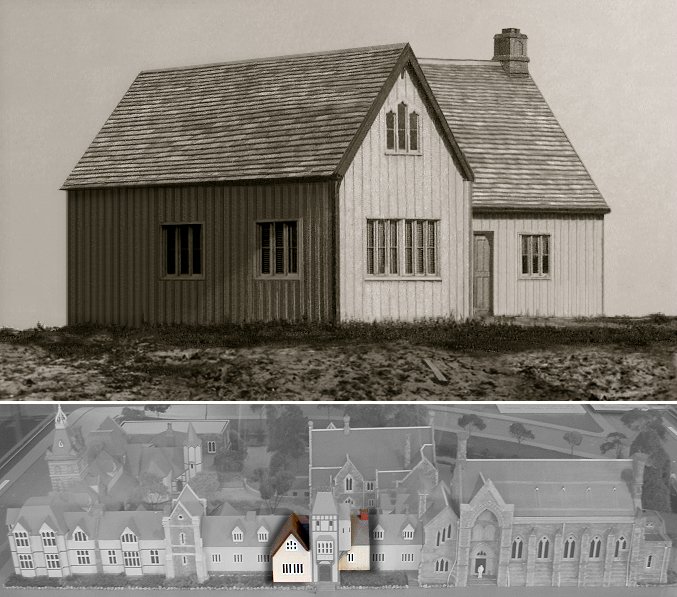
By means of the digital interpolation of the first image of the nascent settlement, with the earliest known topographical survey map and recent aerial images of the township, it is possible to indicate an earlier and historically more significant origin to Lyttelton's Grubb cottage.

Joseph Thomas, Principal Surveyor and Acting Agent of the Canterbury Association, arrived at Lyttelton, with a working party of thirty five, on the 2nd of July, 1849. In the hold of the Fair Tasmanian were five prefabricated dwellings, a Blacksmith's shop and four horses.

After initially living in tents, erection of the prefabricated buildings was completed nineteen days later. That day Walter Mantell sketched the results from the vicinity of where the Time Ball Station now stands.

Reflecting the prevailing social values of the time, the settlement was spread over three separate locations. The Blacksmith's shop and tradesmen's accommodation were situated to the near northeast of where the proposed wharf was to be built. The three houses for the middle management staff were erected 256 metres to the West on what would become Norwich Quay, next to what is now the Mitre Hotel site.

But more importantly the house of the Acting Agent was situated on a promontory 87 metres to the North-by-northwest of the middle management's cottages. This simple two roomed dwelling was erected on a north-south axis overlooking a small stream, which then dropped 5.2 metres in what would become its front garden when the town survey was completed.

In April, 1850 Thomas moved to a larger cottage in the precinct of the Emigration Barracks and John Grubb, a Carpenter in the Canterbury Association's employ, was subsequently granted formal permission to squat on the section where Joseph Thomas' first home stood. On the 1st of July 1851 the Association held the first ballot for the sale of sections and John Grubb purchased his section for £23. As the set price for a Lyttelton section was £12, this amount would appear to indicate pre-existing improvements.
As indicated in an April, 1852 sketch by William Holmes (above), Grubb had extended the cottage to a "T" shape, with a single storey extension on the southern end of the earlier two-roomed cottage. On an east-west axis the extension featured a simple, south facing, veranda overlooking London Street. The subsequent photographic record indicates that the bedrooms in the higher gabled roof line and the bull nosed veranda of this extension were added about 1865. This is the building as it now appears.

The rear portion of the house is accordingly believed to be the original home of the actual founder of Canterbury and the oldest surviving dwelling of the provincial settlement.

The house remained in the Grubb family until 1961 and was subsequently purchased in 2006 by the Christchurch City Council for $260,000. At the end of May, 2008 the Council announced plans for spending a further $250,000 to fund necessary conservation and stabilisation work.

Satellite view of the building's location
geo:lat= -43.601916
geo:lon= 172.719294

May 1, 2008

Early Inner City House Identified

Without its Edwardian neo-classic cornice and arcaded pediment and beneath layers of paint, what has become a relatively undistinguished building on the South side of Hereford Street between Liverpool Street and Latimer Square hides a secret.


Behind the century old former Christchurch Drainage Board offices is a substantial 1863 house.

Bricklayer and Plasterer Patrick Foley (1835-1905) immigrated to Christchurch in 1856. Three year later he was joined by his two brothers and two sisters. Patrick and John Foley (1829-1899) had set themselves up as plasterers at Hereford Street premises by 1860. Prominent in the Loyal Order of Foresters Lodge and a founder of the Mechanic's Institute (now the Christchurch Public Library), John also became well known in local music circles.

In October 1862 John Foley acquired Town Section 813 further along the same street. A two storey house was erected on the site and 30 year-old John and Elizabeth Ann Foley made it their home from early 1863. Built of Terracotta brick in the Late Georgian style, the simple facade featured stone masonry window surrounds.


The Foley's house is seen in the above image to the Right of the Family Hotel (subsequently known as Collins' Hotel and then as the Occidental Hotel from 1889, the 148 year-old building is derelict in 2008).

The brothers' business flourished and in 1866 they were commissioned to undertake interior decoration of the new Canterbury Provincial Council Chamber. Unfortunately John's commercial acumen did not match his vocal skills, declared Bankrupt in February 1868, the Foley's home reverted to the Provincial Trust & Loan Association.


The 1870s were a boom period for the province and the inner city commercial district expanded to engulf the house, which became the offices of New Zealand Insurance Company. Overlooking the yard of Cobb & Co, a large sign was painted on the Western wall (above).


Five years later the offices of the Christchurch Local Board of Health and the Christchurch Drainage Board were opened in the former home. The legal practice of Acton-Adams & Kippenberger were also in the building from 1887, from where Phillip Kippenberger acted as Consul for Germany.


In 1908 the Christchurch Drainage Board built adjoining offices in what had been the front garden of the house.


Although the ceilings in the later extension are entirely plain, there is one exception, that being what was probably the first floor Board Room. Its ceiling is elegantly decorated with mouldings in the Rococo style (below), which might appear to indicate that they originally graced the reception rooms of the Plasterers 1863 home.


The combined buildings served as the Drainage Board's offices until 1989. Subsequently occupied by the Surveying, Civil Engineering and Town Planning partnership of Davie and Lovell-Smith, they have been the premises of the 198 Youth Health Centre since 1995.

Google Map of the location (geo:lat=-43.532224 lon=172.640952)

Feb 17, 2008

Cultural Evolution and Polynesian Canoes

The process of natural selection can act on human culture as well as on genes, a new study finds. Scientists at Stanford University have shown for the first time that cultural traits affecting survival and reproduction evolve at a different rate than other cultural attributes. Speeded or slowed rates of evolution typically indicate the action of natural selection in analyses of the human genome.

This study of cultural evolution, scheduled to appear Feb. 19, in the online Proceedings of the US National Academy of Sciences, compares the rates of change for structural and decorative Polynesian canoe-design traits.

More at Science Daily 17 February 2008
More at About.com 19 February 2008


Natural selection and cultural rates of change -- Rogers and Ehrlich, Proceedings of the National Academy of Sciences

Deborah S. Rogers and Paul R. Ehrlich

Abstract

It has been claimed that a meaningful theory of cultural evolution is not possible because human beliefs and behaviors do not follow predictable patterns. However, theoretical models of cultural transmission and observations of the development of societies suggest that patterns in cultural evolution do occur. Here, we analyze whether two sets of related cultural traits, one tested against the environment and the other not, evolve at different rates in the same populations. Using functional and symbolic design features for Polynesian canoes, we show that natural selection apparently slows the evolution of functional structures, whereas symbolic designs differentiate more rapidly. This finding indicates that cultural change, like genetic evolution, can follow theoretically derived patterns.