Showing posts with label transport. Show all posts

Jul 3, 2009

Recycled Bicycle Path Divider


Many Christchurch citizens would agree that cycling is one of the most eco-friendly and healthy ways of transportation, although it can also be dangerous, even if they use bike lanes (as a deceased City Councillor found out the hard way).

Motorbikes racing past, car doors opening and parked vehicles that need cycling around into the car lanes, are but a few nasty surprises encountered by our cyclists even if they stay on the bike path. Most would agree that bike lanes should be separated from traffic.

Made from recycled plastics, the Zebra is a black oval bumper that is fixed on the line between the road and the bicycle path to discourage motorbikes and cars from entering. Very durable, low-maintenance and non-slippery, the white irregular stripes make it highly visible.

We look forward to the installation of this Spanish safety measure on the streets of our city.

Further reading: Recycled Bicycle Path Divider

Apr 17, 2009

Early Christchurch Electric Vehicles

The diasporical and widely appreciated The New Zealand Journal has recently featured a short post entitled Christchurch City Council Belt-Tightening?, in which it's wondered if there might be any advantage to the Council ordering up from storage its electric truck fleet from the early 1920s, which could have the advantage of enabling the Council to meet its greenhouse gas emissions reductions. The post includes this Alexander Turnbull Library image by The Press newspaper photographer Samuel Heath Head.


LARGE IMAGE OPENS IN A TAB OR NEW WINDOW

By 1915 the Council's Municipal Electricity Department in Armagh Street was charging car batteries overnight, when cheaper off-peak rates were offered between 10 pm and 7 am. The two 100 Kilowatt generators were driven by a pair of steam engines powered by the Council's refuse destructor. In 1921, at the peak of their popularity, the M.E.D. was charging the batteries of 51 vehicles, of which 40 were privately owned, with the other 11 belonging to the Council. The City Council's Municipal Electricity Department even offered hire-purchase agreements to assist companies and individuals to purchase electric vehicles.


LARGE IMAGE OPENS IN A TAB OR NEW WINDOW

In this elevated westerly view of Bealey Avenue near the Carlton Mill Bridge can be seen the city's entire fleet of electric vehicles. The photograph can be dated to 1926 by the construction of the extent Fleming House at the corner of Park Terrace (Left).


Above: photographed on Park Terrace is the circa 1922 American Walker electric lorry of Wardell Brothers, the Cashel Street Grocers. To the Left is the extant 1915 Summers house. Below: also at the same location is the electric lorry of Sharpe Brothers, aerated water and cordial manufacturers. Both of these photographs were also taken by Samuel Heath Head.


Photo credits:

1926 electric vehicle fleet; Municipal Electricity Department archive, Orion New Zealand Ltd

Sharpe Brothers lorry; Alexander Turnbull Library, reference number: 1/1-011062-G

Wardell Brothers lorry; Alexander Turnbull Library, reference number: 1/1-007411-G

Apr 8, 2009

Christchurch 7 April 2009


Another one bites the dust: a circa 1875-1880 villa in inner-city Kilmore Street in the process of demolition.


A velocopidist commuting to the city via the Avon River bank in the suburb of Richmond.


The Pennyfarthing is of recent vintage.


Footnote

A century ago Christchurch, along with Amsterdam, ranked highest among the world's cycling cities and was also the hub of New Zealand's bicycle manufacturing industry. By the mid 1960s the increase in motorised traffic on the city's streets began to see a signficant rise in the injuries sustained by cyclists. An ambulance at the bottom of the cliff mentality saw the introduction of a legal requirment for all cyclists to wear safety helmets and the popularity of the bicycle went into decline. Not even the cycling fatalities sustained by a Christchurch City Councillor, New Zealand Police's most senior Traffic Officer and an internationally renowned cyclist in the last week of a two year world tour, has seen the introduction of enlightened policies and protection aimed at promoting cycling in Christchurch in particular or New Zealand in general.

However, and in spite of the foregoing, we're pleased to note that over the last five years the number of commuter cyclists in Christchurch has increased by 25%. We also applaud the somewhat belated proposal for a national cycleway, so widely popular in more developed countries (Britain's national cycleway recorded 475 million journeys in 2007).

And lest you should think that the foregoing is little more than the rant of a grizzled curmudgeon (you're probably right), it is written from a perspective of sixty years cycling the streets of Christchurch and far beyond (and upon the same Raleigh Roadster, with a camera and tripod in the pannier bag, since 1956).


LARGE IMAGE OPENS IN A TAB OR NEW WINDOW

World cycling champion Frederick Wood (1861-1935) of England comes a cropper at Lancaster Park in early 1888 in a seemingly posed photograph by Alfred Ernest Preece (1863-1946). Photo credit: Christchurch City Libraries, File Reference: CCL PhotoCD 1, IMG0072

Mar 19, 2009

Christchurch Now & Then: High Street


North-westerly views of upper High Street from the Cashel Street intersection, circa 1906 and 2009.

The earlier image is from a postcard printed in Germany and published (possibly by Craig's Pictorial Postcard Depot of Colombo Street) in both monochrome and hand coloured versions, probably to coincide with the Christchurch International Exhibition of 1906-7.

To indicate the modernity of Christchurch, a motor bus, which first entered the photographic record in 1905, is included in the photograph.

A much enlarged version of the earlier image, annotated on the 7th of February 1908, can be seen on The New Zealand Journal web site.

Feb 22, 2009

Podcast: Tramlines


In a 14 minute talk from Radio Australia's Ockham's Razor series, retired chemist Dr Trevor McAllister looks at the history of the tram, from the first horse-drawn service to the technology that has created the electric trams.


Image: once again a familiar sight in central Christchurch, is this vintage tram being removed from a New Brighton garden in 1969.

Dec 4, 2008

1860s Canterbury Transport


LARGE IMAGE OPENS IN A NEW WINDOW

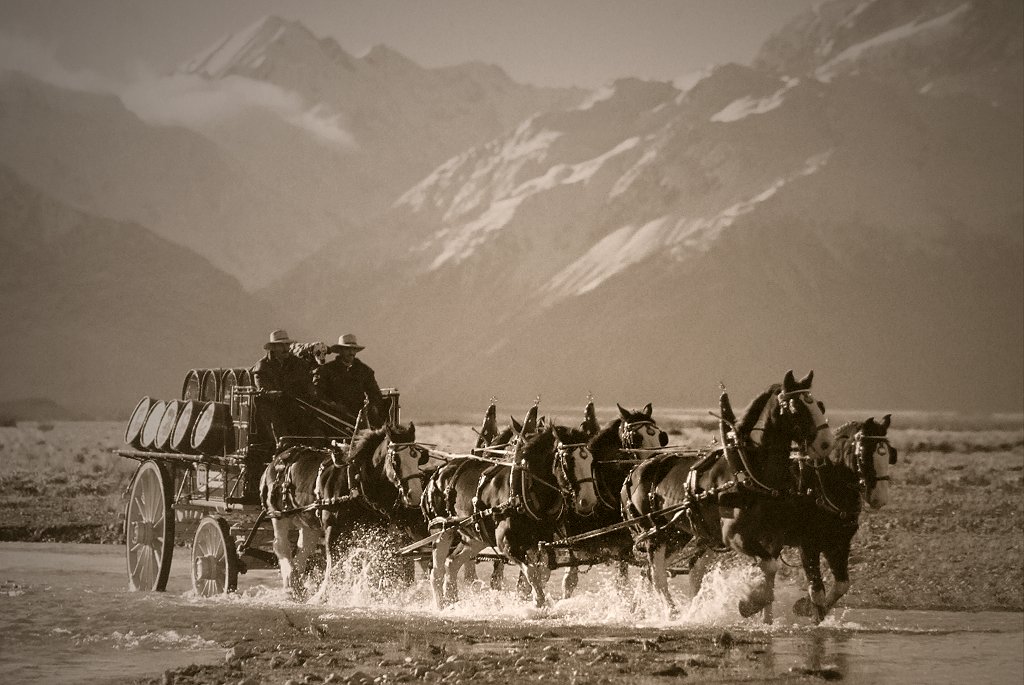
With Mount Cook in the background, an 1860s six-in-hand Brewer's wagon crosses the braided Rangitata River on a northward journey to Christchurch.

Nov 7, 2008

New Ship for Lyttelton


Soon to be a frequent visitor to the port of Lyttelton, the largest New Zealand operated cargo ship Spirit of Endurance will arrive at Auckland on Sunday, the 9th of November, 2008 on her maiden voyage from China. 

With a service speed of 17 knots and a gross tonnage of 7,464 tonnes, the 130 metre vessel will load about a thousand containers for Lyttelton and Port Chalmers.


Photographs by courtesy of Pacifica Shipping (1985) Limited

Nov 6, 2008

Lyttelton 3 January 1938


The Imperial Airways Short S23 C Class Flying Boat G-ADUT Centaurus at the port of Lyttelton on the 3rd of January, 1938 (with a coal hulk and a coastal collier at Gladstone Pier in the middle background).


Centaurus Road in the Christchurch suburb of Cashmere was named to commemorate this first visit of a flying-boat to the South Island.

Delivered in December 1936 the aircraft carried 5 crew, 17 passengers, and 2035 kg of mail. There was sleeping accommodation on night flights for 12 passengers.

Seconded to the Royal Australian Air Force in September 1939, she was sunk at her mooring in Roebuck Bay during a Japanese air raid on Broome on the 3rd of March 1942.


From the photograph album of Ray Burgess and Elsie Mulholland published by John Willoughby of Didcot, Oxfordshire, England.

Oct 15, 2008

Cathedral Square 1979


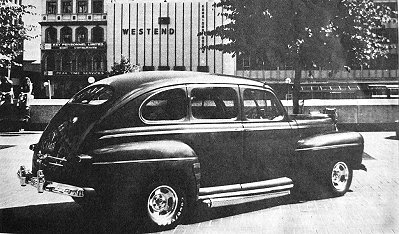
Geoff Duff's 1947 Ford V8 Sedan pictured in front of Kerridge Odeon's Westend Cinema (1915-2007) and the 1914 Sevicke Jones building at the corner of Chancery Lane.

Photographed in the Summer of early 1979, it's to be regretted that this isn't a colour photo as the classic Street Rod was finished in Maroon, with a Gold tint added for a candy-style gloss over highlights.

Oct 2, 2008

Victorian Linwood


LARGE IMAGE OPENS IN A NEW WINDOW

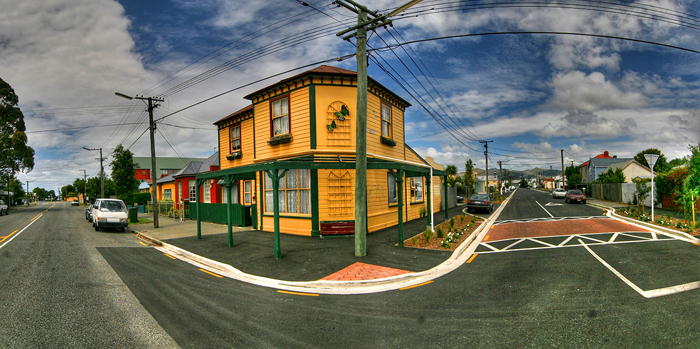
A classic example of a late Victorian corner store at the intersection of Cashel and Saxon Streets.

This part of Linwood first underwent suburban development in the early 1870s, with a significant proportion of smaller houses of an earlier era moved from the inner city on Bullock Drays.

The shop probably owes it location to a stop along the 1887 tram line to New Brighton, which quickly attracted between three and four thousand passengers a week in a time when the population of Christchurch had barely reached 35,000 (on Boxing Day 1888 more than 5,000 people took the tram to the popular beach resort).

The introduction of American style self-help shopping in the later 1950s, soon followed by Supermarkets, marked the death knell of the Victorian corner shop. Many have disappeared in the last half century, but the owners of this fine example are to be congratulated on its preservation.

Photograph by Benedikt Saxler

Sep 30, 2008

A Century Apart


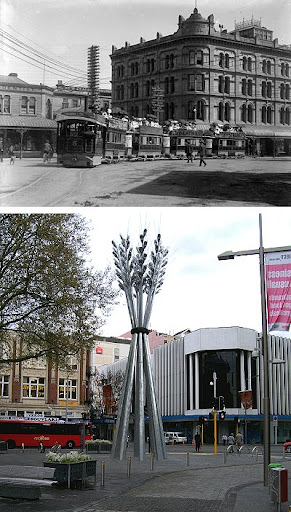
Familiarly known as "The Bottleneck" in earlier times, these are north-westerly aspects of the junction of High, Hereford and Colombo Streets.

A September, 2008 addition to the Christwegian aesthetic is a galvanised representation of a Corn sheaf at the beginning of the City Mall, which is currently undergoing refurbishment.

Provision is being made for extending the vintage tram tracks through the mall, along part of the original route, which closed in 1954.

Sep 23, 2008

Christchurch Airport 1950s


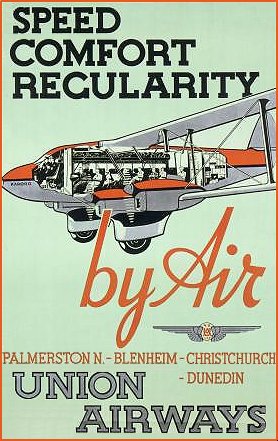
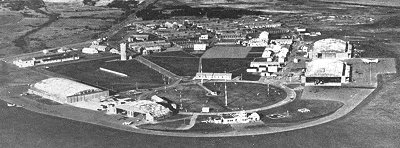
Christchurch Airport at Harewood opened for commercial service in 1940, with passengers flying aboard a four engined de Havilland Dragon Express (above). However, the Second World War got in the way and it wasn't until the 16th of December, 1950 that the aerodrome officially became New Zealand’s first International Airport - a century to the day from the arrival of the first Canterbury Association settlers to arrive directly from London (a few had already arrived via Wellington, but our received history prefers to ignore that inconvenient fact).


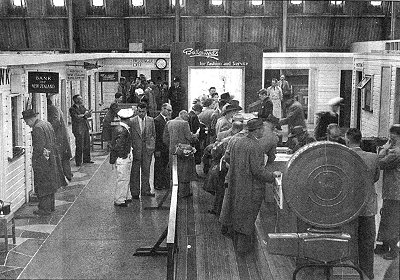
From 1946 the passenger terminal (below) had been situated in a former RNZAF hanger about where the far end of the current overseas terminal now stands. It ceased to be used as such after the completion of a new terminal in 1960, but wasn't demolished until 1978.


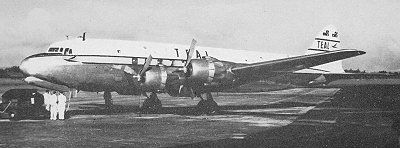
Regular trans-Tasman flights began on the 29th of June 1951, when Tasman Empire Airways Ltd. chartered an aircraft from QANTAS (below). Under the command of Capt D. F. McMaster the Philippine Trader, a 42 passenger Douglas DC-4 aeroplane began a regular service between Melbourne and Christchurch (the 16 year old aircraft would eventually crash into the sea off Brindisi, Italy shortly after take-off in July 1962).


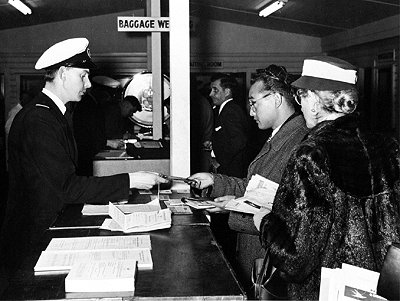
By 1953 TEAL (Air New Zealand since 1965) in conjunction with BOAC (now British Airways) was offering a three and half day service to London. Local Passengers connected with with a de Havilland Comet jet at Sydney and flew on via the Far East. It was an expensive alternative to a six week sea voyage and intending Christchurch passengers could expect a Travel Consultant from the airline to call upon them at home to discuss the various options.


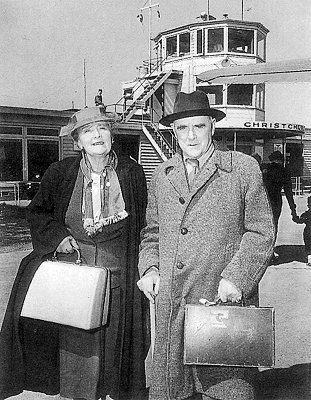
A couple of distinguished thespians bringing Shakespeare to Christchurch's Theatre Royal; Dame Sybil Thorndike and Sir Lewis Casson in front of the original Control Tower in 1954.


To promote the Christchurch City Libraries Retrospective: Christchurch life, architecture and design 1940s - 1970s photo competition, we're featuring a series of images from each decade. This week is the 1950s and next week we'll take a look at the 1960s.

Jul 21, 2008

98 Year-Old Christchurch Tram


Built by Joseph Kitson Boon (1844-1935) at his surviving carriage works in Lower High Street (now Ferry Road), the tram entered service on the 9th of June 1910.

12.37 metres long and weighing about 15 tons, it's powered by two 600 Volt (DC) forty horsepower electric motors.


Withdrawn from service in 1952, the tram became a garden shed at South New Brighton. Rescued in August, 1969 (above), 23,000 man-hours of restoration were required before the project was completed in 1981.


The forty-eight passenger double-saloon car returned to service on the 4th of February, 1995.