Jun 28, 2008

Historical Revision

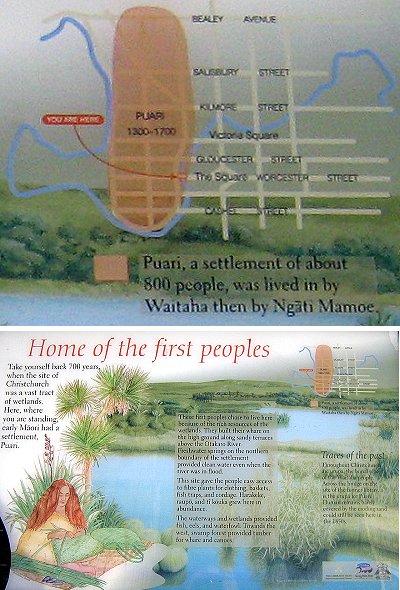
Hyped by the local TV station as the Southern Hemisphere's finest cultural precinct, this is an interpretive display sign at the centre of things.

Amongst the information that it conveys to the visitor is the revelation that Christchurch is in fact a 700 year old community originally known as Puari, with a population of about 800.*

There's no historical evidence for this assertion, which would appear to be an unfortunate instance of the facts not being allowed to get in the way of a good story.

The notion that a Māori version of prehistoric events should not be questioned conveys the idea that they have some privileged access to the truth. And when people sense that they are held to account by a different standard of evidence to everyone else, they understandably begin to reinterpret their past in line with current values and expectations rather than hard evidence.

* Puari was a large settlement at Port Levy on Banks Peninsula. Known to European whalers from the later 1820s, the population had declined by the mid 1840s, as a consequence of inter-tribal warfare and disease, to about 300 Māori and 12 Europeans.

Jun 27, 2008

Podcast: Emigration Records

From the National Archives UK, this 42 minute talk explains the reasons behind the emigration of some 13 million people since the 17th century.

It discusses the most popular destinations for emigrants and sources such as outgoing passenger lists, passport records, and a host of emigration schemes supported and fostered by the government.

It also features the various child migration schemes that have been responsible in migrating some 150,000 children from the UK between 1618 and 1967.

Particular reference is made to the growing number of online sources relevant to this subject.

Curse Strikes Again


A Shipping Corporation of India collier that has suffered two major incidents in Australian waters in seven years has been involved in a third and fatal accident.

A mooring line snapped when the 47,350 ton Devprayag, was arriving at Lyttelton's Cashin Quay to load coal, killing a Lyttelton Port Company worker. The nearby Lyttelton Container Terminal was shut down for around thirty six hours and the vessel has been detained pending official inquiries by Maritime NZ and the Department of Labour.

On 7 February this year, while berthed at Queensland’s Dalrymple Bay Coal Terminal, the Devprayag broke its moorings in monsoon conditions and struck a mooring dolphin. It sustained cracks, plate and frame damage and lost an anchor before it could be brought to anchor between DBCT and Hay Point Coal Terminal. The vessel was later repaired in Brisbane.

On 21 April, 2001 the Devprayag ran aground off Portland, Victoria in strong onshore winds during hold-cleaning after discharging a fertiliser cargo. She was refloated by three tugs four days later.

Jun 25, 2008

Wakefield Journal to stay in NZ


The long-lost journal written by early colonist Edward Jerningham Wakefield (1820–79) will not now be sold overseas.

Covering the period from 1850 to 1858, the journal was missing for about a century before coming up for auction in Dunedin last year. An Alexander Turnbull Library spokesman said the manuscript could not be exported without the permission of the Ministry for Culture and Heritage, given restrictions under the Protected Objects Act.

Wakefield suffered, as his father put it, from “colonial habits”, the worst of them being intemperance as a result of which, what might have been a brilliant career terminated in disappointment (dogged by alcoholism he died penniless at Ashburton). But even if he failed to fulfill the precocious promise of his youth, Jerningham established a claim on the esteem of posterity, by his journeys and explorations and, above all, by the liveliness and colour of his 1845 book, Adventure in New Zealand, from 1839 to 1844; with Some Account of the Beginning of the British Colonization of the Islands.

Jun 17, 2008

Swamp City Verité


Artbash is an online community of New Zealanders who love art and love talking and writing about art. Inside Artbash you will find forums of art criticism, a calendar of exhibitions, a guide to New Zealand art galleries and an online art store where members exhibit and sell their art online.

A recent article satirises Christchurch's High Street Off-site Art Project:
"Booze buses (vomit comets ) will cruise the entertainment inner-city districts - discharging inebriated riders into a series of low and middle-brow pubs.

Large screen TV's will broadcast sport tests and music videos featuring pneumatically titted anorexics. Visibly bored cover bands will play short sets of stereotypical classic rock (which will be ignored by drinkers).

Entering and exiting the booze buses lads will jostle, threaten and body-check pedestrians. Booze bus patrons will projectile vomit on the interior surfaces of the buses and on each other"

Jun 14, 2008

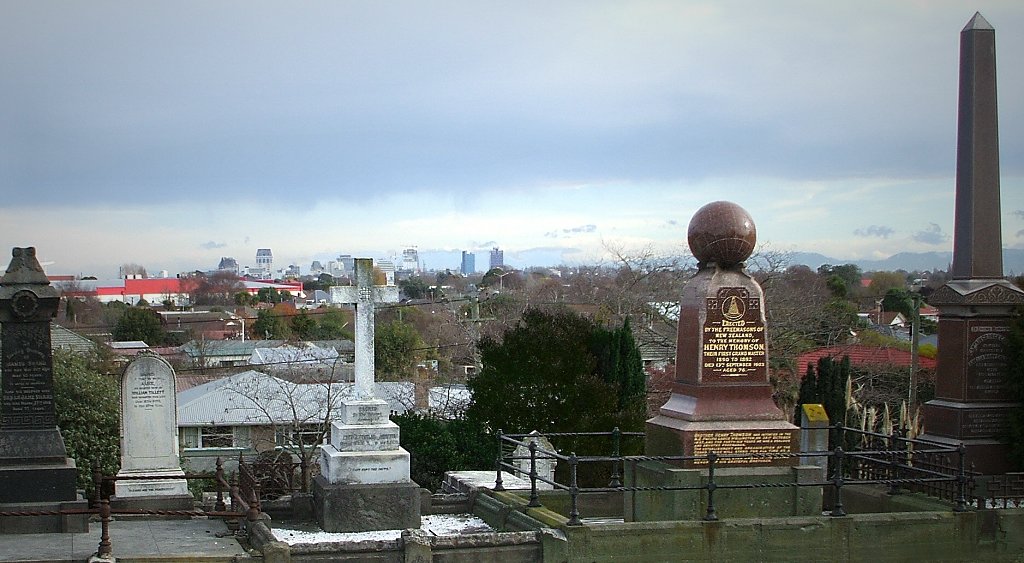
Tombstone Territory


The tombs of many of the city's earliest settlers enjoy an elevated Westerly view of the central business district from the 1880 Linwood Cemetery.

Christchurch is somewhat flatter than the city known to its original inhabitants, only the old cemeteries retain the original contours.

Most of the graves evidence neglect and damage, but only the Jewish section of the cemetery shows the care and honour bestowed upon its founders by a subculture that continues to value its heritage.

See from where this photograph was taken.

Jun 10, 2008

The 1909 Steam Dredge Te Whaka photographed in late 1975


Built by Ferguson Brothers, Port Glasgow for the Lyttelton Harbour Board and steamed out to Lyttelton via the Suez Canal, Colombo, Djakarta, Fremantle and Melbourne.

The 324 ton Te Whaka was also equipped for towing when the 1907 tug Lyttelton was not available. Chartered in 1919 to deepen berths at Nelson. Steam steering gear fitted from whale chaser Star III in 1928.

Fitted with electric light and extra cabins built forward in 1948 for a trip to Wanganui. The original Scotch boiler was replaced in December 1965 with a slightly smaller one from the Greymouth tug Kumea. The original steam driven grab crane was also replaced that year, this time by a Priestman diesel crane.

The vessel was laid up from 1987 until 1993, when she was bought by the Te Whaka Maritime Heritage Trust and towed to Dunedin in March 1994. The intention is to convert the 126 foot vessel to a passenger carrying steamer for excursions on Otago Harbour.

Te Whaka at Lyttelton, 1910.

Another Apartment High Rise for Ferrymead


It is reported that the developer of the seven storey, 34 apartment, Waters Edge building (above) at Ferrymead has, after an appeal, been granted resource consent to build an adjoining property, with a height limit of up to the equivalent of twelve floors.

Update 13 September, 2008


The unfortunate reality bears little resemblance to the artistic license of the marketing hype.

Jun 9, 2008

Major Christchurch City Residential Development


A one hundred and sixty home residential development to be built in Christchurch's inner city has been granted planning approval.

Formerly the Southpower facility on the 4 hectare block enclosed by Madras, Packe, Canon and Purchase Streets, the development will include fifteen shops and a small supermarket.

Plans will be released to the public in two months.

Satellite view of the development location

Podcast: Godley Head Heritage


A 26 minute interview with Peter Wilkins, Curator of the Godley Head Heritage Trust. He talks about coastal defense in New Zealand from the Victorian period right through to World War II.

While our idea of who New Zealand’s enemies were changed over time, we find out that the idea of foreign invasion was a very real thing. During the Second World War U-boats found their way into New Zealand’s waters. The liner Niagara was sunk and there's also the mystery of the ten mines that were laid along Lyttelton Harbour, never to be found.

We also hear about the women who served on Godley Head, freeing up the men who were urgently required in North Africa.