Jul 21, 2008

Historic Church For Sale


Faced with a declining congregation and situated on what is now a valuable commercial site opposite The Palms shopping mall, the church which gave its name to the suburb of Shirley, is for sale.

Built on Craddock's Corner in 1919, the Normanesque tower was added nine years later. Both were designed by Joseph Salkeld (1866-1935), the son of an early Lyttelton Builder & Contractor. The architect was also the Choir Master of the Wesleyan chapel.

In the 1980s extensive alterations were made to the church and a new entrance was established. The exterior Sandstone facings were painted Pink, to be replaced by an equally unfortunate shade of Blue more recently.

Except for the 1938 pipe organ, the extensively modified chapel is of no particular architectural distinction and probably not worth saving. However, the 1928 tower, if restored, could prove a significant landmark as part of a commercial development of the extensive site. We trust that it will not be declared yet another "earthquake risk."

Conventional aesthetic considerations do not appear to be part of the restrictions upon exterior colour schemes within the realm of the local Council. Accordingly, something along these lines could be considered.

Further reading
Shirley Methodist Church One Hundred Years of Witness, 1966 Centennial History of the Parish (full text).

More Shirley Stories - The Press, 26 December, 1981.

Christchurch Library - Heritage: Shirley Methodist Church

Canterbury Heritage gratefully acknowledges the copyright of Jessica Park, the Methodist Church of New Zealand and New Zealand Newspapers Ltd with respect to the above images.

Changing Christchurch Skyline


A partially completed 22 floor hotel and apartment complex framed by the south transept of Christ Church cathedral and the 1908 tower of The Press newspaper building.

98 Year-Old Christchurch Tram


Built by Joseph Kitson Boon (1844-1935) at his surviving carriage works in Lower High Street (now Ferry Road), the tram entered service on the 9th of June 1910.

12.37 metres long and weighing about 15 tons, it's powered by two 600 Volt (DC) forty horsepower electric motors.


Withdrawn from service in 1952, the tram became a garden shed at South New Brighton. Rescued in August, 1969 (above), 23,000 man-hours of restoration were required before the project was completed in 1981.


The forty-eight passenger double-saloon car returned to service on the 4th of February, 1995.

Podcast: The Uses and Abuses of History


Professor Margaret MacMillan teaches International History at the University of Oxford, where she is also warden of St Antony's College.

In this lecture, she discusses how history casts a shadow over the present in more ways than we realise, and how history can be harnessed to help understand contemporary global conflicts.

Margaret MacMillan delivered this 54 minute lecture at the Lowy Institute in Sydney. Her visit to Australia was organised by the Association for Canadian Studies in Australia and New Zealand, and the Canadian High Commission.

Jul 20, 2008

1864 Building Identified


A Sushi Restaurant on the Northeast corner of Colombo and Lichfield Streets occupies one of the city's oldest buildings.

The historic premises first enters the documentary record in 1864 as the shop of William Hislop (1828-95), a Nurseryman & Seedsman.

The Scottish Gardener, with his wife Mary Ann and their daughter Elizabeth (1854-1918), had arrived in Christchurch in 1855. Hislop soon established the Woodburn Nursery on the west side of Antigua Street, between St Asaph Street and Moorhouse Avenue, and by 1861 was able to advertise fifteen thousand one year old apple trees for sale. By 1867 Hislop had been elected as a Christchurch City Councilor.

To the Right in the old photograph is the city's first three storey building. Completed at the beginning of 1876, by 1901 it had been identified as a building of historic significance. It was demolished at the end of 2006 after being designated as yet another "earthquake risk."

See where these photographs were taken.

Jul 18, 2008

Naming Christchurch Streets

Canterbury Heritage is soon to publish the memoirs of Edward Jollie, the Surveyor who laid out the city of Christchurch in 1849.

Among the appendices to the memoir is this excerpt from the reminisces of his fourth daughter Mary, who was born at Christchurch in 1868.

"The chief was Captain Thomas, who had come out to Wellington about 1841. He had been in a British cavalry regiment. The cadets in Wellington had once saved him from arrest for debt by rolling him up in some big maps in the survey office. He was a man of strong opinions.

When helping to lay out Christchurch my father built himself a Raupo whare, which was the first dwelling in that town. The younger surveyors made plans and submitted them to Captain Thomas for approval. It is to be regretted that he disapproved of the suggestion that the streets should be twice their present width. He was sorry after, when it was too late.

Then came the question of naming the streets. They were to be called after bishoprics of the Anglican Church. They had a sort of informal council, and looking at the plan one would say,

"What about street No. 20: shall we call it after the See of Blank?"

"That will do," would say Captain Thomas, "the Bishop of Blank is a Conservative and a good fellow, so put it down."

"Then how about naming street No. 13 after the See of Dash?"

"I'll be damned if you do, the Bishop is a Radical, quite a low fellow."

So some Sees were left out, because the chief disliked the bishops. He must have had an extensive knowledge of them.

When the ships at last arrived a number of immigrants came straggling over the Port Hills, and the Raupo whare had to accommodate quite a number of future notabilities for the night. But it did not take long to get the new town going..."

Jul 17, 2008

Editorial

Six months have now elapsed since the online inauguration of Canterbury Heritage, a journal of social history and cultural heritage.

Although a facility to analyse readership statistics was set up at inception, in an effort to avoid that Godzonian predilection for self-congratulation, we managed not to peek at them, until now...

However, among recent requests for re-publication rights has come a question about just how widely known and appreciated the journal is. Accordingly, we're pleased to be able to report a current monthly readership of 2,244.

The use of a blog, rather than a conventional web site, for the journal may appear somewhat unusual. However, there are distinct advantages in this format. Not the least of these being that, consequential to specific programming techniques (which we're not about to divulge), Canterbury Heritage articles appear in Google search results within two hours of publication.

Editor

1864 Canterbury Emigrant Ship


The world's oldest surviving clipper ship, The City of Adelaide, was built in 1864 to carry emigrants to Australia and New Zealand. As such she was a regular visitor to Lyttelton until 1887. The 860 ton vessel has been stored at the Scottish Maritime Museum in Irvine, Ayrshire since 1993.

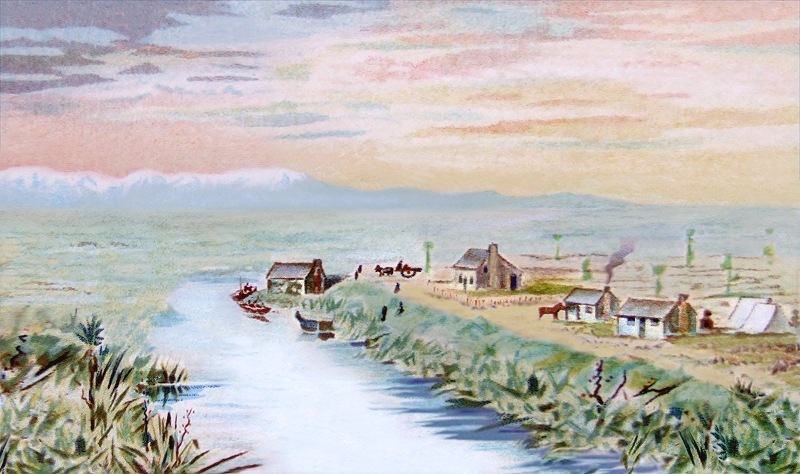
Christchurch 1850


An idealistic and somewhat inaccurate view of the nascent city about June, 1850.

If the Barbadoes Street bridge had been there at this time then this would have been the elevated view in a Southwesterly direction towards Wigram and the snow clad Port Hills.

To the Right is what is now Cambridge Terrace. Beyond the two cottages is the home of Edward Jollie (1825-1894), the Canterbury Association's Surveyor. Down on the bank of the Avon is the Surveyor's Store. Nearby stands a horse and cart at the end of what will become Peterborough Street. This street approximates the position of the 1840 track to the first European settlement on the plains, accordingly it might well lay claim to be the city's oldest thoroughfare.

This had been the location of a Maori seasonal hunting whare near an artesian spring. By 1840 this site, at the highest tidal reach of the river, was in use as a landing place for the European farm at what would become Riccarton. By 1843 the Deans brothers were using the abandoned whare for temporary storage.

By the end of 1850 a landing stage stood on the opposite bank (subsequently known as The Bricks Wharf), beyond it will soon be seen the Canterbury Association's Land Office at the corner of Oxford Terrace and Worcester Street.

This is a restoration of a circa 1905 watercolour attributed to Albert Henry Fullwood (1863-1930).

Fullwoood, an English Artist living in Sydney, came to New Zealand about 1905 to paint a series topical images for Raphael Tuck and Sons, postcard publishers of London. Most of these cards were released in the Tuck's Oilette series to coincide with the 1906-7 Christchurch International Exhibition.

Fullwood occasionally reinterpreted other artist's work for these scenes and this particular example would appear to be influenced by the contemporary sketches of Walter Mantell (1820-1895) and the reminisces Edward Jollie, et al.

Not published in the postcard series, this painting of the lost location of the city's earliest historic site appears to have been overly enhanced in a subsequent rework and then published in The Press newspaper. A lithographic copy of the painting is held by the Christchurch Library, where it is attributed to John Durey.

Son of a Riccarton farmer, the sixteen year-old Durey had arrived at Lyttelton, with his parents, three sisters and older brother in December, 1850. He is later recorded as an employee of The Press newspaper. There is no documentary evidence of any other work of art by John Durey.

___________________________

In his memoir Edward Jollie wrote, "I lived in Scroggs' grass house at the Bricks and the six men who were with me occupied a weather boarded house of one room about forty yards off."

These are the only known contemporary views of the site: the upper is late 1849 and the lower early 1851.


Jollie's trigonometric survey pole in the upper image would have been sited on what is now the north-east corner of Salisbury and Barbadoes Streets (marked below in red on an 1877 map).


Jul 16, 2008

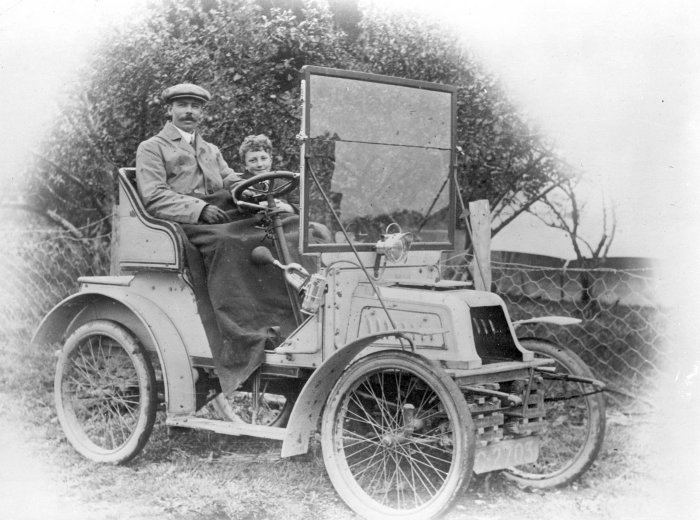
Cecil Walkden Wood


Cecil Walkden Wood (1874-1965) in his third home-built car about 1910. The body is by the Wheelwright and Coach Builder John James Grandi (1858-1913), Mayor of Timaru from 1896. The passenger is Wood's son, Cecil Walkden Wood Junior (1902-1991).


Born at Timaru in March, 1874 Wood served for a time as a mechanical engineer at Lyttelton, and ultimately turned his attention to the cycle trade in Christchurch, where he worked as an Apprentice at the Tourist Cycle Works from 1892. Returning to Timaru he founded C. W. Wood & Company, Bicycle & Motor Engineers in 1894.

Cecil Wood was the first person in New Zealand to build an internal combustion engine, making his own spark plugs, carburettors and crankshafts plundered from old tobacco tins and cast-iron irrigation pipes.

Between 1897 and 1902 Wood built the country's first motorbike, first car built in New Zealand and a two-cylinder, 25 horsepower petrol engine for the March 1903 flight of the self-built monoplane of the reclusive Richard Pearse (1877-1953).

Top image: Reference number: 1/2-018732-F. Collection: Photographic Archive, Alexander Turnbull Library.