May 16, 2009

Curators Choice: Christchurch 1938 Lithograph


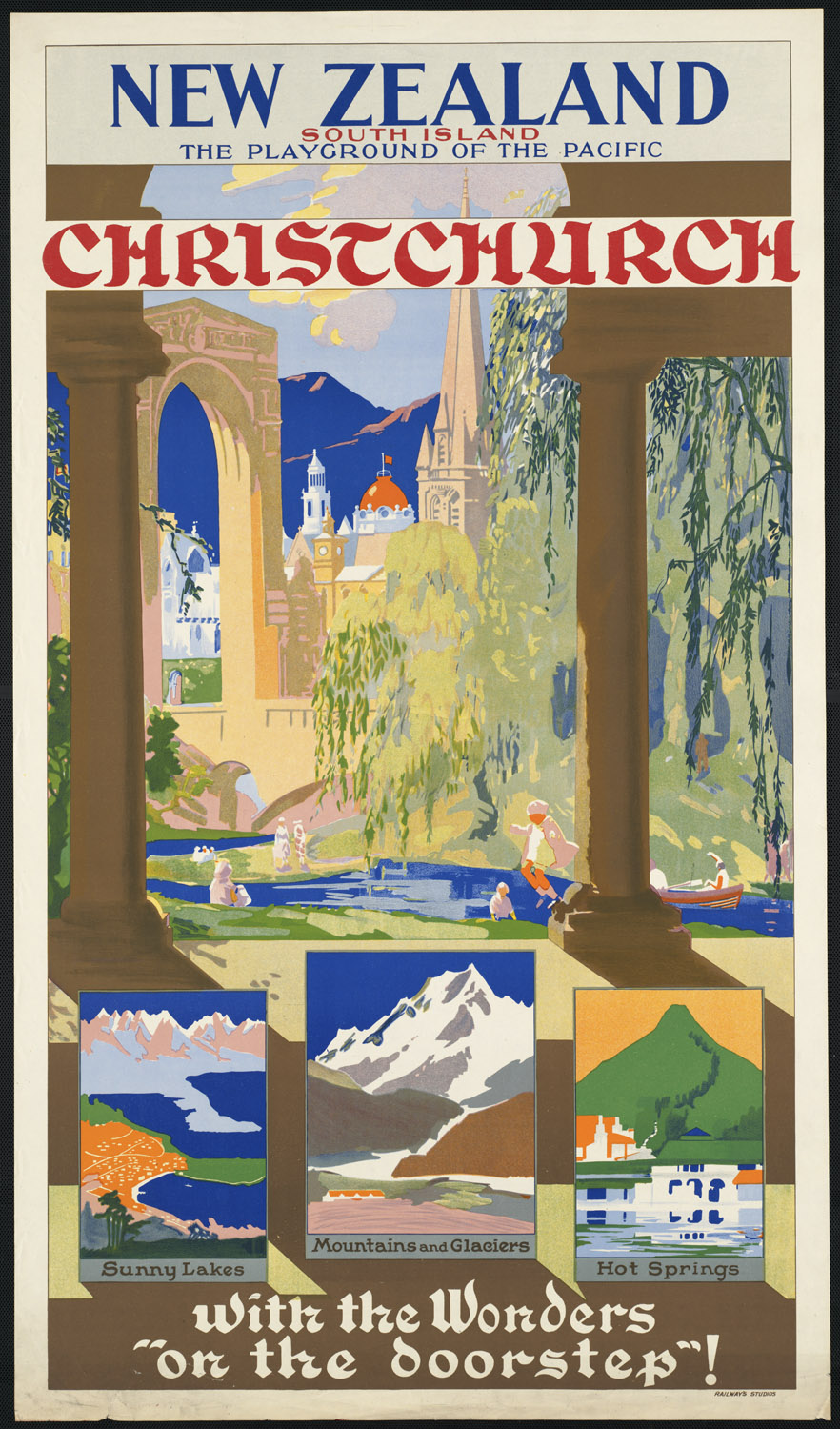
Detail from a circa 1938 lithographic poster of Christchurch for the New Zealand Department of Railways. Although unsigned, the painting can be attributed with reasonable certainty to the Wellington artist Leonard Cornwall Mitchell (1901-1971).

Depicted to the immediate Right of the Bridge of Remembrance is the lost tower of the 1918 Crystal Palace theatre, sadly demolished in 1986 in favour of the nondescript Crystal Plaza arcade.


An 882 x 1500 pixel image opens in a new tab or window

May 12, 2009

Wakatu: first chapter in a family saga of maritime loss

The last of the Lyttelton to Wellington passenger ferries to make the 280 kilometere voyage via Kaikoura ended her eventful 45 year career very close to where she had previously attended the tragic wreck of notable predecessor. Her demise would be the first chapter in a tale of the loss of two inter-island ferries by father and son captains


At the beginning of November 1878 John Currie Moutray and Robert Martin Crosbie of Nelson's Soho Foundry laid the keel of a cargo-passenger vessel for the local shipping enterprise of the Cross brothers and Burchard Franzen. Completed for a contract price of £6,000 and christened with the Maori name for Nelson Bay, the Wakatu was launched on the evening of the 6th of July 1879 from the foundry's Bridge Street slipway, near the Nelson Post Office.

In as much as Moutray and Crosbie had previously built a replacement engine and boiler for Captain G. Cross's paddle steamer Result, it may be surmised that they also constructed the compound steam engines for the propulsion and steam winches of the new vessel. With a boiler pressure of 65 pounds of steam per square inch, her engine developed a nominal 25 horsepower, therby maintaining a service speed of 9 knots.

Built for Cross and Company's Nelson to Wellington and Wanganui service, the 90 ton (78 tons net) steamship, was originally 32.23 metres in length, with a beam of 5.5 metres and a draft of only 1.8 metres. Up to a hundred tons of freight could be carried in her 6 metre deep hold. Fitted out at the Corporation Wharf as gaff rigged schooner, she could initially accommodate about 40 first class passengers. With the main saloon aft, there was also a seperate ladies' cabin amidships on the main deck. Further accommodation for second-class passengers was forward on the lower deck.

In the second week of November 1879, under the command of Captain Charles Evans, the Wakatu commenced her maiden voyage to Wanganui, returning to her port of registry via the capital a week later. But her first career would come to an abrupt end little more than two years later when she was stranded while crossing the Patea bar. An attempt to get her off with the evening tide failed, and she crashed violently against the cliff, a portion of which fell upon the ship. The hull therby being stove in, the Wakatu filled with water and became a total loss.


Sold to Levin & Company of Wellington, the vessel underwent a major reconstruction. With the hull extended by 4.25 metres and the gross displacement increased to 157 tons, the main deck passenger accommodation was significantly enlarged (above). Transferring her registry to the capital, William Levin put the rebuilt steamer on the Wellington to Lyttelton run, a service that the Wakatu would perform with reliability for longer than any other vessel.


Wakatu at her usual Lyttelton berth on the Ferry wharf.

In an omen of what would be her own and adjacent fate, Wakatu attended the wreck of the Lyttelton bound 228 ton coastal steamer Taiaroa, which went ashore just to the north of Waipapa Point on the Kaikoura coast in April 1886. With only 14 saved, 34 lives were lost and the Wakatu returned to Lyttelton with an awful cargo of coffins.

Apart from a night time collision with the steamer Storm off Motunau Island in March 1909, which left a gaping hole in her bow, the next two decades were fairly uneventful for the Wakatu. The highlight being when the Australian Poet Henry Lawson and his wife took passage aboard her in May 1897. Excitement returned in the early days of the First World War when she was was fired upon by the guns in the fortress on Ripapa Island in Lyttelton Harbour for failing to observe the War Regulations.


In the later ownership of the Wellington based Wakatu Shipping Company, she encountered her final mishap in thick fog at 5.00 am on the 6th of September 1924, while sailing from Wellington to Kaikoura and Lyttelton. An unusually strong current threw her high onto the beach on the northern side of Waipapa Point, very close to the wreck of the Taiaroa (below).


The remains of the Taiaroa as seen from the stranded Wakatu

The Wakatu was under the command of her regular master, Captain David Robertson, who was exonerated by the Court of Inquiry, which found that when the weather came up thick, with fine rain, a south-east wind, and a heavy swell, the vessel was at least four miles off shore, which was a safe position; that in altering the course at 2:30 a.m., and 2:40 a.m., the master adopted a safe and prudent course which, under ordinary circumstances, would have carried the Wakatu well clear of Waipapa Point, and that the casualty was caused by an unusually strong set owing to the action of the wind and tide, and to the fact that the vessel was lightly laden.


The crew of the Wakatu still aboard the stranded vessel.

Four years later Captain Robertson would be dismissed for trying to conceal another mishap, when his next command went ashore on Banks Peninsula. In a curious quirk of fate, David Robertson's son Captain Gordon Robertson would be in command of the inter-island ferry Wahine, when she sank in April 1968, with a loss of 51 lives.


Holed and buckled near the stern, the ships' resting place was so far up on the beach as to make salvage impossible, but her location greatly simplified the recovery of the cargo. Several attempts were made to refloat the ship, but were unsuccessful, and she was abandoned as a total loss on September the 12th.


Only a few hundred yards from the road, the Wakatu was still a photographic opportunity in March 1927.


Subsequently cut up for scrap where she lay, only her keel now remains to be seen on the beach.


Long supplanted by larger and faster vessels in the Lyttelton-Wellington service and the development of road and rail transport along the South Island's north-eastern coast, the loss of the Wakatu marked the end of Kaikoura as any more than a fishing harbour, but the long lost vessel is still commemorated in the name of that township's Wakatu Quay.


Many thanks to Steven McLachlan of the Shades Stamp Shop, the late Frederick William Weidner (Kaikoura Star photographer), Graham Stewart, the Nelson Examiner newspaper, the National Library of New Zealand, et al.

May 11, 2009

Historic 1879 Christchurch Photograph Identified


Unidentified until now is a photograph that will be familiar to many with an interest in Christchurch history.

Taken in Cathedral Square in May 1879, it shows a large wooden building in the process of being relocated. In the background is the newly completed Government Building, subsequently the Chief Post Office and now the tourist information centre.

During that era pressure for commercial redevelopment within the inner city saw many dwellings from the earliest residential areas moved to what are now the inner suburbs, where they continue to survive into the twenty-first century.

Shown above is the 1868 Baptist church on its way from Hereford Street to Oxford Terrace. Built for £272 on the site now occupied by the central Police Station, it was relocated next to the subsequent Baptist Tabernacle (below), which continues to occupy the south-east corner of Madras Street and Oxford Terrace.


Enlarged upon its new site, the church re-opened on the 29th of June 1879, becoming the Baptist Sunday School on the completion of its neo-classic replacement in 1882. Damaged by fire in 1903, the front part of the 1868 church was replaced in brick (below). Aerial photographs indicate that the Sunday School was demolished in the early 1970s.


Photo Credits: top; Christchurch Star newspaper archives, center; Early Canterbury Photographers, Bottom; Frederick George Radcliffe (1863-1923).

May 10, 2009

Rare Survivor of Earliest Sydenham


The long derelict cottage at 3 Harold Street, Sydenham occupies the western part of Lot 67 on Deposited Plan 75 in the former Borough of Sydenham (1876-1903).

That the dwelling's site shares the same legal description as 35 Buchan Street indicates that it occupied a quarter acre section, which originally faced on to Buchan Street, with two recent commmercial premises now occupying what had formerly been its front garden.

Harold Street was known as Aynsley Street until 1948 and its environs probably formed a part of the investment properties of the pioneer merchant Hugh Aynsley (1828-1917), who subsequently rose to civic prominence as Hugh Percival Murray-Aynsley, Esq.

The cottage appears to have begun life in the 1850s as a simple two-roomed dwelling, with a later extension to the north in the same style. It's design suggests a kitset cottage imported from Australia, and that it survives in relatively sound condition in spite of decades of neglect, would appear to indicate the durabilty of Australian hardwoods.

The apparent era of construction predates the development of this part of Sydenham as a built-up residential district. It's therefore surmised that the cottage was probably either the residence of an early market garden or had been removed from the inner city as the pressure for commercial redevelopment began to overtake Christchurch's earliest residential areas.

A further eight photographs of the cottage by Dr Greg O'Beirne, of the University of Canterbury, can be seen as a set on his flickr web site.


Addendum:


LARGE IMAGE OPENS IN A NEW TAB OR WINDOW

From Early Canterbury Photographers comes this photograph by Hubert David Bettger (1873-1935), of a similar, but architecturally ornamented dwelling from a slightly later era. Named Mabe Cottage, it continues to survive at Olliviers Road, in the eastern suburb of Linwood.

May 9, 2009

Hack Circle or Pioneer Plaza?


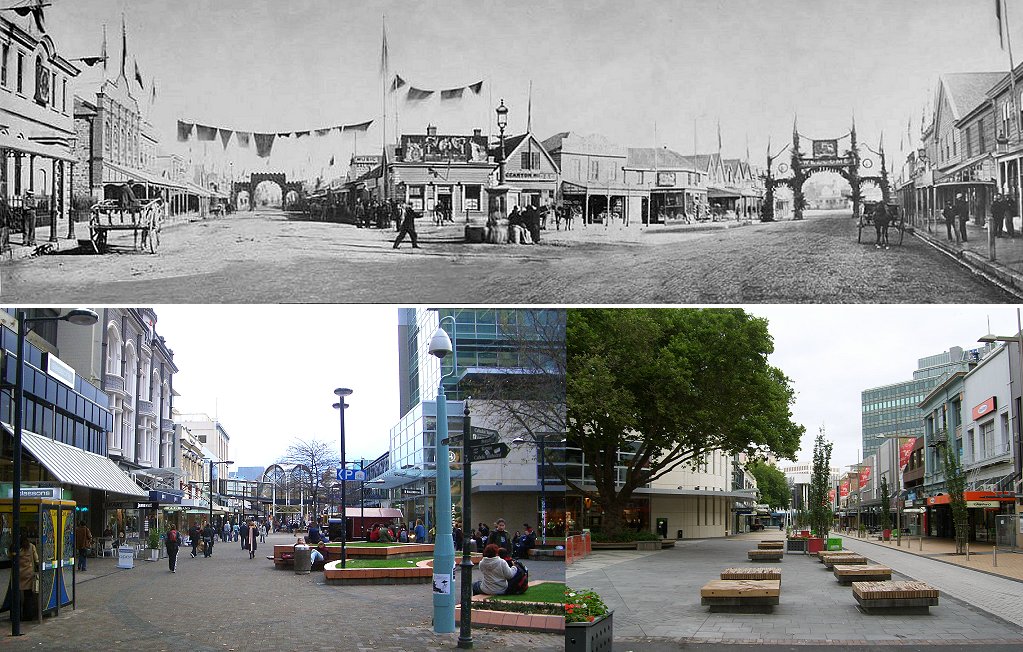
LARGE IMAGE OPENS IN A NEW TAB OR WINDOW

Nicknamed the Hack Circle from the 1990s, the former site of the 1989 amphitheatre at the intersection of High and Cashel Streets is to be renamed as part of an upgrade that will include an extension to the vintage tram route. A Christchurch City Council spokesman is reported as saying that public submissions on a new name for the area could be the basis for a popular vote.

Accordingly we suggest the name Pioneer Plaza for what is undoubtedly one of the most significant historic locations in the city. Above is a panoramic view of the junction on the morning of Thursday, the 22nd of April 1869 and below is a similar aspect in 2008.


Known simply as "The Triangle" for a century, the triangular junction was matched to the south-east by the "Clocktower" junction at High and Manchester Streets and "The Bottleneck" junction at the intersection of High, Hereford and Colombo Streets to the northwest.

"The Triangle" intersection was the origin of the city's commercial precinct. Here was the 1851 passenger terminus for coaches to the ferry at Heathcote, first hotel (The White Hart), first Restaurant (Birdsey's), first Chemist shop (Wallace & Co), first fire station and the Customs House.


Above: Cobb & Company's circa 1854 booking office on the site now occupied by the Hallenstein's building. From here coaches departed for Papanui, Riccarton and the outlying settlements at Kaiapoi, Rangiora and Oxford. By the mid 1860s Cobb's coaches were carrying passengers from here to Timaru and the goldfields of the West Coast.


From here could be hired horse-drawn passenger cabs and Carrier's carts. Hansom cabs were a familiar sight on the rank until 1944 (above), which continued as a taxi rank into the 1960s.


Above: because of its historical significance as the place where they first arrived in Christchurch, the surviving pioneers from the first emigrant ships of 1850 gathered here to be photographed in 1900.


In 1910 the original gas lamp standard was replaced by a triangular flower bed, with a fountain at the centre. This feature survived until the early 1980s, but was removed for the 1983 first stage of the City Mall.

Accordingly, we consider that in naming the revamped intersection Pioneer Plaza, this generation will be honouring the memory of those pioneers who founded our city.


The 1989 Hack Circle amphitheatre

May 8, 2009

The Limes Private Hospital 1880-1963


1883 NORTHERLY VIEW ACROSS VICTORIA SQUARE

A recent response from a regular reader concerned the last address of her GGG grandad John Kennedy, a 70 year old News Vendor who was living at 84 Kilmore Street, when he died in 1918. The reader understood that this was probably a house almost opposite the 1972 Town Hall. However the photographic record indicates that the presumed location continued to be occupied by early commercial premises until 1958 and further research indicated that number 84 was actually on the southern side of Kilmore Street on the site now occupied by the Town Hall's auditorium.

With a southern boundary on Cambridge Terrace, John Plank had built a two storey wooden boarding house facing Victoria Square on the quarter acre section by 1862. But in 1880 it was demolished and across the site and its adjoining section (originally occupied by the Blacksmith William Gosling), the newly arrived Dr James Irving built a substantial brick hospital, which was soon extended with a new wing to the east. The Limes Private Hospital derived its name from the trees which occupied the Cambridge Terrace river bank and although informally referred to as being in Victoria Square, the official address of The Limes Hospital Ltd was 84 Kilmore Street.

At the time of John Kennedy's demise the hospital was also providing care for invalid and convalescent soldiers from the Great War of 1914-1919.


The Scottish James Irving had arrived at Lyttelton as the ship's doctor aboard the Shaw Savill Line's sailing vessel Crusader in 1879, with eight children (subsequently enlarged to six sons and five daughters) and a Nanny. Prominent in the Social Purity Society, Beautifying Association, Chrysanthemum Society and New Zealand Medical Association, Irving was the Surgeon-Major of the Canterbury Mounted Rifles and also donated the Cathedral's High Altar in gratitude for his family's safe voyage from England. Aged sixty-four, Irving died suddenly at his hospital in the evening of the 26th of October 1900 and was buried in the Barbadoes Street Cemetery. Appended below is an excerpt from Dr Irving's letter book, which gives an interesting perspective of Christchurch in 1879.

James Irving's son William followed his father into the medical profession and was subsequently Honorary Secretary of the New Zealand branch of the British Medical Association, Medical Superintendent of the St Helens Hospital in Durham Street South and then with the St George's Hospital in Papanui. However, having been qualified for less than three years at the time of his father's demise, the superintendency of The Limes passed to the Edinburgh trained Dr Alexander Paterson who had come to Christchurch in 1897.

James Irving's daughter, Dr Hannah Margaret Irving (1881-1972) was the last burial in the Anglican section of the Barbadoes Street Cemetery.

Many local residents either began or ended their mortal span at The Limes, not the least being the twin brothers Dr David and Sir Hamish Hay, born in 1927.

In 1963 the Christchurch City Council purchased the old hospital and it was demolished in favour of a car park by 1965. In 1969 construction of the new Town Hall began, which includes the commemorative Limes Room conference facility.


An excerpt from Dr James Irving's letter book for Wednesday, the 24th of September 1879 (with the editor's comments in parenthesis).

We are being quietly tugged up the harbour of Port Lyttelton - a beautiful one - with precipitous hills on either side, green down to the water's edge, the scenery not unlike some parts of Wales and Scotland. The pilot came out to us in the night about two o'clock, the steam tug (ss Mullogh) soon followed, and we shall soon be alongside the wharf.

Evening: The medical officer of health came on board about ten - found us all healthy - congratulated me as medical officer in charge, and we went alongside the wharf at once. Off immediately to the train to go up to Christchurch, some seven miles, and whose face is the first seen but my brother, who came here some three weeks since; a very agreeable surprise for all, as we did not know that he was here.

We took a buggy and drove round and about Christchurch. It is a perfectly flat, square city, containing about 20,000 souls; within the town is a mile square, all the streets run at right angles and quite straight, except one which runs corner-wise. The Cathedral - so much of it as is built - is in the centre of the mile square, and all the streets are named after a Bishopric. Our hotel is in Hereford Street (the Occidental), with Latimer Square just in front, Cranmer Square being on the other side of the town.

The houses are mostly of wood and are very picturesque; the town has been divided into quarter-acre sections, hence most of the houses stand back from the street, in their section, with a verandah and flower garden in front. Many houses are only one storey, but there is a degree of neatness and comfort about them, which is quite refreshing after the dull brick of most of our English towns.

Appearances are studied here, but convenience and utility not sacrificed. In England appearance is seldom thought of; at least in and around Newark, though there are some exceptions. One part of the town is within what is called the "fire block" (probably Colombo from Hereford to Cashel Streets), there the houses are of brick or stone, and closer together; wooden erections are now prohibited. All the streets are wide. An open drain made of cement on each side of the road, next the footpath, with a continual stream from the artesian wells. The footpaths are broad, and one half of them is asphalted. The kerbing is of wood, 2½ by 9 or 11 (inches).

Many of the houses and shops have verandahs extending right over the footpath, some covered with corrugated iron, some with glass painted so as to subdue the light and diminish the heat. All paths are asphalted - no slabbing. As any further description of the country cannot be very interesting to strangers, I shall close here, and write what I have to say of the country and its prospects in a future letter.

The men wanted here are small working farmers with five or six hundred pounds. They do their own labour, have none to pay for, and consequently reap all the benefits of the products of rich land.

May 6, 2009

The Artists of the Canterbury Museum

There can be few visitors to our museum who fail to appreciate the contributions of local artists to the displays, but of the artists themselves there would appear to be little known.


Thirty-four year-old Ray Jacobs joined the staff of the museum as a Preparator in 1940. Son, father and grandfather of Taxidermists, Ray constructed the much admired recreation of a Victorian period Christchurch street (above). In addition to being an outstanding Taxidermist he also constructed the foregrounds and painted the diorama backdrops for all of the habitat groups in the 1956 Edgar Stead Hall of New Zealand birds. Ray retired in 1972 and died in 1974, about six weeks after a bedside investiture by the Governor General as an Officer in the Civil Division of the Most Excellent Order of the British Empire.


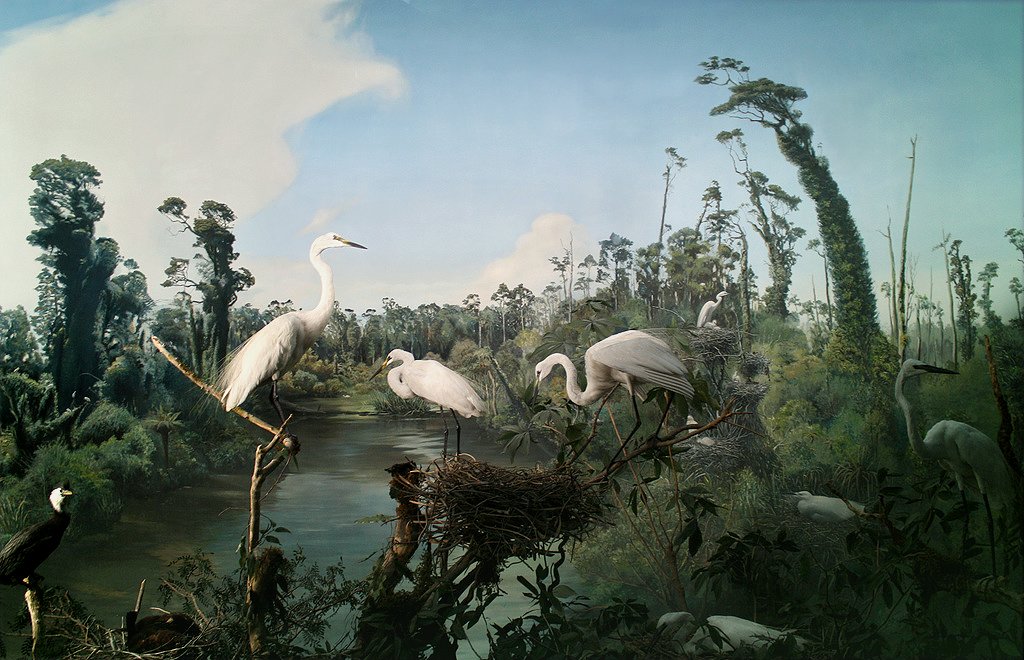
Above: Ray Jacobs creating the diorama of the Waitangituna Stream at Okarito in South Westland for the hall of New Zealand birds. White Herons (Kotuku) and a similar estaurine habitat would have been familiar to the hunters who first inhabited the confluence of the Avon and Heathcote rivers from about 1350. Much sought after for their feathers, the Heron was almost exterminated and is still a rare sighting in the Christchurch district.


The completed diorama
LARGE IMAGE OPENS IN A NEW TAB OR WINDOW


Leo J Cappel was also a Preparator at the Canterbury Museum. Subsequently author of A Guide to Model Making and Taxidermy: A Comprehensive Manual for Sportsmen and Teachers, for Model Railway Enthusiasts and Other Hobbyists, Leo created the Museum's Moa Hunter diorama (above) before transfering to the Auckland Museum in 1964. Now in his mid-seventies and widely renowned as a writer, sculptor, composer and award winning playwright, Leo lives on Kawau Island in Auckland's Hauraki Gulf.


Commissioned to paint three large dioramas of wildlife studies for the museum's Hall of Antarctic Discovery in 1977, Wing Commander Robert Maurice Conly (1920-1995) also published Ice on my Palette in the same year. The large format book includes 27 sketches and 26 colour plates of his Antarctic impressions.

For 54 years Maurice Conly was the last Royal New Zealand Air Force Official Artist. Beyond his works of art and postage stamp designs, Conly's designs for our twenty cent and one dollar coin are familiar to all New Zealanders.


Appreciation: thanks to Cheryl Bernstein for the precipitative query and also to Sarndra Wilson of the Auckland Museum, the polymathic Leo Cappel and Terry Jacobs (youngest son of Ray Jacobs) of The Taxidermist Ltd.

May 3, 2009

Christwegian Courtesans & Other Less Interesting Developments.

Subsequent to the opening of the second Railway Station on Moorhouse Avenue in 1867, Manchester Street South became the principal tram route between the inner city and the station. As a consequence, that part of Manchester Street from High Street to Moorhouse Avenue became lined with hotels, restaurants and various places of entertainment, etc.

Not surprisingly, in a tradition spanning at least 130 years, the street has been the favoured haunt of those practitioners of what is reputed to be among the world's older professions. Although probably unaware of their long precedent, Christwegian courtesans are still to be found plying their precarious trade along the more northern part of Manchester Street during the hours of darkness.


Marrying a rich widow, the dandified John Etherden Coker built his third hotel on her land. Opened in 1880, it would be far from the largest, but quite the most luxurious of the Manchester Street hotels. Pictured above is the hotel's dining room. With its marble statuary and starched table linen this room offered elaborate farinaceous repast to such notables as Rudyard Kipling and the Antarctic explorer Robert Falcon Scott. Two years after Coker's demise the hotel's public bar was reported to be the haunt of prostitutes and their consorts.


Alas all hotels have their heyday and long gone are the Terminus, Silver Grill, A1 Temperance, Railway, Manchester and Leviathan, but in much reduced circumstances, Coker's Hotel lingers on as a Backpacker's hostel. A significant part of its formerly elegant facade is now artistically rendered to represent a semi-derelict wooden shanty and the sadly dilapidated dining room (above) continues to serve a similar, but more modest purpose.


In 1938 William Gray Young (1885-1962) submitted a Bauhaus inspired design for a new Railway Station. To be the city's largest building, construction was delayed until 1953 and the somewhat modified design was finally completed in 1960. The Railway Station survived as such for only 31 years to be sold off for redevelopment as an entertainment centre.


Much touted as Christchurch's tallest building, the 86 metre, 23 level C1 apartment building in Gloucester Street East has been plagued with problems. Although all but four of the apartments have been pre-sold, the above photographs indicate the minimal extent of construction development between May 2008 and May 2009.

May 2, 2009

Podcast: Migrant Passenger Lists


With specific reference to New Zealand and the lack of lists of migrants arriving via Australia, this 53 minute talk from the UK's National Archives, will be of particular interest to family historians.

In Every journey has two ends: using passenger lists, Chris Watts reveals the benefits of using both arrival and departure records when searching for details of our migrant ancestors, as well as demonstrating how the shortcomings of content, indexing and accessibility can be minimised.

Photo: attended by the extant 1907 tug Lyttelton, RMS Rangitiki (1928-1962) docks at Lyttelton's Gladstone pier after a five week maiden voyage from London via Curacao and the Panama Canal.

May 1, 2009

1935 Cycling Hazards

Entitled “Every Christchurch person who buys a car goes white-haired within a week,” this cartoon appeared in the June 1935 issue of The New Zealand Railways Magazine. Although cycling is less popular 74 years on, the subject is still quite topical.


Victoria Square 1949